|
Guinea – The Kennedys
1969 Proof Silver 200 Francs 30.2mm (11.70 grams) 0.999 Silver (0.3758 oz. ASW)
Reference: KM# 10, Schön# 12
Certification: NGC PF 66 ULTRA CAMEO 2845083-015
REPUBLIQUE DE GUINEE 1917-1963 1925-1968 JOHN F. – ROBERT F. KENNEDY, John and Robert Kennedy facing right.
1958-1968 X. ANNIVERSAIRE 1970 200 FRANCS GUINEENS, Coat-of-arms of Guinea (Elephant within shield, dove atop)
You are bidding on the exact item pictured, provided with a Certificate of Authenticity and Lifetime Guarantee of Authenticity.
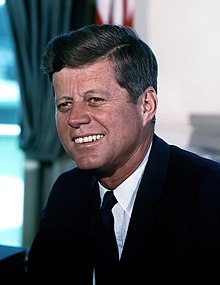 John Fitzgerald Kennedy (May 29, 1917 – November 22, 1963), often referred to by his initials JFK and Jack, was an American politician who served as the 35th president of the United States from January 1961 until his assassination in November 1963. Kennedy served at the height of the Cold War, and the majority of his work as president concerned relations with the Soviet Union and Cuba. A Democrat, Kennedy represented Massachusetts in the U.S. House of Representatives and Senate prior to becoming president.
Kennedy was born into a wealthy political family in Brookline, Massachusetts. He graduated from Harvard University in 1940, before joining the U.S. Naval Reserve the following year. During World War II, he commanded a series of PT boats in the Pacific theater and earned the Navy and Marine Corps Medal for his service. After the war, Kennedy represented the Massachusetts’s 11th congressional district in the U.S. House of Representatives from 1947 to 1953. He was subsequently elected to the U.S. Senate and served as the junior Senator from Massachusetts from 1953 to 1960. While in the Senate, Kennedy published his book, Profiles in Courage, which won a Pulitzer Prize. In the 1960 presidential election, he narrowly defeated Republican opponent Richard Nixon, who was the incumbent vice president.
Kennedy’s administration included high tensions with communist states in the Cold War. As a result, he increased the number of American military advisers in South Vietnam. In April 1961, he authorized an attempt to overthrow the Cuban government of Fidel Castro in the Bay of Pigs Invasion. Kennedy authorized the Cuban Project in November 1961. He rejected Operation Northwoods (plans for false flag attacks to gain approval for a war against Cuba) in March 1962. However, his administration continued to plan for an invasion of Cuba in the summer of 1962. The following October, U.S. spy planes discovered Soviet missile bases had been deployed in Cuba; the resulting period of tensions, termed the Cuban Missile Crisis, nearly resulted in the breakout of a global thermonuclear conflict. The Strategic Hamlet Program began in Vietnam during his presidency. Domestically, Kennedy presided over the establishment of the Peace Corps and the continuation of the Apollo space program. He also supported the civil rights movement, but was only somewhat successful in passing his New Frontier domestic policies.
On November 22, 1963, he was assassinated in Dallas, Texas. Vice President Lyndon B. Johnson assumed the presidency upon Kennedy’s death. Marxist and former U.S. Marine Lee Harvey Oswald was arrested for the state crime, but he was shot and killed by Jack Ruby two days later. The FBI and the Warren Commission both concluded Oswald had acted alone in the assassination, but various groups contested the Warren Report and believed that Kennedy was the victim of a conspiracy. After Kennedy’s death, Congress enacted many of his proposals, including the Civil Rights Act and the Revenue Act of 1964. Kennedy ranks highly in polls of U.S. presidents with historians and the general public. His personal life has also been the focus of considerable sustained interest, following public revelations in the 1970s of his chronic health ailments and extramarital affairs.
 Guinea (/ˈɡɪni/), officially the Republic of Guinea (French: République de Guinée), is a country on the western coast of Africa. Formerly known as French Guinea (French: Guinée française), the modern country is sometimes referred to as Guinea-Conakry in order to distinguish it from other countries with “Guinea” in the name and the eponymous region, such as Guinea-Bissau and Equatorial Guinea. Guinea has a population of 12.4 million and an area of 245,860 square kilometres (94,927 sq mi).
 The sovereign state of Guinea is a republic with a president that is directly elected by the people and is head of state and head of government. The unicameral Guinean National Assembly is the legislative body of the country, and its members are also directly elected by the people. The judicial branch is led by the Guinea Supreme Court, the highest and final court of appeal in the country. The country is named after the Guinea region. Guinea is a traditional name for the region of Africa that lies along the Gulf of Guinea. It stretches north through the forested tropical regions and ends at the Sahel. The English term Guinea comes directly from the Portuguese word Guiné, which emerged in the mid-15th century to refer to the lands inhabited by the Guineus, a generic term for the black African peoples below the Senegal River, as opposed to the ‘tawny’ Zenaga Berbers, above it, whom they called Azenegues or Moors.
 Guinea is a predominantly Islamic country, with Muslims representing 85 percent of the population. Guinea’s people belong to twenty-four ethnic groups. French, the official language of Guinea, is the main language of communication in schools, in government administration, and the media, but more than twenty-four indigenous languages are also spoken.
Guinea’s economy is largely dependent on agriculture and mineral production. It is the world’s second largest producer of bauxite, and has rich deposits of diamonds and gold. The country was at the core of the 2014 Ebola outbreak. Human rights in Guinea remain a controversial issue. In 2011 the United States government claimed that torture by security forces, and abuse of women and children (e.g. female genital mutilation) were ongoing abuses of human rights.
|


