|
Portugal
Battle of Ourique – 1139
1928 Silver 10 Escudos 29mm (12.46 grams) 0.835 Silver (0.3356 oz. ASW)
Reference: KM# 579 | Engraver: Simões Almeida
REPUBLICA PORTUGUESA 10 Esc. 1928, Crowned shield.
Comemoração da Batalha de Ourique – 1139, Horseman with sword and shield at battleground.
You are bidding on the exact item pictured, provided with a Certificate of Authenticity and Lifetime Guarantee of Authenticity.
 The Battle of Ourique (Arabic: معركة أوريكه) was a battle that took place on 25 July 1139, in which the forces of Portuguese count Afonso Henriques (of the House of Burgundy) defeated those led by the Almoravid governor of Córdoba, Muhammad Az-Zubayr Ibn Umar, identified as “King Ismar” in Christian chronicles.
Learning that during his Battle of Valdevez against Alfonso VII of León, Muslim forces had attacked and destroyed Leiria and Trancoso. Afonso Henriques’s anxiety at this incursion at his southern frontier hastened his negotiations with Alfonso VII of León, leading to the Treaty of Zamora and freeing Afonso Henriques’s troops to deal with the Muslim attack.
Historians are divided as to the location of this battle. At the time, the name “Ourique” designated a large area south of Beja. Since 12th-century chroniclers were unfamiliar with the region where the battle took place, they might have decided to call the location “field of Ourique” for lack of a more precise term. Nonetheless, the great distance that separated Ourique from the Christian lines farther north has led some historians to suggest various localities in central Portugal, abandoning the traditional idea that the combat occurred in Ourique in the Alentejo. It would have been difficult for the then Count of Portugal, with a realm little beyond the Mondego River, to go all the way south to battle five Muslim kings. One plausible alternative is Vila Chã de Ourique, some ten miles (16 km) from Santarém.
However, incursions by Christian armies deep in Muslim territory were not unheard of. Alfonso VII had directed expeditions that had reached Cordoba and Seville, well beyond the limits of Castillian dominions, and in 1147 he managed to conquer the Mediterranean port of Almería, south of Granada. This was possible because the largest Almoravid armies were positioned at the frontier, while armies stationed in small towns would rather retreat into their castles than face a strong enemy force. It is feasible that Afonso led a raid into the Gharb, and then, while retreating, was intercepted by a sizable Almoravid force intending to crush his army and recover the spoils taken by the Portuguese.
Before the battle, Count Afonso was hailed as rex (king) by his men in the Germanic fashion, by being lifted atop his shield by the leading nobles of Portugal.
Despite the fact that the Christian Portuguese forces were strongly outnumbered, the Muslim armies were weakened by internal leadership problems, which led to Afonso Henriques’s victory and subsequently his proclamation as King of the Portuguese, as Afonso I, with the support from his troops, vanquishing and slaying, so legend says, five Muslim kings.
The earliest accounts provide little detail. In one account the Muslim forces are led by five kings (Life of St. Theotonius), while in another, they are under the command of one king, Ismar (Chronicles). In the more detailed Chronicle of the Goths, Ismar waited until Henriques penetrated into Muslim territory, then systematically sent his troops from Seville, Badajoz, Elvas, Évora, and Beja against the Portuguese count. It is thus possible that the five kings were actually the leaders of the Almoravid garrisons of each of the Andalusi cities, under the overall command of the Almoravid governor of Cordoba, Muhammad Az-Zubayr Ibn Umar. Further, the Portuguese forces were surrounded on the hilltop where they encamped, Ismar hosted knights, who were executed later by Henriques, and that the Muslim king escaped in defeat. Arabic and Spanish accounts do not clarify the circumstances, and they even confuse the issue, identifying the Ismar as, alternatively, Ismar Abuzicri or Ismar and Abuzicri, with later historians identifying Abu Zakariya, the governor of Santarém, as the protagonist. It is also likely that the numbers were inflated by the chroniclers from a large-scale raid to grand assault by Muslim forces.
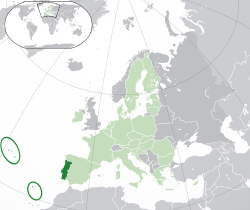 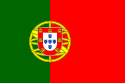 Portugal, officially the Portuguese Republic (Portuguese: República Portuguesa), is a country on the Iberian Peninsula, in Southwestern Europe. It is the westernmost country of mainland Europe, being bordered by the Atlantic Ocean to the west and south and by Spain to the north and east. The Portugal-Spain border is 1,214 km (754 mi) long and considered the longest uninterrupted border within the European Union. The republic also includes the Atlantic archipelagos of the Azores and Madeira, both autonomous regions with their own regional governments.
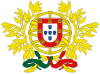 The territory of modern Portugal has been continuously settled, invaded and fought over since prehistoric times. The Pre-Celts, Celts, Phoenicians, Carthaginians and the Romans were followed by the invasions of the Visigothic and the Suebi Germanic peoples, who were themselves later invaded by the Moors. These Muslim peoples were eventually expelled during the Christian Reconquista. Portuguese nationality can be traced back to the creation of the First County of Portugal, in 868. In 1139, Afonso Henriques was proclaimed King of Portugal, thus firmly establishing Portuguese independence, under the Portuguese House of Burgundy.
In the 15th and 16th centuries, under the House of Aviz, which took power following the 1383-85 Crisis, Portugal expanded Western influence and established the first global empire, becoming one of the world’s major economic, political and military powers. During this time, Portuguese explorers pioneered maritime exploration in the Age of Discovery, notably under royal patronage of Prince Henry the Navigator and King João II, with such notable discoveries as Vasco da Gama’s sea route to India (1497-98), Pedro Álvares Cabral’s discovery of Brazil (1500), and Bartolomeu Dias’s reaching of the Cape of Good Hope. Portugal monopolized the spice trade during this time, under royal command of the Casa da Índia, and the Portuguese Empire expanded with military campaigns led in Asia, notably under Afonso de Albuquerque, who was known as the “Caesar of the East”.
The destruction of Lisbon in a 1755 earthquake, the country’s occupation during the Napoleonic Wars, the independence of Brazil (1822), and the Liberal Wars (1828-1834), all left Portugal crippled from war and diminished in its world power. After the 1910 revolution deposed the monarchy, the democratic but unstable Portuguese First Republic was established, later being superseded by the “Estado Novo” right-wing authoritarian regime. Democracy was restored after the Portuguese Colonial War and the Carnation Revolution in 1974. Shortly after, independence was granted to all its colonies and East Timor, with the exception of Macau, which was handed over to China in 1999. This marked the end of the longest-lived European colonial empire, leaving a profound cultural and architectural influence across the globe and a legacy of over 250 million Portuguese speakers today.
Portugal is a developed country with a high-income advanced economy and high living standards. It is the 5th most peaceful country in the world, maintaining a unitary semi-presidential republican form of government. It has the 18th highest Social Progress in the world, putting it ahead of other Western European countries like France, Spain and Italy. It is a member of numerous international organizations, including the United Nations, the European Union, the eurozone, OECD, NATO and the Community of Portuguese Language Countries. Portugal is also known for having decriminalized the usage of all common drugs in 2001, the first country in the world to do so. However, the sale and distribution of these drugs is still illegal in Portugal.
|