|
Italy
Italian States – Naples – Kingdom of the Two Sicilies
Ferdinand II – King: 8 November 1830 – 22 May 1859
1689 Silver 20 Grani 26mm (4.82 grams)
Reference: KM# 113, MIR# 299
CAROLVS· ·II·DG·REX·HISP ·M·, Armored bust to right.
·VTRIVS·SIC HIERVS·G·XX· ·16 89·, Crowned shield of manifold arms, suspended Golden Fleece divides date below, value ‘G.XX’ at end of legend.
You are bidding on the exact item pictured, provided with a Certificate of Authenticity and Lifetime Guarantee of Authenticity.
 Charles II of Spain (Spanish: Carlos II, 6 November 1661 – 1 November 1700), known as the Bewitched (Spanish: El Hechizado), was the last Habsburg ruler of the Spanish Empire. Best remembered for his physical disabilities and the War of the Spanish Succession that followed his death, Charles’s reign has traditionally been viewed as one of managed decline. However, many of the issues Spain faced in this period were inherited from his predecessors and some recent historians have suggested a more balanced perspective.
For reasons that are still debated, Charles experienced extended periods of ill health throughout his life and from the moment he became king at the age of three in 1665, the succession was a prominent consideration in European politics. Historian John Langdon-Davies summarised his life as follows: “Of no man is it more true to say that in his beginning was his end; from the day of his birth, they were waiting for his death”. Despite this, his successors inherited an Empire that remained largely intact, while under his administration Spain played a prominent role in opposing the expansionist policies of Louis XIV of France.
Although Charles married twice, neither union produced children, and on his death in November 1700, he was succeeded by the 16-year-old Philip of Anjou, grandson of his elder half-sister Maria Theresa of Spain and Louis XIV. However, the question of who inherited the crown was less important than the division of his territories, and failure to resolve the issue through diplomacy led to war in 1701.
Since Charles was a legal minor when Philip died on 17 September 1665, Mariana was appointed Queen Regent by the Council of Castile. The Spanish Empire remained an enormous global confederation, but its economic supremacy was increasingly challenged by the Dutch Republic and England, and its position in Europe destabilised by the expansionist policies of Louis XIV of France. Even modern criticisms of Mariana’s competence in dealing with these issues are often based on reports by contemporaries, who generally believed women were incapable of exercising power on their own.
Her ability to respond effectively to the challenges facing the Empire was hampered by an ongoing power struggle with Don Juan José de Austria, Charles’s older illegitimate half-brother. In addition, enacting essential reforms was complicated since Spain was a personal union between the Crown of Castile and Crown of Aragon, each with very distinct political cultures and traditions. Infighting between those who ruled in Charles’s name during his regency did little to help, but it is debatable how far they can be held responsible for long-term trends predating his reign. The Monarchy proved remarkably resilient, and when Charles died, remained largely intact.
However, government finances were in perpetual crisis, the Crown declaring bankruptcy nine times between 1557 and 1666, including 1647, 1652, 1662, and 1666. Following the policy established by her husband Philip, Mariana ruled through a “valido,” the first being her personal confessor and fellow Austrian, Juan Everardo Nithard. His most urgent task was to end the costly wars with Portugal and France, achieved in the 1668 treaties of Aix-la-Chapelle and Lisbon. Despite acknowledging their necessity, Don Juan forced Mariana to dismiss Nithard in February 1669, who replaced him with Fernando de Valenzuela. A member of the lower hidalgo class, his appointment was deeply resented by the Grandees who normally filled such positions.
In 1673, Spain was drawn into the Franco-Dutch War, placing additional strain on the economy and Don Juan renewed his efforts to remove Mariana as Regent. At his urging, Charles sent him an official summons in October 1675, a month before he reached the age of fourteen and became an adult; this instructed his brother to report to his chambers on 6 November and indicated his intention to take control of government. When the Regency Council and Mariana requested a two-year extension of the regency on 4 November, Charles refused but was then pressured into accepting and forced to issue a Royal Decree ordering Don Juan to leave Madrid.
Don Juan finally gained control of the government in January 1678 and exiled Valenzuela to the Philippines. His first action was to make peace with France in the 1678 Treaties of Nijmegen, with Spain ceding Franche-Comté and areas of the Spanish Netherlands returned in 1668. Seeking to minimise future conflict between the two countries, in August 1679 Don Juan brokered a match between Charles and the 17-year-old Marie Louise of Orléans, eldest niece of Louis XIV and daughter of Philippe I, Duke of Orléans. While the French ambassador wrote “… he is so ugly as to cause fear, and looks ill”, it was considered irrelevant to the political benefits. Arranging the marriage was Don Juan’s last significant act; he died shortly before it took place in November 1679.
In February 1680, the Duke of Medinaceli became the new valido. He clashed with Marie-Louise over the alleged influence exerted over her by the French Ambassador, Pierre de Villars, who was expelled from Madrid in 1681, badly affecting the relationship between the two. Medinaceli was further undermined by economic problems and the loss of Luxembourg following the 1683 War of the Reunions. In June 1684, he sought to bolster his support by appointing the Count of Oropesa as President of the Council of Castile, the second most powerful position in the state. However, continuing ill-health led him to resign in April 1685, with Oropesa taking over as de facto valido. He retained this position until 1690.
The so-called “Little Ice Age” of the 17th century was a period of crisis throughout Europe, leading to poor harvests and economic decline. Spain was especially affected, due in part to the parlous economic situation, particularly in Castille, where the population dropped from 6.5 million in 1600 to less than 5 million in 1680, while figures for Spain as a whole were 8.5 to 6.6 million. This was exacerbated by a series of wars with France and the need to defend the Empire, which were a constant drain on public expenditure. In 1663, Phillip IV had converted state debt into government bonds, or juros, but a history of default required high rates of interest, meaning taxes were often assigned to creditors years in advance to pay current liabilities. Although silver bullion imports from the Americas increased, the vast majority went to paying off foreign debtors.
One less obvious side effect of this globalisation of the Spanish trading system was that its opponents had the most to lose from its collapse. By the 1670s, foreign trade was controlled by Dutch and English merchants, while the domestic economy relied on French labour and imported wheat. The Marqués de Varinas, a senior colonial official, observed in 1687 that the Empire continued to exist in its present form “only because it enables the English, Dutch and French to exploit more cheaply”. In the 1680s, Spanish officials took steps to restore faith in the currency and issued a series of drastic deflationary decrees, revaluing the coinage at 25% of its previous value. The immediate impact was the total disruption of commerce and collapse of financial credit; in response, debtors were given three months to repay government debts using the existing rate, later extended to six months. Having stabilised the position, in 1686, the coinage was readjusted to a more favourable rate and thereafter left unaltered.
The domestic political situation was transformed when Marie-Louise died in February 1689, shortly after the outbreak of war with France; based on the description of her symptoms, modern doctors believe her illness was almost certainly appendicitis. In August, Charles married Maria Anna of Neuburg by proxy, the formal wedding taking place in May 1690. Mariana died on 16 May 1696 and Maria Anna took control of access to Charles. By now it was clear Charles’s health was finally failing and agreeing on a successor became increasingly urgent. The Nine Years’ War showed France could not achieve its objectives on its own; the 1697 Treaty of Ryswick was the result of mutual exhaustion and Louis’s search for allies in anticipation of a contest over the Spanish throne. Emperor Leopold refused to sign since it left the issue unresolved; he reluctantly did so in October 1697, but viewed it as a pause in hostilities.
 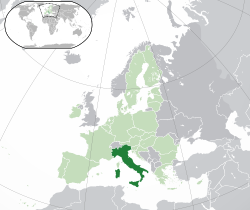 Italy, officially the Italian Republic (Italian: Repubblica Italiana), is a unitary parliamentary republic in Europe. Italy covers an area of 301,338 km2 (116,347 sq mi) and has a largely temperate climatelo Stivale (the Boot). With 61 million inhabitants, it is the 4th most populous EU member state. Located in the heart of the e Mediterranean Sea, Italy shares open land borders with France, Switzerland, Austria, Slovenia, San Marino and Vatican City.
 Since ancient times, Greek, Etruscan, Celtic, and other cultures have thrived on the Italian Peninsula. Rome ultimately emerged as the dominant power, conquering much of the ancient world and becoming the leading cultural, political, and religious centreWestern civilisation. During the Dark Ages, the region suffered sociopolitical collapse amid calamitous barbarian invasions, but by the 11th century, numerous Italian city-states rose to great prosperity through shipping, commerce and banking, and even laid the groundwork for capitalism. The Renaissance led to a flourishing of Italian culture, producing famous scholars, artists, and polymaths such as Leonardo da Vinci, Galileo, Michelangelo and Machiavelli. Italian explorers such as Marco Polo, Christopher Columbus, Amerigo Vespucci, and Giovanni da Verrazzano discovered new routes to the Far Eastst and the New World, helping to usher in the European Age of Discovery. Nevertheless, Italy remained politically fragmented and fell prey to European powers such as France, Spain, and later Austria, subsequently entering a long period of decline that lasted until the mid-19th century.
After various unsuccessful attempts, the second and the third wars for Italian independence resulted in the eventual unification of most of present-day Italy by 1866. From the late 19th century to the early 20th century, the new Kingdom of Italycolonial empire, becoming a great power. However, southern and rural areas of the country remained largely excluded from industrialisation, fuelling a large and influential diaspora. Despite being one of the main victorsrs in World War I, Italy entered a period of economic crisis and social turmoil, leading the way to the rise of a Fascist dictatorship in 1922. The subsequent participation in World War II on the Axis side ended in military defeat, economic destruction and civil war. In the years that followed, Italy abolished the monarchy, reinstated democracy, and enjoyed a prolonged economic boom, thus becoming one of the world’s most developed nations.
Italy has the third largest economy in the Eurozone and the eighth largest economy in the world. It has a very high level of human development and enjoys the highest life expectancy in the EU. Italy plays a prominent role in global military, cultural and diplomatic affairs and is also considered to be a major regional power in Europe. Italy is a founding and leading member of the European Union and the member of numerous international institutions, including the UN, NATO, the OECD, the OSCE, the WTO, the G7/G8, G20, the Union for the Mediterranean, the Council of Europe, Uniting for Consensus, and many more. As a reflection of its vast cultural wealth, Italy is home to 51 World Heritage Sites, the most in the world, and is one of the most visited countries..
|


