|
France. City of Metz (Lorraine)
1406-1588 Silver Groschen 26mm (2.66 grams)
Reference: Roberts 8932; Boudeau 1659, MB# 25, Schult# 2187
Certification: NGC XF 45 4912505-011
S.STEPHA.PROTH.M, Saint Stephen kneeling and praying to the left, head encircled with a halo, between two city shields, under a blessing hand.
BNDICT.SIT.NOM.DNI.NRI.IHV.XP GRO-SSU-S.M-ETE (Translation: God bless the name of our Lord Jesus
Gros of Metz), Cross patty with 4 stars, under 1 shield of the city.
You are bidding on the exact item pictured, provided with a Certificate of Authenticity and Lifetime Guarantee of Authenticity.
 Stephen (Greek: Στέφανος Stéphanos, meaning “wreath, crown” and by extension “reward, honor”, often given as a title rather than as a name, Hebrew: סטפנוס הקדוש), (c. AD 5 – c. AD 34) traditionally venerated as the protomartyr or first martyr of Christianity, was according to the Acts of the Apostles a deacon in the early church at Jerusalem who aroused the enmity of members of various synagogues by his teachings. Accused of blasphemy at his trial, he made a long speech denouncing the Jewish authorities who were sitting in judgment on him and was then stoned to death. His martyrdom was witnessed by Saul of Tarsus, a Pharisee who would later become a follower of Jesus and known as Paul the Apostle.
The only primary source for information about Stephen is the New Testament book of the Acts of the Apostles. Stephen is mentioned in Acts 6 as one of the Greek-speaking Hellenistic Jews selected to participate in a fairer distribution of welfare to the Greek-speaking widows.
The Catholic, Anglican, Lutheran, Oriental Orthodox, Eastern Orthodox Churches, and the Church of the East venerate Stephen as a saint. Traditionally, Stephen is invested with a crown of martyrdom; artistic representations often depict him with three stones and the martyr’s palm frond. Eastern Christian iconography shows him as a young, beardless man with a tonsure, wearing a deacon’s vestments, and often holding a miniature church building or a censer.
The Roman Catholic Diocese of Metz (Latin: Dioecesis Metensis; French: Diocèse de Metz) is a diocese of the Latin Rite of the Roman Catholic Church in France. In the Middle Ages it was a prince-bishopric of the Holy Roman Empire, a de facto independent state ruled by the prince-bishop who had the ex officio title of count. It was annexed to France by King Henry II in 1552; this was recognized by the Holy Roman Empire in the Peace of Westphalia of 1648. It formed part of the province of the Three Bishoprics. Since 1801 the Metz diocese has been a public-law corporation of cult (French: établissement public du culte).
Metz was definitely a bishopric by 535, but may date from earlier than that. Metz’s Basilica of Saint-Pierre-aux-Nonnains is built on the site of a Roman basilica which is a likely location for the one of the earliest Christian congregations of France.
Originally the diocese was under the metropolitan of Trier. After the French Revolution, the last prince bishop, Cardinal Louis de Montmorency-Laval (1761-1802) fled and the old organization of the diocese was broken up. With the Concordat of 1801 the diocese was re-established covering the departments of Moselle, Ardennes, and Forêts, and was put under the Archdiocese of Besançon. In 1817 the parts of the diocese which became Prussian territory were transferred to the Diocese of Trier. In 1871 the core areas of the diocese became part of Germany, and in 1874 Metz diocese, then reconfined to the borders of the new German Lorraine department became immediately subject to the Holy See. As of 1910 there were about 533,000 Catholics living in the diocese of Metz.[citation needed]
When the 1905 French law on the Separation of the Churches and the State was enacted, doing away with public-law religious corporations, this did not apply to the Metz diocese then being within Germany. After World War I it was returned to France, but the concordatary status has been preserved since as part of the Local law in Alsace-Moselle. In 1940, after the French defeat, it came under German occupation till 1944 when it became French again. Together with the Archdiocese of Strasbourg the bishop of the see is nominated by the French government according to the concordat of 1801. The concordat further provides for the clergy being paid by the government and Roman Catholic pupils in public schools can receive religious instruction according to diocesan guide lines.
Bishops
According to the traditional list of bishops, the current bishop Pierre René Ferdinand Raffin is the 105th bishop of Metz. According to this list, the first bishop was Saint Clement, supposedly sent by Saint Peter himself to Metz. The first fully authenticated bishop however is Sperus or Hesperus, who was bishop in 535. Many of the bishops were declared holy or blessed, like Saint Arnulf (611-627), Saint Chrodegang (742-766) or Saint Agilram (768-791). Adelbero was bishop of Metz in 933 AD. The bishop of Metz is appointed by the President of the Republic.
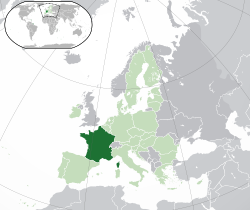
  France, officially the French Republic (French: République française), is a sovereign state comprising territory in western Europe and several overseas regions and territories. The European part of France, called Metropolitan France, extends from the Mediterranean Sea to the English Channel and the North Sea, and from the Rhine to the Atlantic Ocean. France spans 640,679 square kilometres (247,368 sq mi) and has a total population of 67 million. It is a unitary semi-presidential republic with the capital in Paris, the country’s largest city and main cultural and commercial centre. The Constitution of France establishes the state as secular and democratic, with its sovereignty derived from the people.
During the Iron Age, what is now Metropolitan France was inhabited by the Gauls, a Celtic people. The Gauls were conquered in 51 BC by the Roman Empire, which held Gaul until 486. The Gallo-Romans faced raids and migration from the Germanic Franks, who dominated the region for hundreds of years, eventually creating the medieval Kingdom of France. France emerged as a major European power in the Late Middle Ages, with its victory in the Hundred Years’ War (1337 to 1453) strengthening French state-building and paving the way for a future centralized absolute monarchy. During the Renaissance, France experienced a vast cultural development and established the beginning of a global colonial empire. The 16th century was dominated by religious civil wars between Catholics and Protestants (Huguenots).
France became Europe’s dominant cultural, political, and military power under Louis XIV. French philosophers played a key role in the Age of Enlightenment during the 18th century. In 1778, France became the first and the main ally of the new United States in the American Revolutionary War. In the late 18th century, the absolute monarchy was overthrown in the French Revolution. Among its legacies was the Declaration of the Rights of Man and of the Citizen, one of the earliest documents on human rights, which expresses the nation’s ideals to this day. France became one of modern history’s earliest republics until Napoleon took power and launched the First French Empire in 1804. Fighting against a complex set of coalitions during the Napoleonic Wars, he dominated European affairs for over a decade and had a long-lasting impact on Western culture. Following the collapse of the Empire, France endured a tumultuous succession of governments: the monarchy was restored, it was replaced in 1830 by a constitutional monarchy, then briefly by a Second Republic, and then by a Second Empire, until a more lasting French Third Republic was established in 1870. By the 1905 law, France adopted a strict form of secularism, called laïcité, which has become an important federative principle in the modern French society.
France reached its territorial height during the 19th and early 20th centuries, when it ultimately possessed the second-largest colonial empire in the world. In World War I, France was one of the main winners as part of the Triple Entente alliance fighting against the Central Powers. France was also one of the Allied Powers in World War II, but came under occupation by the Axis Powers in 1940. Following liberation in 1944, a Fourth Republic was established and later dissolved in the course of the Algerian War. The Fifth Republic, led by Charles de Gaulle, was formed in 1958 and remains to this day. Following World War II, most of the empire became decolonized.
Throughout its long history, France has been a leading global center of culture, making significant contributions to art, science, and philosophy. It hosts Europe’s third-largest number of cultural UNESCO World Heritage Sites (after Italy and Spain) and receives around 83 million foreign tourists annually, the most of any country in the world. France remains a great power with significant cultural, economic, military, and political influence. It is a developed country with the world’s sixth-largest economy by nominal GDP and eight-largest by purchasing power parity. According to Credit Suisse, France is the fourth wealthiest nation in the world in terms of aggregate household wealth. It also possesses the world’s second-largest exclusive economic zone (EEZ), covering 11,035,000 square kilometres (4,261,000 sq mi).
French citizens enjoy a high standard of living, and the country performs well in international rankings of education, health care, life expectancy, civil liberties, and human development. France is a founding member of the United Nations, where it serves as one of the five permanent members of the UN Security Council. It is a member of the Group of 7, North Atlantic Treaty Organization (NATO), Organisation for Economic Co-operation and Development (OECD), the World Trade Organization (WTO), and La Francophonie. France is a founding and leading member state of the European Union (EU).
|