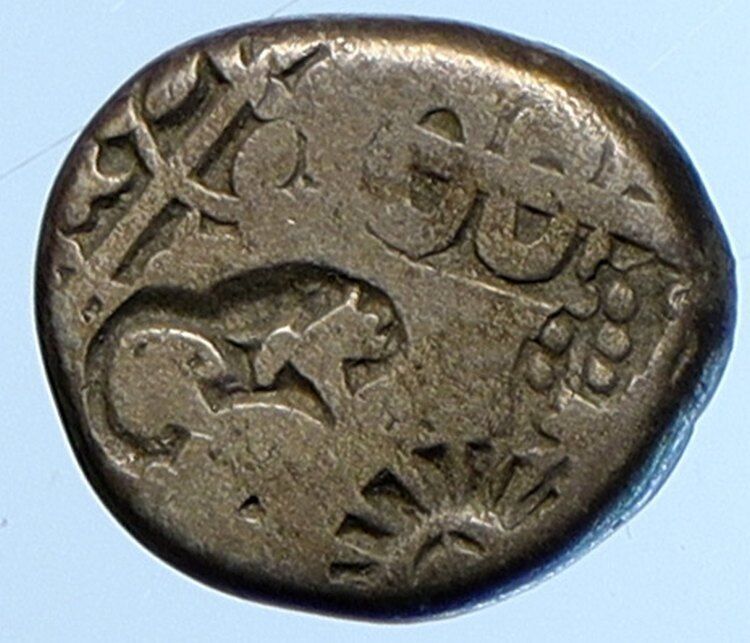
1510AD Malwa Sultanate Kingdom of India Authentic Medieval Islamic Coin i45375

$250.00 $225.00

Availability: 1 in stock

SKU: i45375 Category:

Item: i45375


Authentic Ancient

Islamic
Malwa Sultanate
in
India

Mahmud Shah II, 1510-1531 A.D.
AE 1/2 Falus 15mm (5.04 grams)
NM, AH922
G-M173

You are bidding on the exact item pictured,

provided with a Certificate of Authenticity and Lifetime Guarantee of

Authenticity.

The Malwa Sultanate was a late medieval independent kingdom in the
Malwa
region of
the present day
Madhya Pradesh
state in
India
in
1392–1562.

History

For earlier history, see article
MALWA
.


Preparation of wada for the Sultan Ghiyath al-Din, the Sultan of
Mandu

The sultanate of Malwa
was founded by
Dilawar
Khan Ghuri

, the governor of the
Delhi Sultanate
in Malwa, who asserted his independence in 1392, but did not
actually assume the ensigns of royalty till 1401. Initially
Dhar was the
capital of the new kingdom, but soon it was shifted to
Mandu
which was renamed Shadiabad (the city of joy). After his death, he was
succeeded by his son
Alp Khan
, who assumed the title of Hoshang Shah. The Ghuri dynasty founded
by Dilawar Khan Ghuri was replaced by Mahmud Shah I, who proclaimed himself king
on May 16, 1436. The Khilji dynasty founded by him ruled over Malwa till 1531.
Mahmud I was succeeded by his eldest son Ghiyas-ud-Din. The last days of
Ghiyas-ud-Din was embittered by a struggle for throne between his two sons,
Nasir-ud-Din and Ala-ud-Din. Nasir-ud-Din, however emerged victorious and
ascended the throne on October 22, 1500. The last ruler Mahmud Shah II
surrendered to Bahadur Shah, the sultan of Gujarat after the fort of Mandu fell
to Bahadur on May 25, 1531.

During 1531 – 1537 the kingdom was under the control of Bahadur Shah though
the Mughal emperor
Humayun

captured it for a short period during 1535-36. In 1537, Qadir Shah, an
ex-officer of the previous Khilji dynasty rulers regained control over a part of
the erstwhile kingdom. But in 1542,
Sher Shah Suri
conquered the kingdom defeating him and appointed Shuja’at
Khan as the governor. His son, Baz Bahadur declared himself independent in 1555.
In 1561, Akbar
‘s
army led by Adham Khan
and Pir Muhammad Khan attacked
Malwa
and
defeated Baz Bahadur in the battle of
Sarangpur
on 29 March, 1561. Akbar, soon recalled Adham Khan and made over
command to Pir Muhammad. Pir Muhammad attacked Khandesh and proceeded up to
Burhanpur

but he was defeated by a coalition of three powers:
Miran Mubarak Shah II
of
Khandesh
,
Tufal Khan of
Berar
and Baz Bahadur. Pir Muhammad died while retreating. The confederate
army pursued the Mughals and drove them out of Malwa. Baz Bahadur regained his
kingdom for a short period. In 1562, Akbar sent another army led by Abdullah
Khan, the Uzbeg, which finally defeated Baz Bahadur. He fled to
Chittor
.[2]
It became a
Subah
of the Mughal empire and Abdullah Khan became its first governor.

Art and Architecture


An illustration from the manuscript of the
Nimat Nama
completed during the reign of Nasir-ud-Din Shah

Malwa painting

Many remarkable illustrated manuscripts were prepared during the period of
the sultanate. An illustrated manuscript of Kalpa Sutra (1439) (presently
in the National Museum, Delhi) was prepared in Mandu during the reign of Mahmud
Shah I But the most interesting is a manuscript of the Nimat Nama, a
treatise on the art of cooking, which bears many portraits of Ghiyas-ud-Din Shah but the
colophon bears the name of Nasir-ud-Din Shah. The other notable illustrated
manuscripts of this period are of the Miftah-ul-Fuzala, a dictionary of
rare words, the Bustan (1502) painted by Haji Mahmud and the
Aja’ib-us-San’ati
(1508). Another manuscript of the Anwar-i-Suhaili
(now in the National Museum, Delhi) probably also belong to this period.

Malwa architecture

The monuments built during the sultanate period are almost concentrated in
Mandu city. The early monuments were assembled out of the materials of earlier
Hindu temples, according to the Islamic plan and convention. But nothing seems
to have been done to conceal or alter their essential Hindu appearance. The
significant among them are the Kamal Maula Masjid (c.1400), the Lal
Masjid
(1405), Dilawar Khan’s Masjid (c.1405) and the Masjid of
Malik Mughis
(1452) in Mandu.


the

Hoshang Shah laid the foundation of the Mandu fort on the ruins of the
original fortification. With him began the second and the classical phase of
Malwa architecture. Some of the ten gateways on the 25 miles long wall of the
fortress of Mandu were built by the Malwa sultans, the earliest one being the
Delhi Darwaza
(northern gateway). Within the walls of the fortress,
presently only forty structures survive in different stages of preservation. The
largest and most impressive of them is Jami Masjid, which according to an
inscription was begun by Hoshang Shah and completed by Mahmud Shah I in 1454.
The remarkable Durbar hall, known as the Hindola Mahal is also attributed
to Hoshang Shah. Opposite to Jami Masjid, the large structural complex known as
the Ashrafi Mahal comprises a group of buildings successively built in
course of a rather long period. Its original nucleus seems to be a madrasa
building erected as an adjunct to the Jami Masjid, probably during the
reign of Hoshang Shah. According to
Firishta
,
the tomb of Hoshang Shah was built by Mahmud Shah I. The later mausoleums, such
as the tomb of Darya Khan, the Dai ka Mahal and the Chhappan Mahal
were built on the same design. A long structural complex situated between two
lakes has a curious name, the Jahaz Mahal (ship-palace). Though the date
of this monument is not definitely known, its general style is in accord with
the character of Ghiyas-ud-Din Khilji. A lonely building on the slope of a hill
by the side of Riwa Kund is known by the local people as Baz Bahadur’s palace.
According to an inscription this monument was actually built by Nasir-ud-Din
Shah. The Rani Rupmati Pavilion stands on the southern edge of the plateau and
as its situation and form indicate, was, in all probability, designed for
military purposes.[5]

The rulers

The
Ghuri dynasty (1401–36)

  1. Dilawar Khan
    1401–1406
  2. Husam-ud-Din Hoshang Shah
    1406–1432
  3. Taj-ud-Din Muhammad Shah I 1432–1436


The Khilji dynasty (1436–1531)

  1. Ala-ud-Din Mahmud Shah I 1436–1469
  2. Ghiyas-ud-Din Shah 1469–1500
  3. Nasir-ud-Din Shah 1500–1510
  4. Shihab-ud-Din Mahmud Shah II 1510–1531

The intermission

  1. Bahadur Shah (the sultan of Gujarat) 1531–1537
  2. Humayun

    (Mughal emperor) 1535–1536

The later rulers

  1. Qadir Shah 1537–1542
  2. Shuja’at Khan (the governor of Sher Shah Suri) 1542–1555
  3. Baz Bahadur
    1555–1561

See also

  • Malwa
  • Mandu
  • List of Sunni Muslim dynasties

External links

  • Coins of the Malwa Sultanate

Frequently Asked equently Asked QuestionsAsked Questions

How long until my order is shipped?
Depending on the volume of sales, it may take up to 5 business days for

shipment of your order after the receipt of payment.

How will I know when the order was shipped?
After your order has shipped, you will be left positive feedback, and that

date should be used as a basis of estimating an arrival date.

After you shipped the order, how long will the mail take?
USPS First Class mail takes about 3-5 business days to arrive in the U.S.,

international shipping times cannot be estimated as they vary from country

to country. I am not responsible for any USPS delivery delays, especially

for an international package.

What is a certificate of authenticity and what guarantees do you give

that the item is authentic?
Each of the items sold here, is provided with a Certificate of Authenticity,

and a Lifetime Guarantee of Authenticity, issued by a world-renowned numismatic

and antique expert that has identified over 10000 ancient coins and has provided them

with the same guarantee. You will be quite happy with what you get with the COA; a professional presentation of the coin, with all of the relevant

information and a picture of the coin you saw in the listing.

Compared to other certification companies, the certificate of

authenticity is a $25-50 value. So buy a coin today and own a piece

of history, guaranteed.

Is there a money back guarantee?

I offer a 30 day unconditional money back guarantee. I stand

behind my coins and would be willing to exchange your order for

either store credit towards other coins, or refund, minus shipping

expenses, within 30 days from the receipt of your order. My goal is

to have the returning customers for a lifetime, and I am so sure in

my coins, their authenticity, numismatic value and beauty, I can

offer such a guarantee.

Is there a number I can call you with questions about my

order?

You can contact me directly via ask seller a question and request my

telephone number, or go to my

About Me Page to get my contact information only in regards to

items purchased on eBay.

When should I leave feedback?
Once you receive your

order, please leave a positive. Please don’t leave any

negative feedbacks, as it happens many times that people rush to leave

feedback before letting sufficient time for the order to arrive. Also, if

you sent an email, make sure to check for my reply in your messages before

claiming that you didn’t receive a response. The matter of fact is that any

issues can be resolved, as reputation is most important to me. My goal is to

provide superior products and quality of service.

  • Selection Required: Select product options above before making new offer.
  • Offer Sent! Your offer has been received and will be processed as soon as possible.
  • Error: There was an error sending your offer, please try again. If this problem persists, please contact us.

Make Offer

To make an offer please complete the form below:
$
Please wait...
YEAR

Year_in_description

CERTIFICATION

Uncertified

DENOMINATION

Denomination_in_description

Shopping Cart