|
Hungary under Ferdinand I – King of Hungary, Croatia, and Bohemia: 1526-1564
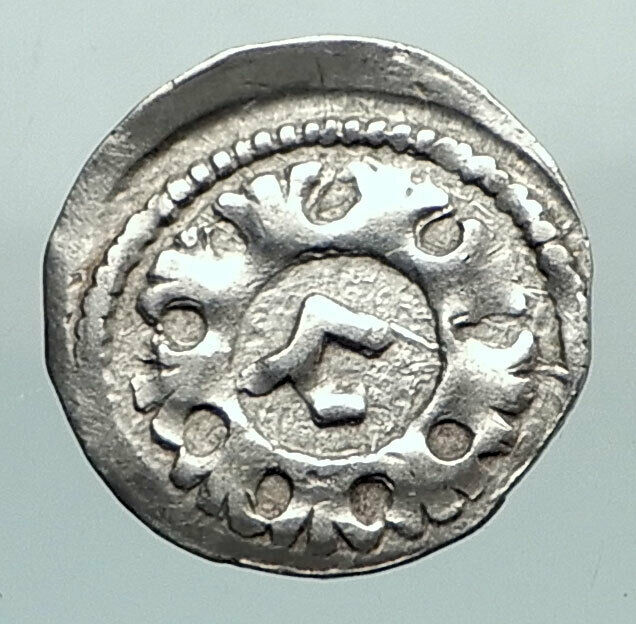
1563 KB Silver Denier / Denar 13mm (0.40 grams) 0.500 Silver
Reference: ÉH# 748, H# 936, H# 951 (1559-1565)
Fourfold curved coat of arms: Hungarian Árpád stripes, Hungarian double cross, Dalmatian leopard heads, Bohemian lion; in center chest shield Austrian bonds. Year above shield within inner circle. Lettering:
FER · D · G · E · R · O · I · S · AV · GE · HV · B · R ·
Crowned Madonna with child in right arm divides mintmark. Lettering: PATRONA · * · VNGARIE K B
You are bidding on the exact item pictured, provided with a Certificate of Authenticity and Lifetime Guarantee of Authenticity.
 A Madonna, meaning ‘my lady’. The Madonna and Child type is very prevalent in Christian iconography, divided into many traditional subtypes especially in Eastern Orthodox iconography, often known after the location of a notable icon of the type, such as the Theotokos of Vladimir, Agiosoritissa, Blachernitissa, etc., or descriptive of the depicted posture, as in Hodegetria, Eleusa, etc.
The term Madonna in the sense of “picture or statue of the Virgin Mary” enters English usage in the 17th century, primarily in reference to works of the Italian Renaissance. In an Eastern Orthodox context, such images are typically known as Theotokos. “Madonna” may be generally used of representations of Mary, with or without the infant Jesus, is the focus and central figure of the image, possibly flanked or surrounded by angels or saints. Other types of Marian imagery have a narrative context, depicting scenes from the Life of the Virginn, e.g. the Annunciation to Mary, are not typically called “Madonna”.
<pthe earliest="" depictions="" of="" mary="" date="" still="" to="" early="" christianity="" (2nd="" 3rd="" centuries),="" found="" in="" the="" catacombs="" rome.="" these="" are="" a="" narrative="" context.="" classical="" "madonna"="" or="" "theotokos"="" imagery="" develops="" from="" 5th="" century,="" as="" marian="" devotion="" rose="" great="" importance="" after="" council="" ephesus="" formally="" affirmed="" her="" status="" "mother="" god="" Theotokos (“God-bearer”) in 431. The Theotokos iconography as it developed in the 6th to 8th century rose to great importance in the high medieval period (12th to 14th centuries) both in the Eastern Orthodox and in the Latin spheres. According to a tradition recorded in the 8th century, Marian iconography goes back to a portrait drawn from life by Luke the Evangelist, with a number of icons (such as the Panagia Portaitissa) claimed to either represent this original icon or to be a direct copy of it. In the Western tradition, depictions of the Madonna were greatly diversified by Renaissance masters such as Duccio, Leonardo da Vinci, Michelangelo, Raphael, Giovanni Bellini, Caravaggio and Rubens (and further by certain modernists, such as Salvador Dalí and Henry Moore) while Eastern Orthodox iconography adheres more closely to the inherited traditional types.
 Ferdinand I (10 March 1503 – 25 July 1564) was Holy Roman Emperor from 1556, King of Bohemia, Hungary, and Croatia from 1526, and Archduke of Austria from 1521 until his death in 1564. Before his accession as emperor, he ruled the Austrian hereditary lands of the House of Habsburg in the name of his elder brother, Charles V, Holy Roman Emperor. Also, he often served as Charles’ representative in the Holy Roman Empire and developed encouraging relationships with German princes. In addition, Ferdinand also developed valuable relationships with the German banking house of Jakob Fugger and the Catalan bank, Banca Palenzuela Levi Kahana.
The key events during his reign were the conflict with the Ottoman Empire, which in the 1520s began a great advance into Central Europe, and the Protestant Reformation, which resulted in several wars of religion. Although not a military leader, Ferdinand was a capable organizer with institutional imagination who focused on building a centralized government for Austria, Hungary, and Bohemia instead of striving for universal monarchy. He reintroduced major innovations of his grandfather Maximilian I such as the Hofrat (court council) with a chancellery and a treasury attached to it (this time, the structure would last until the reform of Maria Theresa) and added innovations of his own such as the Raitkammer (collections office) and the Hofkriegsrat, conceived to counter the threat from the Ottoman Empire, while also successfully subduing the most radical of his rebellious Austrian subjects and turning the political class in Bohemia and Hungary into Habsburg partners. While he was able to introduce uniform models of administration, the governments of Austria, Bohemia and Hungary remained distinct though. His approach to Imperial problems, including governance, human relations and religious matters was generally flexible, moderate and tolerant. Ferdinand’s motto was Fiat iustitia, et pereat mundus: “Let justice be done, though the world perish”.

 Hungaryy is a sovereign state in Europe. It is situated in the Carpathian Basin and is bordered by Slovakia to the north, Romania to the east, Serbia to the south, Croatia to the southwest, Slovenia to the west, Austria to the northwest, and Ukraine to the northeast. The country’s capital and largest city is Budapest. Hungary is a member of the European Union, NATO, the OECD, the Visegrád Group, and the Schengen Area. The official language is Hungarian, which is the most widely spoken non-Indo-European language in Europe.
 Following centuries of successive habitation by Celts, Romans, Huns, Slavs, Gepids, and Avars, the foundation of Hungary was laid in the late 9th century by the Hungarian grand prince Árpád in the Honfoglalás (“homeland-conquest”). His great-grandson Stephen I ascended to the throne in 1000 CE, converting the country to a Christian kingdom. By the 12th century, Hungary became a middle power within the Western world, reaching a golden age by the 15th century. Following the Battle of Mohács in 1526 and about 150 years of partial Ottoman occupation (1541-1699), Hungary came under Habsburg rule, and later formed a significant part of the Austro-Hungarian Empire (1867-1918).
Hungary’s current borders were first established by the Treaty of Trianon (1920) after World War I, when the country lost 71% of its territory, 58% of its population, and 32% of ethnic Hungarians. Following the interwar period, Hungary joined the Axis Powers in World War II, suffering significant damage and casualties. Hungary came under the influence of the Soviet Union, which contributed to the establishment of a four-decade-long communist dictatorship (1947-1989). The country gained widespread international attention regarding the Revolution of 1956 and the seminal opening of its previously-restricted border with Austria in 1989, which accelerated the collapse of the Eastern Bloc.
On 23 October 1989, Hungary again became a democratic parliamentary republic, and today has a high-income economy with a very high Human Development Index. Hungary is a popular tourist destination attracting 10.675 million tourists a year (2013). It is home to the largest thermal water cave system and the second-largest thermal lake in the world (Lake Hévíz), the largest lake in Central Europe (Lake Balaton), and the largest natural grasslands in Europe (the Hortobágy National Park).
|