|
Germany – German States. Saxony
George III – Elector of Saxony: 22 August 1680 – 12 September 1691
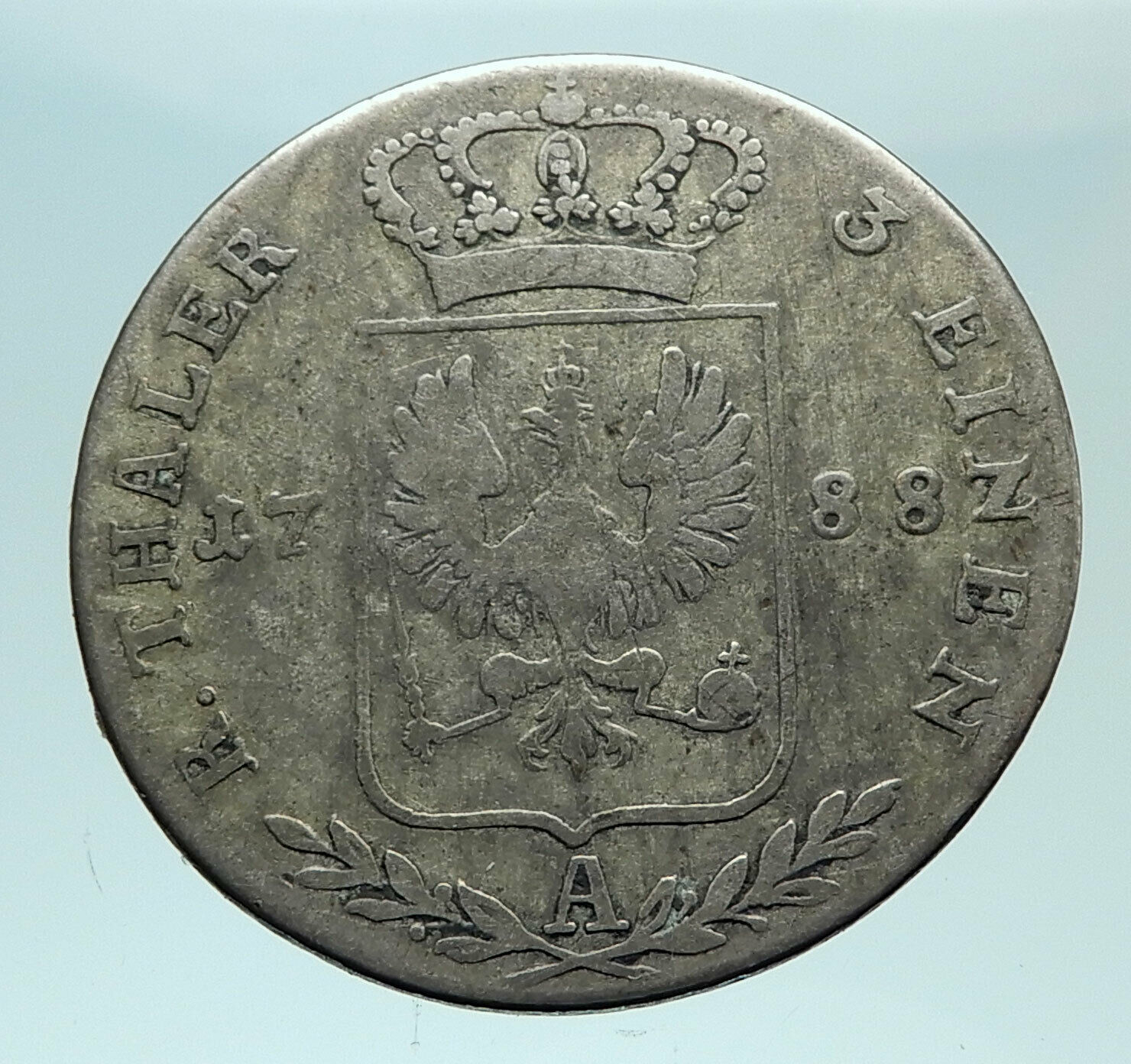
1690 IK Silver 2/3 Thaler 36mm (15.60 grams) Dresden Mint
Reference: KM# 571, Dav ECT# 810
Certification: NGC MS 62 3935966-008
IOIIGEORGIIIDG DUX SAX IC&AI, George facing right.
CHIMET ELECT 16 SACROMIMPAR 2/3, Crowned coat-of-arms.
You are bidding on the exact item pictured, provided with a Certificate of Authenticity and Lifetime Guarantee of Authenticity.
 Johann George III (20 June 1647 – 12 September 1691) was Elector of Saxony from 1680 to 1691. He belonged to the Albertine line of the House of Wettin.
Johann Georg III was born in Dresden, the only son of Johann George II and Magdalene Sybille of Brandenburg-Bayreuth.
John George succeeded his father as Elector of Saxony when he died, in 1680; he was also appointed Marshal of the Holy Roman Empire. Because of his courage and his enthusiasm for the War he gained the nickname of the “Saxonian Mars“.
From his childhood, he learned the typical duties and manners of an heir to the throne. That included not only a strictly Lutheran education but also language tuition and instruction in the art of fortress building and warfare.
In character he resembled his father. He shared his liking for Italian music and theatre. In 1685 John George III met the Venetian opera singer Margarita Salicola and began a relationship; he brought her to Dresden (not only to work, but also as his official mistress). She began a new era for the opera in Saxony, which had previously been dominated by the castrati. In 1686, the pietist Philipp Jakob Spener became the court chaplain in Dresden. But Spener was not generally accepted there and in 1691 he moved to Brandenburg.
Meanwhile, the duchy had recovered again from the consequences of the Thirty Years’ War. By 1689, Dresden had a population of 21,300 and was becoming less provincial. Four years before, in 1685, the old city of Dresden was destroyed by a fire; later, Wolf Caspar von Klengel and Balthasar Permoser were entrusted by the Duke with the reconstruction of the city in the baroque style which was the new fashion at the time.
John George showed a strong interest in the military and even while he was still the heir led Saxonian Army forces in the Rhine Campaign.
After his accession as Elector, he reduced the size of the royal household and began with the establishment of a small standing army of 12,000 men, after the model of the Margraviate of Brandenburg and managed to extract from the states of the realm a commitment to contribute funds. The Privy War Chancellery (geheime Kriegskanzlei) was set up as the highest military authority. Extreme pressure was used to obtain recruits for the new army. He always neglected home affairs.
In foreign policy, he was less inconstant than his father. He broke off relations with the French crown and strove energetically to win Brandenburg and other German princes for the Imperial war against the French aggressor.
Valued as an ally by the Habsburg court, he was nevertheless viewed with extreme distrust and was not able to overall command of all the imperial troops in the face of a Turkish invasion and he did not obtain the means (food supply and winter accommodation) necessary for the maintenance of his auxiliary troops. There was also the matter of John George’s wish for Emperor Leopold I to decide a law case concerning a wooded area in the Ore Mountains (Erzgebirge) in his favour. The Emperor did not grant material support until the siege of Vienna made his situation look increasingly desperate. Johann Georg even led his 10,400 strong army against the Turks. However, there was strong opposition from the estates of Saxony, not only because this expensive campaign was exhausting the finances of the Electorate of Saxony but also because they were not pleased at this support for the catholic Emperor, who had often proceeded harshly against Protestants in his own country. At Tulln, on the Danube, he joined the Imperial army and they set off for the relief of Vienna. In the ensuing Battle of Vienna (12 September 1683) he commanded the left wing, where he demonstrated great personal courage. The battle call selected by the emperor “Maria Help” (which might carry Roman Catholic connotations) had been previously amended to “Jesus and Maria help” at the request of John George.
King John III of Poland, who also took part in the battle, said of John George: “the Elector of Saxony is an honest man with a straight heart“.
John George also accompanied the Emperor after the victory when he entered Vienna. But on 15 September, without taking leave of the Emperor or the other commanders, he set off with his troops on the march back to Saxony, probably as a result of the brusque treatment he had been accorded as a Protestant.
In 1686 he again supported Leopold’s Turkish War. For payment of 300,000 thalers, he sent a troop of 5,000 men to the Emperor. In 1685 he had already hired out 3,000 Saxon nationals for 120,000 thalers to the Republic of Venice for their war in Morea on the Greek Peloponnese Peninsula.
He did not join the League of Augsburg of 1686 against France, but he did travel personally to The Hague in March 1688, to discuss with Prince William III of Orange, Duke George William of Brunswick-Lüneburg, and Duke Frederick William of Brandenburg possible moves against Louis XIV. However, he did not directly support the forthcoming assumption of the English throne by William.
Following a renewed invasion by France in (1689), he again led his troops into battle to protect Franconia. He later joined the army of Duke Charles V of Lorraine and took part in the siege of Mainz.
He later had to leave the theatre because of an illness but, against the advice of his physicians and advisors, he returned in May 1690 and with a reinforced alliance with the Emperor, took overall command of the imperial army. Success was limited, however, partly owing to personal skirmishes between John George, the Field Marshal Hans Adam von Schöning and the Austrian commander Caprara; only the crossing of the Rhine at Sandhofen succeeded.
John George died shortly after in Tübingen, where he had been brought, of an epidemic illness, probably Cholera or the Plague. He was buried in the Cathedral of Freiberg.
 Saxony (German: Sachsen, Upper Sorbian: Sakska), officially the Free State of Saxony, Upper Sorbian: Swobodny stat Sakska), is a landlocked federal state of Germany, bordering the federal states of Brandenburg, Saxony Anhalt, Thuringia, and Bavaria, as well as the countries of Poland (Lower Silesian and Lubusz Voivodeships) and the Czech Republic (Karlovy Vary, Liberec, and Ústí nad Labem Regions). Its capital is Dresden, and its largest city is Leipzig.
Saxony is the tenth largest of Germany’s sixteen states, with an area of 18,413 square kilometres (7,109 sq mi), and the sixth most populous, with 4 million people.
 The history of the state of Saxony spans more than a millennium. It has been a medieval duchy, an electorate of the Holy Roman Empire, a kingdom, and twice a republic.
The area of the modern state of Saxony should not be confused with Old Saxony, the area inhabited by Saxons. Old Saxony corresponds roughly to the modern German states of Lower Saxony, Saxony-Anhalt, and the Westphalian part of North Rhine-Westphalia.
  Germany, officially the Federal Republic of Germany is a federal parliamentary republic in western-central Europe. It includes 16 constituent states and covers an area of 357,021 square kilometres (137,847 sq mi) with a largely temperate seasonal climate. Its capital and largest city is Berlin. With 81 million inhabitants, Germany is the most populous member state in the European Union. After the United States, it is the second most popular migration destination in the world.
Various Germanic tribes have occupied northern Germany since classical antiquity. A region named Germania was documented before 100 CE. During the Migration Period the Germanic tribes expanded southward. Beginning in the 10th century, German territories formed a central part of the Holy Roman Empire. During the 16th century, northern German regions became the centre of the Protestant Reformation.
The rise of Pan-Germanism inside the German Confederation resulted in the unification of most of the German states in 1871 into the Prussian-dominated German Empire. After World War I and the German Revolution of 1918-1919, the Empire was replaced by the parliamentary Weimar Republic. The establishment of the Third Reich in 1933 led to World War II and the Holocaust. After 1945, Germany split into two states, East Germany and West Germany. In 1990, the country was reunified.
 In the 21st century, Germany is a great power and has the world’s fourth-largest economy by nominal GDP, as well as the fifth-largest by PPP. As a global leader in several industrial and technological sectors, it is both the world’s third-largest exporter and importer of goods. Germany is a developed country with a very high standard of living sustained by a skilled and productive society. It upholds a social security and universal health care system, environmental protection and a tuition free university education.
Germany was a founding member of the European Union in 1993. It is part of the Schengen Area, and became a co-founder of the Eurozone in 1999. Germany is a member of the United Nations, NATO, the G8, the G20, and the OECD. The national military expenditure is the 9th highest in the world. Known for its rich cultural history, Germany has been continuously the home of influential artists, philosophers, musicians, sportsmen, entrepreneurs, scientists and inventors.
|