|
Canada – Bank of Montreal
1837 Copper 1/2 Penny (1 Sou) Token 28.2mm (9.06 grams)
Reference: CCT# LC-8D, Breton His# 522, KM# Tn9, N#22506
Mintage: 480,000
PROVINCE DU BAS CANADA. UN SOU, Standing figure of a habitant in winter dress, with his tuque, frock overcoat of homespun with hood, moccasins, sash and whip.
BANK TOKEN CONCORDIA SALUS BANK OF MONTREAL 1837 HALF PENNY.; Coat of arms of the City of Montreal, with the name of the issuing bank on the ribbon (Bank of Montreal).
Coin Notes: An Habitant is an early French settler in Canada (esp. Quebec) or Louisiana.
You are bidding on the exact item pictured, provided with a Certificate of Authenticity and Lifetime Guarantee of Authenticity.
The Bank of Montreal, abbreviated as BMO, is a Canadian multinational investment bank and financial services company.
The bank was founded in Montreal, Quebec, in 1817 as Montreal Bank, making it Canada’s oldest bank. In 2023, the company’s seat in the Forbes Global 2000 was 84. Its head office is in Montreal and its operational headquarters and executive offices are located in Toronto, Ontario, since 1977. It is commonly known by its ticker symbol BMO on both the Toronto Stock Exchange and the New York Stock Exchange. In April 2024, it had CA$1.37 trillion in total assets. The Bank of Montreal swift code is BOFMCAM2 and the institution number is 001. In Canada, BMO has more than 900 branches and more than 1000 in the United States, serving over 13 million customers globally.
In the United States, BMO does business as BMO Financial Group, where it has substantial operations in the Chicago area and elsewhere in the country, where it operates BMO Bank, N.A.. BMO Capital Markets is BMO’s investment and corporate banking division, while the wealth management division is branded as BMO Nesbitt Burns. On 12 December 2021, the Bank of Montreal announced the strategic acquisition of Bank of the West from BNP Paribas for US$16.3 billion.
The bank was established on 23 June 1817 when a group of merchants signed the Articles of Association, formally creating the “Montreal Bank”. The signors of the document include Robert Armour, John C. Bush, Austin Cuvillier, George Garden, Horatio Gates, James Leslie, George Moffatt, John Richardson, and Thomas A. Turner. The bank was first located in rooms rented on Rue Saint-Paul, Montreal, before moving to its permanent building on Rue Saint-Paul in 1818. In the same year, the bank opened its first branch in Quebec City; and several offices in Upper Canada, including Amherstburg, Kingston, Perth, and York (present day Toronto). The bank also opened its first foreign permanent office in 1818, opening an office in Willam Street in New York City.
By 1822, the bank converted from the status it had held since its founding as a private company owned by a small group of people into a public company owned by 144. At this time, it became officially known by its current name.
Expansion into Upper Canada was halted in 1824, after legislation from the Parliament of Upper Canada forbade bank branches whose head offices were not based in Upper Canada from operating. In 1838, the bank reentered the Upper Canadian market with the purchase of the Bank of the People, a bank based in Toronto. BMO was permitted to open its own branches in the area, after Upper Canada and Lower Canada were united to create the Province of Canada in 1841. Shortly after the two colonies merged, the bank opened branches into Cobourg, Belleville, Brockville, and Ottawa.
Expansion into the Maritimes and Western Canada was facilitated following Canadian Confederation. In 1877, the bank opened its first branch in Western Canada, with the opening of a branch in Winnipeg. New branches were also opened in the Maritimes, in Halifax, Moncton, and Saint John completed shortly after Confederation. The Bank of Montreal established branches in Newfoundland Colony on 31 January 1895, at the behest of the colonial government. The colonial government of Newfoundland made the request to the Bank of Montreal four days after the collapse of the Commercial Bank and Union Bank of Newfoundland on 10 December 1894.
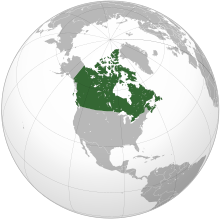  Canada is a country, consisting of ten provinces and three territories, in the northern part of the continent of North America. It extends from the Atlantic to the Pacific and northward into the Arctic Ocean, covering 9.98 million square kilometres (3.85 million square miles) in total, making it the world’s second-largest country by total area and the fourth-largest country by land area. Canada’s common border with the United States forms the world’s longest land border. Canada is sparsely populated overall, the majority of its land territory being dominated by forest and tundra as well as the mountain range of the Rocky Mountains; about four-fifths of the population live near to the southern border. The majority of Canada has a cold or severely cold winter climate, but southerly areas are warm in summer.
The land now called Canada has been inhabited for millennia by various Aboriginal peoples. Beginning in the late 15th century, British and French colonies were established on the region’s Atlantic coast. As a consequence of various conflicts, the United Kingdom gained and lost North American territories until left, in the late 18th century, with what mostly comprises Canada today. Pursuant to the British North America Act, on July 1, 1867, three colonies joined to form the autonomous federal Dominion of Canada. This began an accretion of provinces and territories to the new self-governing Dominion. In 1931, Britain granted Canada near total independence with the Statute of Westminster 1931 and full sovereignty was attained when the Canada Act 1982 severed the vestiges of legal dependence on the British parliament.
Canada is a federal parliamentary democracy and a constitutional monarchy, Queen Elizabeth II being the current head of state. The country is officially bilingual at the federal level. It is one of the world’s most ethnically diverse and multicultural nations, the product of large-scale immigration from many countries, with a population of approximately 35 million as of 2015. Its advanced economy is the eleventh largest in the world, relying chiefly upon its abundant natural resources and well-developed international trade networks. Canada’s long and complex relationship with the United States has had a significant impact on its economy and culture.
Canada is a developed country and one of the wealthiest in the world, with the tenth highest nominal per capita income globally, and the eighth highest ranking in the Human Development Index. It ranks among the highest in international measurements of government transparency, civil liberties, quality of life, economic freedom, and education. Canada is a Commonwealth Realm member of the Commonwealth of Nations, a member of the Francophonie, and part of several major international and intergovernmental institutions or groupings including the North Atlantic Treaty Organization, the G8, the Group of Ten, the G20, the North American Free Trade Agreement and the Asia-Pacific Economic Cooperation forum.
|