|
Germany. German States. Hannover
George V – Last King of Hannover: 18 November 1851 – 20 September 1866
50th Anniversary – Battle of Waterloo
1865 B Silver Thaler 33mm (18.47 grams) 0.900 Silver (0.5359 oz. ASW)
Reference: KM# 241 Mintage: 15,000
GEORG V v. G. G. KOENIG v. HANNOVER B, Bare head of George V left.
DEN SIEGERN BEI WATERLOO GEWIDMET AM 18 JUNI 1865 within wreath.
This coin was given to veterans of the battle in pension payments.
You are bidding on the exact item pictured, provided with a Certificate of Authenticity and Lifetime Guarantee of Authenticity.
The Battle of Waterloo was fought on Sunday 18 June 1815, near Waterloo (at that time in the United Kingdom of the Netherlands, now in Belgium). A French army under the command of Napoleon was defeated by two of the armies of the Seventh Coalition. One of these was a British-led coalition consisting of units from the United Kingdom, the Netherlands, Hanover, Brunswick, and Nassau, under the command of the Duke of Wellington (referred to by many authors as the Anglo-allied army or Wellington’s army). The other was composed of three corps of the Prussian army under the command of Field Marshal von Blücher (the fourth corps of this army fought at the Battle of Wavre on the same day). The battle marked the end of the Napoleonic Wars. The battle was contemporaneously known as the Battle of Mont Saint-Jean (France) or La Belle Alliance (“the Beautiful Alliance” �” Prussia).
Upon Napoleon’s return to power in March 1815, many states that had previously opposed him formed the Seventh Coalition, while hurriedly mobilising their armies. Wellington’s and Blücher’s armies were cantoned close to the northeastern border of France. Napoleon planned to attack them separately in the hope of destroying them before they could join in a coordinated invasion of France with other members of the coalition. On 16 June, Napoleon successfully attacked the bulk of the Prussian army at the Battle of Ligny with his main force, causing the Prussians to withdraw northwards on 17 June, but parallel to Wellington and in good order.
Napoleon sent a third of his forces to pursue the Prussians, which resulted in the separate Battle of Wavre with the Prussian rear-guard on 18�”19 June, and prevented that French force from participating at Waterloo. Also on 16 June, a small portion of the French army contested the Battle of Quatre Bras with the Anglo-allied army. The Anglo-allied army held their ground on 16 June, but the withdrawal of the Prussians caused Wellington to withdraw north to Waterloo on 17 June.
Upon learning that the Prussian army was able to support him, Wellington decided to offer battle on the Mont-Saint-Jean escarpment across the Brussels road, near the village of Waterloo. Here he withstood repeated attacks by the French throughout the afternoon of 18 June, aided by the progressively arriving Prussians who attacked the French flank and inflicted heavy casualties. In the evening, Napoleon assaulted the Anglo-allied line with his last reserves, the senior infantry battalions of the Imperial Guard. With the Prussians breaking through on the French right flank, the Anglo-allied army repulsed the Imperial Guard, and the French army was routed.
Waterloo was the decisive engagement of the Waterloo campaign and Napoleon’s last. According to Wellington, the battle was “the nearest-run thing you ever saw in your life”.[13] Napoleon abdicated four days later, and coalition forces entered Paris on 7 July. The defeat at Waterloo ended Napoleon’s rule as Emperor of the French and marked the end of his Hundred Days return from exile. This ended the First French Empire and set a chronological milestone between serial European wars and decades of relative peace, often referred to as the Pax Britannica.
The battlefield is located in the Belgian municipalities of Braine-l’Alleud and Lasne, about 15 kilometres (9.3 mi) south of Brussels, and about 2 kilometres (1.2 mi) from the town of Waterloo.
The site of the battlefield today is dominated by the monument of the Lion’s Mound, a large artificial hill constructed from earth taken from the battlefield itself; the topography of the battlefield near the mound has not been preserved.
 George V (George Frederick Alexander Charles Ernest Augustus; German: Georg Friedrich Alexander Karl Ernst August; 27 May 1819 – 12 June 1878) was the last king of Hanover, the only child and successor of King Ernest Augustus. George V’s reign was ended during the Unification of Germany.
Prince George of Cumberland was born on 27 May 1819 in Berlin, the only son of Prince Ernest Augustus, Duke of Cumberland – the fifth son of George III – and his wife, Princess Frederica of Mecklenburg-Strelitz.
He was baptized on 8 July 1819 at a hotel in Berlin where his parents were staying, by the Rev. Henry Thomas Austen (brother of author Jane Austen). His godparents were the Prince Regent (represented by the Duke of Cumberland), the King of Prussia, the Emperor of Russia, the Crown Prince of Prussia, Prince William of Prussia, Prince Frederick Louis of Prussia, Prince Henry of Prussia, the Prince William of Prussia, Grand Duke of Mecklenburg-Strelitz, Duke Charles of Mecklenburg, the Empress Maria Feodorovna of Russia, the Queen of the Netherlands, the Princess Augusta Sophia, the Hereditary Princess of Hesse-Homburg, the Duchess of Gloucester and Edinburgh, Princess Sophia, Princess Alexandrine of Prussia, the Electoral Princess of Hesse-Kassel, the Duchess of Anhalt-Dessau, Princess William of Prussia, Princess Ferdinand of Prussia, Princess Louisa of Prussia and Princess Radziwill.[1]
George spent his childhood in Berlin and in Great Britain. He lost the sight of one eye following a childhood illness in 1828, and in the other eye following an accident in 1833. His father had hoped that the young prince might marry his cousin Victoria, who was older by three days, thus keeping the British and Hanoverian thrones united, but nothing ever came of the plan.
Crown Prince
Upon the death of King William IV and the accession of Queen Victoria to the British throne, the 123-year personal union of the British and Hanoverian thrones ended due to the operation of Salic Law in the German states. The Duke of Cumberland succeeded to the Hanoverian throne as Ernst August, and Prince George became the Crown Prince of Hanover. As a legitimate male-line descendant of George III, he remained a member of the British Royal Family, and second in line to the British throne, until the birth of Queen Victoria’s first child, Victoria, Princess Royal, in 1840. Since he was totally blind, there were doubts as to whether the Crown Prince was qualified to succeed as king of Hanover; but his father decided that he should do so.
Marriage
George married, on 18 February 1843, at Hanover, Princess Marie of Saxe-Altenburg, the eldest daughter of Joseph, Duke of Saxe-Altenburg, by his wife, Duchess Amelia of Württemberg.
King of Hanover
The Crown Prince succeeded his father as the King of Hanover and Duke of Brunswick-Lüneburg as well as Duke of Cumberland and Teviotdale, in the Peerage of Great Britain and Earl of Armagh, in the Peerage of Ireland, on 18 November 1851, assuming the style George V.
From his father and from his maternal uncle, Prince Charles Frederick of Mecklenburg-Strelitz, one of the most influential men at the Prussian court, George had learned to take a very high and autocratic view of royal authority. During his 15-year reign, he engaged in frequent disputes with the Hanoverian parliament.
George was generally supportive of Austria in the Diet of the German Confederation. As the Austro-Prussian War started, the Prussian government sent a dispatch on 15 June 1866 demanding that Hanoverian troops submit to their authority or face war.
Despite previously having concluded that Hanover could not win an armed confrontation with Prussia, George remained protective of his throne and refused the ultimatum. Contrary to the wishes of the parliament, Hanover joined the Austrian camp in the war. As a result, the Prussian army occupied Hanover and the Hanoverian army surrendered on 29 June 1866 following the Battle of Langensalza, the King and royal family having fled to Austria.
The Prussian government formally annexed Hanover on 20 September 1866, despite the King of Prussia, William I, being a first cousin of King George V of Hanover; their mothers were sisters. The deposed King never renounced his rights to the throne or acknowledged Prussia’s actions. From exile in Gmunden, Austria, he appealed in vain for the European great powers to intervene on behalf of Hanover. From 1866 to 1870, George V maintained the Guelphic Legion partially at his own expense.
While in exile from his throne, he was appointed an honorary full general in the British army in 1876.
Death
George V died at his residence in the Rue de Presbourg, Paris, on 12 June 1878. After a funeral service in the Lutheran Church at the Rue Chaucat, his body was removed to England and buried in St George’s Chapel at Windsor Castle.
 Hanover or Hannover is the capital and largest city of the German state of Lower Saxony. Its 535,061 (2017) inhabitants make it the thirteenth-largest city of Germany, as well as the third-largest city of Northern Germany after Hamburg and Bremen. The city lies at the confluence of the River Leine (progression: Aller→ Weser→ North Sea) and its tributary Ihme, in the south of the North German Plain, and is the largest city of the Hannover-Braunschweig-Göttingen-Wolfsburg Metropolitan Region. It is the fifth-largest city in the Low German dialect area after Hamburg, Dortmund, Essen, and Bremen.
Before it became the capital of Lower Saxony in 1946, Hanover was the capital of the Principality of Calenberg (1636-1692), the Electorate of Brunswick-Lüneburg (1692-1814), the Kingdom of Hanover (1814-1866), the Province of Hanover of the Kingdom of Prussia (1868-1918), the Province of Hanover of the Free State of Prussia (1918-1946), and of the State of Hanover (1946). From 1714 to 1837, Hanover was by personal union the family seat of the Hanoverian Kings of the United Kingdom of Great Britain and Ireland, under their title of the dukes of Brunswick-Lüneburg (later described as the Elector of Hanover).
The city is a major crossing point of railway lines and highways (Autobahnen), connecting European main lines in both the east-west (Berlin-Ruhr area/Düsseldorf/Cologne) and north-south (Hamburg-Frankfurt/Stuttgart/Munich) directions. Hannover Airport lies north of the city, in Langenhagen, and is Germany’s ninth-busiest airport. The city’s most notable institutions of higher education are the Hannover Medical School with its university hospital (Klinikum der Medizinischen Hochschule Hannover), and the University of Hanover.
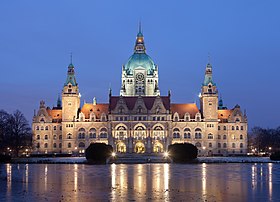
The Hanover fairground, due to numerous extensions, especially for the Expo 2000, is the largest in the world. Hanover hosts annual commercial trade fairs such as the Hanover Fair and up to 2018 the CeBIT. The IAA Commercial Vehicles show takes place every two years. It is the world’s leading trade show for transport, logistics and mobility. Every year Hanover hosts the Schützenfest Hannover, the world’s largest marksmen’s festival, and the Oktoberfest Hannover.
“Hanover” is the traditional English spelling. The German spelling (with a double n) is becoming more popular in English; recent editions of encyclopedias prefer the German spelling, and the local government uses the German spelling on English websites. The English pronunciation, with stress on the first syllable, is applied to both the German and English spellings, which is different from German pronunciation, with stress on the second syllable and a long second vowel. The traditional English spelling is still used in historical contexts, especially when referring to the British House of Hanover.
|