|
German States – Saxe-Weimar-Eisenach
William (Wilhelm) Ernest – Grand Duke: 5 January 1901 – 9 November 1918
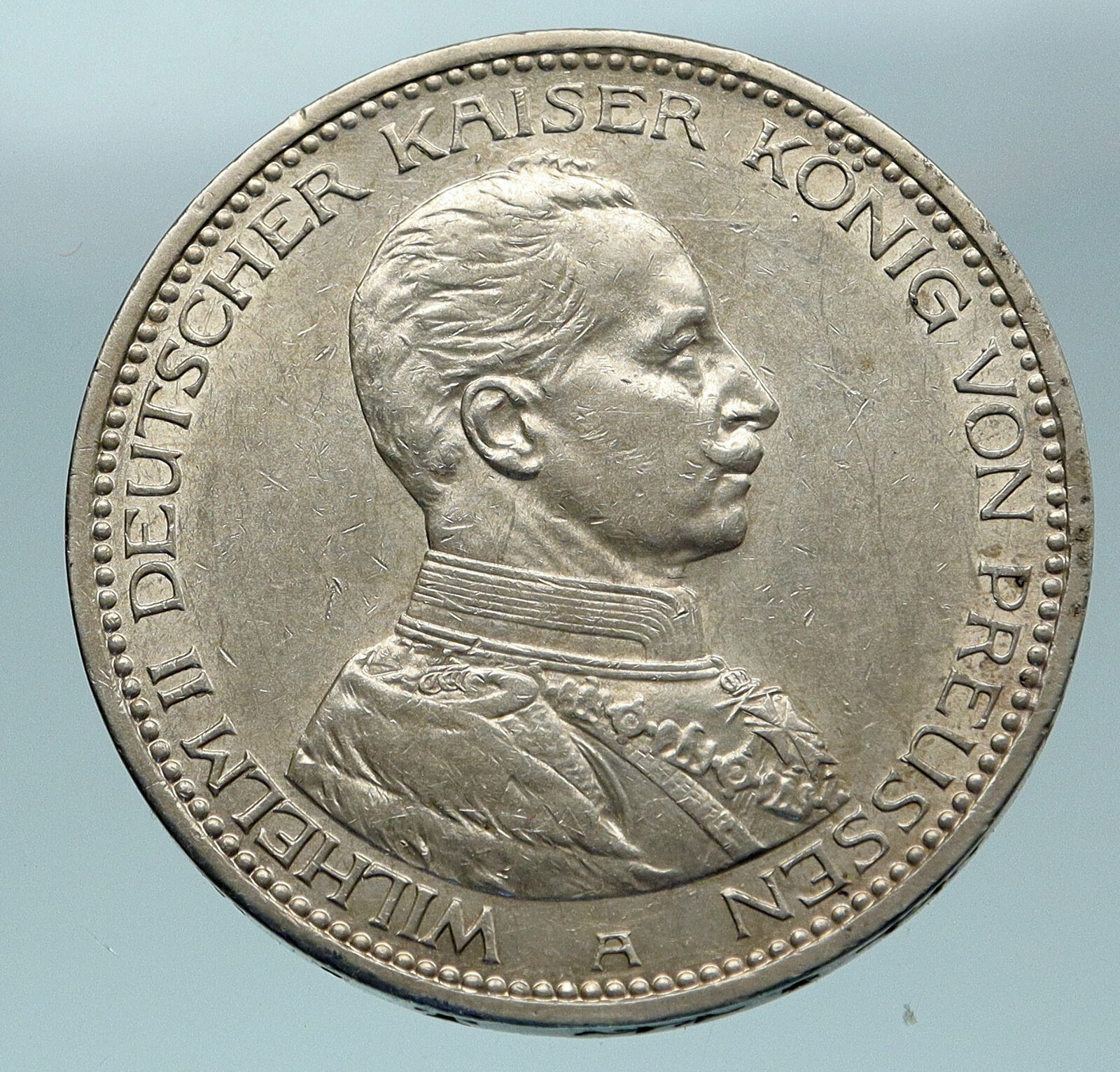
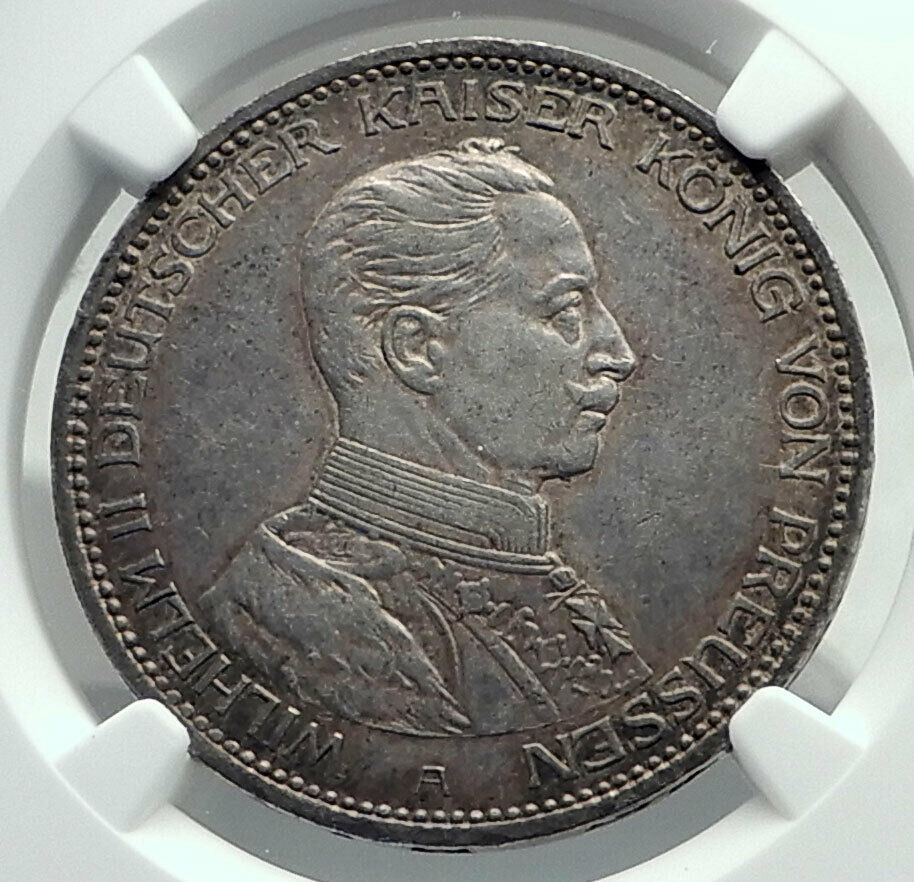
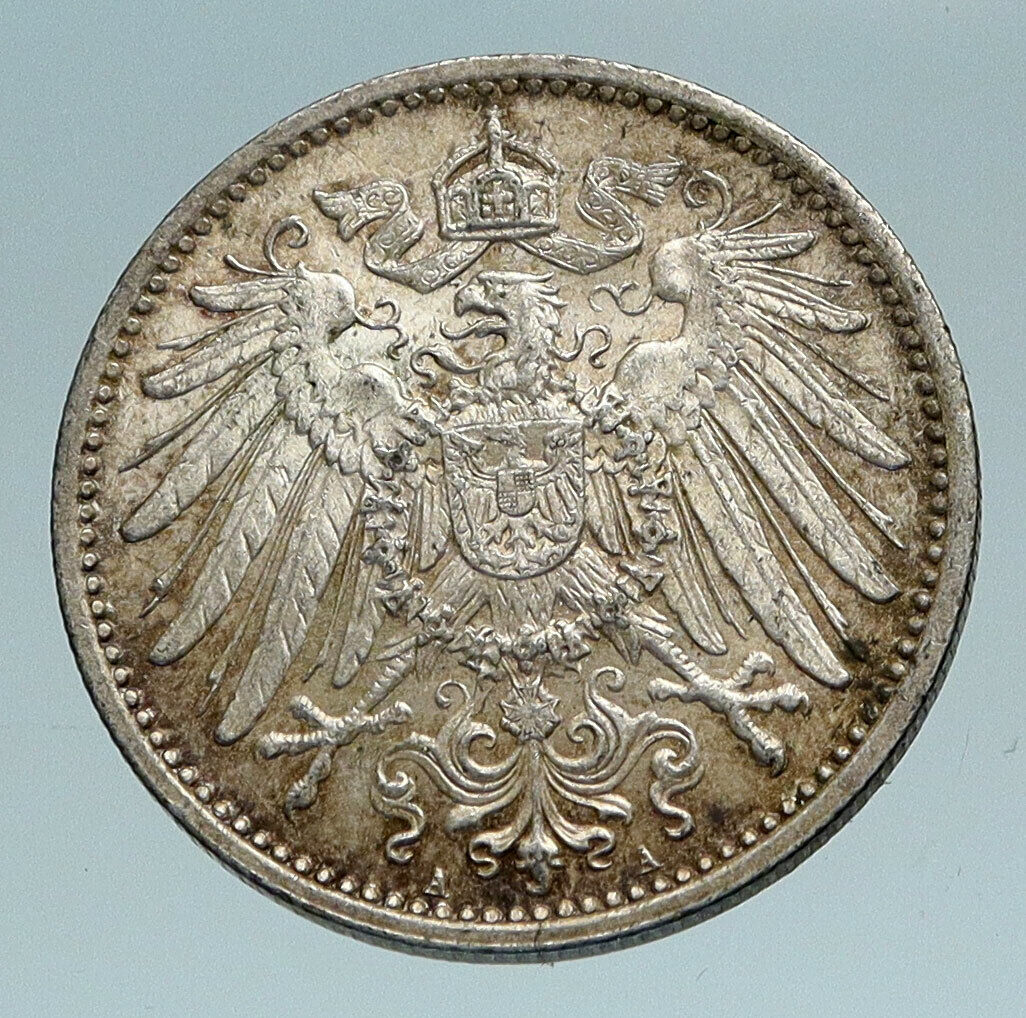
1903 A Silver Thaler 28mm (11.11 grams) 0.900 Silver (0.3215 oz. ASW)
Reference: KM# 217, J# 158
Certification: NGC MS 62 5774967-002
WILHELM ERNST-CAROLINE GROSHERZOG U. GROSZHERTOGIN V.SACHSEN ·30 A IV·, Adjoined busts facing left.
DEUTSCHES REICH 1903 *ZWEI MARK*, Crowned imperial eagle.
You are bidding on the exact item pictured, provided with a Certificate of Authenticity and Lifetime Guarantee of Authenticity.
 William Ernest, Grand Duke of Saxe-Weimar-Eisenach (Wilhelm Ernst Karl Alexander Friedrich Heinrich Bernhard Albert Georg Hermann, English: William Ernest Charles Alexander Frederick Henry Bernard Albert George Herman; 10 June 1876 – 24 April 1923), was the last Grand Duke of Saxe-Weimar-Eisenach.
He was born in Weimar, the eldest son of Karl August of Saxe-Weimar-Eisenach, heir to the Grand Duke, and his wife Princess Pauline of Saxe-Weimar-Eisenach.
He succeeded his grandfather Karl Alexander as Grand Duke on 5 January 1901, as his father had predeceased him.
His heir was a distant cousin, Prince Hermann of Saxe-Weimar-Eisenach, until his disinheritance in 1909. Hermann’s younger brother subsequently served as heir presumptive to the Grand Duchy of Saxe-Weimar-Eisenach until the birth of William Ernest’s eldest son.
Wilhelm Ernst created the new Weimar town centre under the direction of Hans Olde, Henry van de Velde, and Adolf Brütt. He also had the University of Jena rebuilt by Theodor Fischer, and also reconstructed Weimar’s theatres. The improvements to the city included a marble statue of his predecessor Charles Alexander, which was completed in 1911. It was placed in a setting designed by Brütt. The placement of the setting was designed to distinguish the “old town” from the newly built area. A preservation law for the “old town” barred it to the “art nouveau”-style which was used in the new area.
The Dutch throne
According to the Dutch constitution, Wilhelm Ernst was in the line for the throne of the Netherlands (as the grandson of Princess Sophie of the Netherlands) after Queen Wilhelmina. At the beginning of the 20th century, the Dutch feared the possibility of German influence or even annexation of the Netherlands. In order to prevent this, some lawyers tried to change the constitution to exclude Wilhelm Ernst from the succession. Another proposal, however, was this: if Wilhelmina would die childless, then he or his offspring would have to choose between the Dutch and the Weimar throne. The birth of Wilhelmina’s daughter Juliana in 1909 lessened the chance for any member of the House of Wettin (Saxe-Weimar-Eisenach branch) to inherit the Dutch throne. With the amendment to the constitution of 1922, which restricted the right of succession to the offspring of Wilhelmina, the possibility disappeared entirely.
Abdication
On 9 November 1918, Grand Duke Wilhelm Ernst – along with the rest of the German monarchs following the defeat of Germany in World War I – was forced to abdicate. His throne and all his lands were relinquished and he fled with his family to the family estate in Silesia, where he died five years later.
Despite all his work for Weimar during his government, Wilhelm Ernst was a hated ruler. This was for his private life, where he was known to be a sadist; the day of his abdication, he was called the “most unpopular prince in all Germany“.
He died in Heinrichau in Silesia.
 Saxe-Weimar-Eisenach (German: Sachsen-Weimar-Eisenach) was created as a duchy in 1809 by the merger of the Ernestine duchies of Saxe-Weimar and Saxe-Eisenach, which had been in personal union since 1741. It was raised to a grand duchy in 1815 by resolution of the Vienna Congress. In 1903, it officially changed its name to the Grand Duchy of Saxony (German: Großherzogtum Sachsen), but this name was rarely used. The  Grand Duchy came to an end in the German Revolution of 1918-19 with the other monarchies of the German Empire. It was succeeded by the Free State of Saxe-Weimar-Eisenach, which was merged into the new state of Thuringia two years later.
The full grand ducal style was Grand Duke of Saxe-Weimar-Eisenach, Landgrave in Thuringia, Margrave of Meissen, Princely Count of Henneberg, Lord of Blankenhayn, Neustadt and Tautenburg.
The Saxe-Weimar-Eisenach branch has been the most genealogically senior extant branch of the House of Wettin since 1672.
The duchies of Saxe-Weimar and Saxe-Eisenach had been ruled in personal union by the same branch of the House of Wettin since 1741, after the Eisenach line had died out upon the death of Duke Wilhelm Heinrich. The first Duke of the personal union was Ernest Augustus I, who built the Belvedere Palace in Weimar. His son Ernest Augustus II reigned for only three years, and died at the age of 20 years. At the age of 18, he married the Brunswick Princess Anna Amalia, one year his junior and a niece of King Frederick the Great of Prussia. A year later she gave birth to her son, Charles Augustus and after another year, when she was already a widow, to her son Constantine.
As Dowager Duchess Anna Amalia actively took up the regency, with the approval of the Empress Maria Theresa and the support of her ethical Minister Baron von Fritsch. As educator for her sons, she employed the poet Christoph Martin Wieland, who was a professor at the university of Erfurt.
At 18 years of age, Charles Augustus married Princess Louise of Hesse-Darmstadt. He employed the poet Johann Wolfgang von Goethe, with whom he soon became friends. Goethe, in turn, invited the authors Johann Gottfried Herder and Friedrich Schiller to Weimar, thus laying the foundation for the Weimar Classicism circle, which was supported in the background by Anna Amalia. Later regents would see it as main task to guard this heritage.
In 1804 Duke Charles Augustus’ eldest son and heir Charles Frederick married Maria Pavlovna Romanova, sister of Emperor Alexander I of Russia, a conjugal union which decisively promoted the rise of the Ernestine Saxe-Weimar dynasty. It also gave the duchy some protection during the turmoil of the Napoleonic Wars. Though at first an ally of Prussia in the Napoleonic War of the Fourth Coalition, Duke Charles Augustus escaped his deposition by joining the Confederation of the Rhine on 15 December 1806.
After the official merger in 1809, the Duchy of Saxe-Weimar-Eisenach consisted of the separate districts around the capital Weimar in the north and Eisenach in the west. Thanks to their Russian connection, the duchy gained substantially from the Congress of Vienna in 1815. In the east, it gained the district of Neustadt an der Orla (629 km2, 243 sq mi). It also received most of the Principality of Erfurt, which had been an exclave of Mainz before the war and a directly administered French fief under occupation. It further gained smaller possessions, such as Blankenhain and Kranichfeld. In the Rhön area, the Eisenacher Oberland was created from adjacent former parts of Hesse-Kassel and territories held by the secularized Fulda monastery. Finally, the country was raised to a Grand Duchy.
The cosmopolitan Grand Duke gave his grand duchy the first liberal constitution in Germany, on 5 May 1816. Students of the University of Jena organized themselves as Germany’s first fraternity, the Urburschenschaft and celebrated Wartburg Festival at the Wartburg in October 1817. Many liberal-minded people participated and the speakers, most of them students, must be regarded as having been among the earliest democrats in Germany.
Maria Pavlovna, who was Grand Duchess from 1828, featuring composers like Franz Liszt and Peter Cornelius. Her art-loving son Charles Alexander (1818-1901), who was Grand Duke from 1853, also supported the arts, and music in particular. He was married to Sophie, who supported his plans, and he rebuilt the decaying Wartburg the romantic historicism style of the day and had it painted by Moritz von Schwind. He also supported, albeit half-heartedly, the founding of the School of Applied Arts in Weimar, which merged to form the Bauhaus in 1919.
In 1901 Charles Alexander was succeeded by his grandson William Ernest, who was married to Caroline Reuss of Greiz and later to Feodora of Saxe-Meiningen. In 1903, the Grand Duchy officially changed its name to Grand Duchy of Saxony. However, many people continued to call it Saxe-Weimar-Eisenach, to avoid confusion with the neighbouring Kingdom of Saxony.
William Ernest abdicated the throne on 9 November 1918, thereby ending the monarchy in the state. It continued as the Free State of Saxe-Weimar-Eisenach, until 1920, when it merged with most of its neighbours to form Thuringia, with Weimar as the state capital.
|