|
German States – Mecklenburg-Schwerin under Frederick Francis IV – Grand Duke: 10 April 1897 – 14 November 1918
Wedding of Duke Friedrich Franz IV
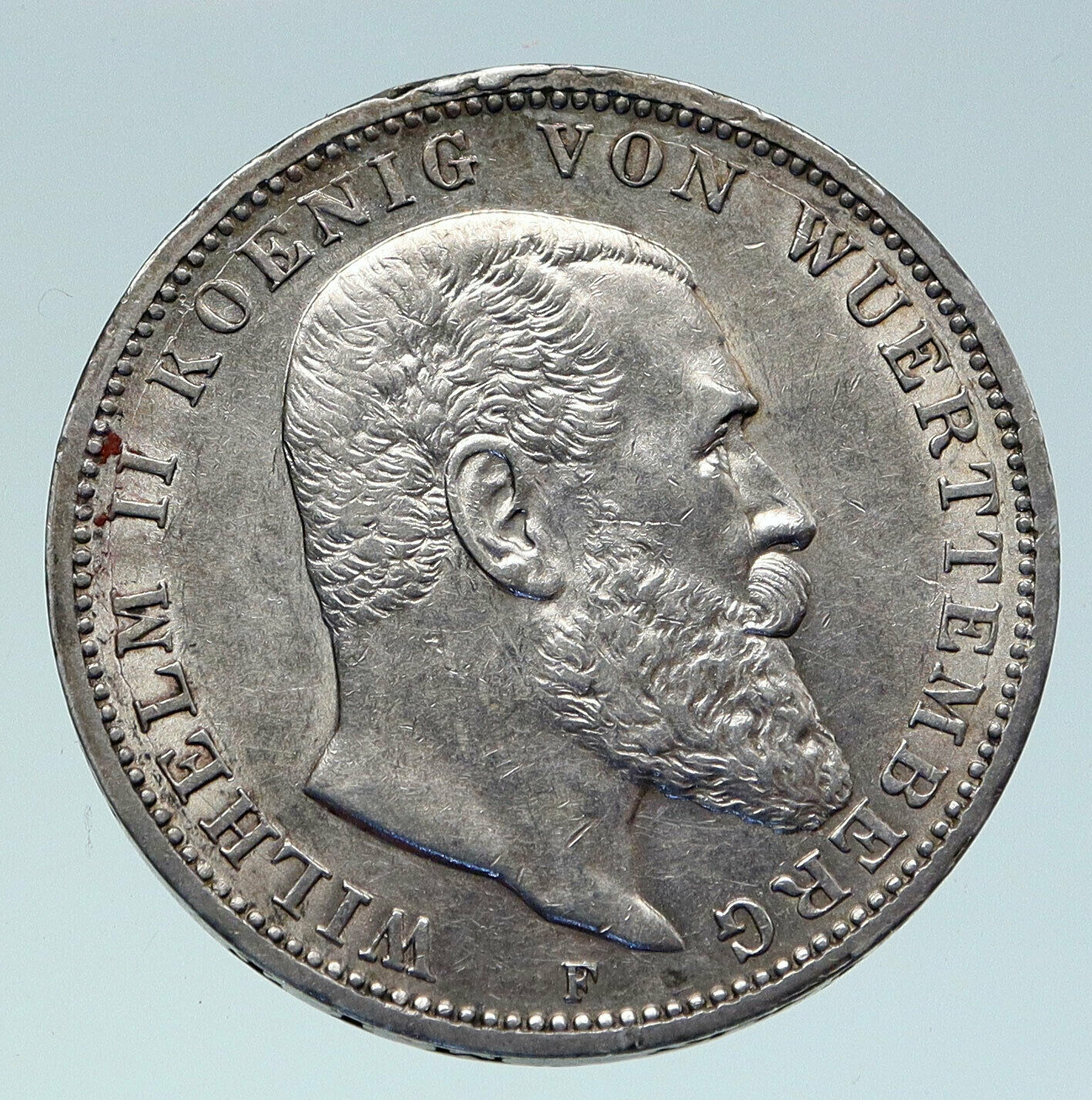
1904 Silver 2 Mark 27mm (11.11 grams) 0.900 Silver (0.3215 oz. ASW)
Reference: KM# 333, J# 86
· FRIEDRICH FRANZ-ALEXANDRA GROSSHERZOG U. GROSSHERZOGIN V. MECKLENB. SCHW. · A 7 VI, Wedding of Duke Friedrich Franz IV
DEUTSCHES REICH 1904 * ZWEI MARK *, Eagle.
You are bidding on the exact item pictured, provided with a Certificate of Authenticity and Lifetime Guarantee of Authenticity.
 Frederick Francis IV (Friedrich Franz Michael; 9 April 1882 – 17 November 1945) was the last Grand Duke of Mecklenburg-Schwerin and regent of Mecklenburg-Strelitz. He inherited the throne when he was fifteen years old in 1897 and was forced to renounce it in 1918.
Frederick Francis was one year old when he became the hereditary grand duke of Mecklenburg-Schwerin at the death of his grandfather Frederick Francis II, Grand Duke of Mecklenburg-Schwerin on 15 April 1883. Frederick Francis IV had an older sister, Alexandrine and a younger one, Cecilie. The three children were raised with simplicity and a lot of freedom by royal standards. Theirs was a polyglot household. The three siblings, who would remain very close throughout their lives, learned English, French, German and Russian. The family spent only half of the year in Schwerin during the summer months. They stayed as little time as possible in Schwerin Castle surrounded by a lake, preferring Gelbensande, a hunting lodge near Rostock and the Baltic Sea. There, the family led the simple life they preferred. Friederich Franz III spent most his time hunting, while Anastasia and the children rode or drove out, visited local people or enjoyed the beach and the surrounding forest. Every year from November until May, they lived in Villa Welden in Cannes where they sailed with their father and swam in the Mediterranean. On their journey back to Germany they stopped in Paris.
Grand Duke of Mecklenburg-Schwerin
Frederick Francis IV succeeded his father as Grand Duke upon his death on 10 April 1897. He had just turned fifteen the day before. As he was a teenager, due to his minority, the grand duchy was governed by his uncle Duke Johann Albrecht as regent. Frederick Francis’s mother, Grand Duchess Anastasia preferred to remain in France while he continued the long preparation to eventually assume the throne. The following year, his older sister, Alexandrine married the Danish Crown Prince (future King Christian X in 1912). His mother and younger sister Cecile visited him frequently in Dresden and during their stays, they would go out for long drives in a carriage and horses bought for him from Schwerin. In 1903, the young Grand Duke moved to Bonn, where he attended university and studied administration and law. Adolf Langfeld was appointed as his study advisor.
On 9 April 1901 Frederick Francis came of age, ending the regency and beginning his reign in Schwerin. He immediately began working on a reform of the constitution, but it failed in the face of opposition from parliament.
Marriage and issue
On 7 June 1904, Frederick Francis married Princess Alexandra of Hanover and Cumberland in Gmunden. She was the second eldest daughter of Ernest Augustus, Crown Prince of Hanover, and his wife Princess Thyra of Denmark, a daughter of Christian IX of Denmark.
They had five children:
- Hereditary Grand Duke Frederick Francis (22 April 1910 – 31 July 2001)
- Duke Christian Ludwig (29 September 1912 – 18 July 1996) married Princess Barbara of Prussia, daughter of Prince Sigismund of Prussia
- Duchess Olga (1916–1917)
- Duchess Thyra (18 June 1919 – 27 September 1981)
- Duchess Anastasia (11 November 1922 – 25 January 1979) married Prince Friedrich Ferdinand of Schleswig-Holstein-Sonderburg-Glücksburg
Abdication
Following the 1918 suicide of Grand Duke Adolphus Frederick VI of Mecklenburg-Strelitz, Frederick Francis took up the regency of Strelitz. This happened because the heir presumptive Duke Charles Michael was serving in the Russian Army at the time and had indicated that he wished to renounce his succession rights. Frederick Francis abdicated the grand ducal throne on 14 November 1918 following the German Empire’s defeat in World War I; the regency ended at the same time.
After his abdication, he was initially not allowed to live in Mecklenburg and had to move to Denmark. A year later, he was permitted to return. He recovered some of his former properties and occupied some of his former homes. Frederick Francis died on 17 November 1945 in Flensburg after being arrested by No6 RAF Security section on 9 November 1945. He was succeeded as head of the grand ducal house by his son Hereditary Grand Duke Friedrich Franz.
 The Grand Duchy of Mecklenburg-Strelitz was a territory in Northern Germany, held by the younger line of the House of Mecklenburg residing in Neustrelitz. Like the neighbouring Grand Duchy of Mecklenburg-Schwerin, it was a sovereign member state of the German Confederation and became a federated state of the North German Confederation and finally of the German Empire upon the unification of 1871. After World War I and the German Revolution of 1918–19 it was succeeded by the Free State of Mecklenburg-Strelitz.
 Germany, officially the Federal Republic of  Germany is a federal parliamentary republic in western-central Europe. It includes 16 constituent states and covers an area of 357,021 square kilometres (137,847 sq mi) with a largely temperate seasonal climate. Its capital and largest city is Berlin. With 81 million inhabitants, Germany is the most populous member state in the European Union. After the United States, it is the second most popular migration destination in the world.
Various Germanic tribes have occupied northern Germany since classical antiquity. A region named Germania was documented before 100 CE. During the Migration Period the Germanic tribes expanded southward. Beginning in the 10th century, German territories formed a central part of the Holy Roman Empire. During the 16th century, northern German regions became the centre of the Protestant Reformation.
The rise of Pan-Germanism inside the German Confederation resulted in the unification of most of the German states in 1871 into the Prussian-dominated German Empire. After World War I and the German Revolution of 1918-1919, the Empire was replaced by the parliamentary Weimar Republic. The establishment of the Third Reich in 1933 led to World War II and the Holocaust. After 1945, Germany split into two states, East Germany and West Germany. In 1990, the country was reunified.
 In the 21st century, Germany is a great power and has the world’s fourth-largest economy by nominal GDP, as well as the fifth-largest by PPP. As a global leader in several industrial and technological sectors, it is both the world’s third-largest exporter and importer of goods. Germany is a developed country with a very high standard of living sustained by a skilled and productive society. It upholds a social security and universal health care system, environmental protection and a tuition free university education.
Germany was a founding member of the European Union in 1993. It is part of the Schengen Area, and became a co-founder of the Eurozone in 1999. Germany is a member of the United Nations, NATO, the G8, the G20, and the OECD. The national military expenditure is the 9th highest in the world. Known for its rich cultural history, Germany has been continuously the home of influential artists, philosophers, musicians, sportsmen, entrepreneurs, scientists and inventors.
|