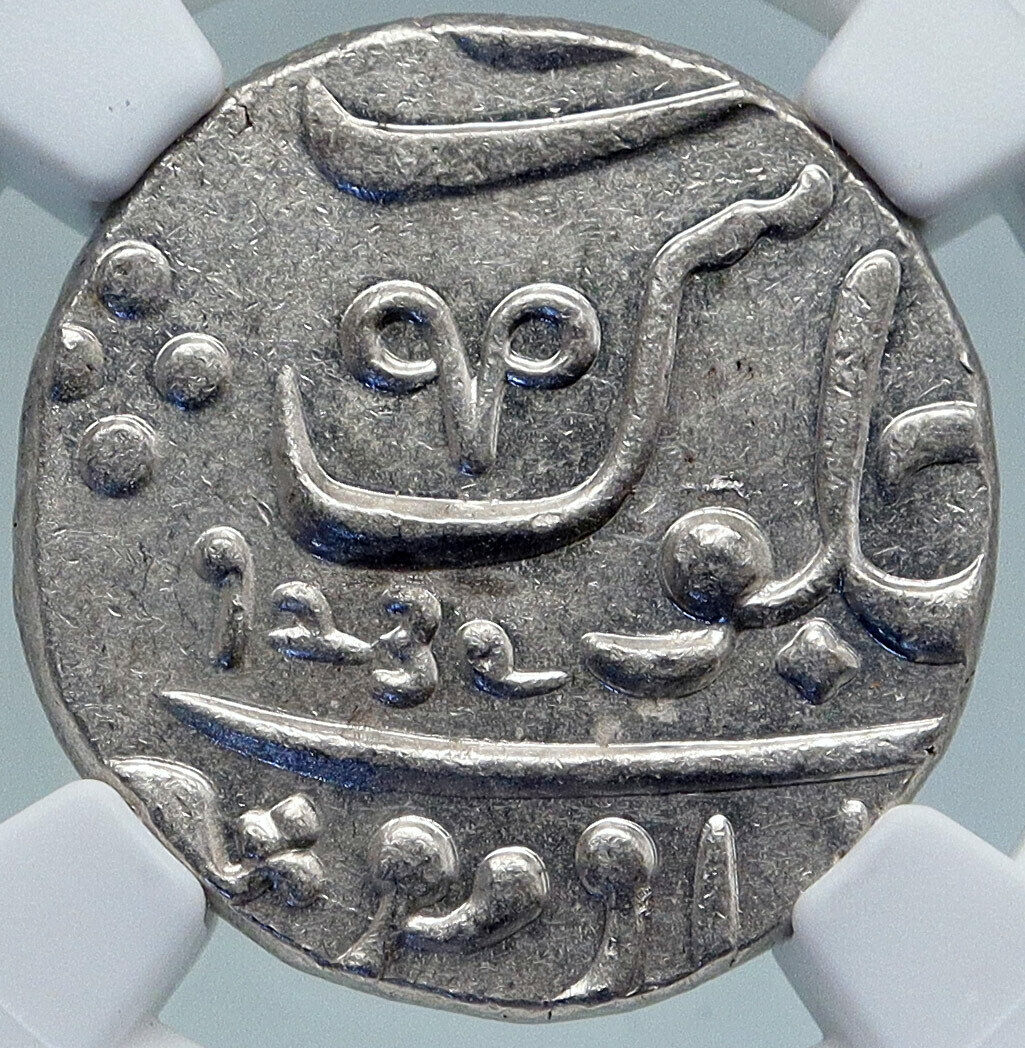
|
India, Colonial
British
India
George V
King of the
United Kingdom
and the British Dominions, Emperor of India:
6 May
1910 – 20 January 1936
AE 1/12 Anna 17mm (1.63 grams)
Reference: KM-509
GEORGE V KING EMPEROR, Crowned bust of George V left.
1/12 ANNA INDIA 1921 surrounded by decoration.
You are bidding on the exact item pictured,
provided with a Certificate of Authenticity and Lifetime Guarantee of
Authenticity.
Colonial India is the part of the
Indian subcontinent
which was under the control
of European colonial powers, through trade and conquest. The first European
power to arrive in India was the
Macedonian
army of
Alexander the Great
in 327–326 BC. The
satraps
he established in the north west of the
subcontinent quickly crumbled after he left. Later,
trade was carried
between Indian states and the
Roman Empire
by Roman sailors who reached India
via the Red Sea
and
Arabian Sea
, but the Romans never sought
trading settlements or territory in India. The
spice trade
between India and Europe was one of
the main types of trade in the world economy and was the main catalyst for the
period of European exploration
.
The search for the wealth and prosperity of India led to the accidental
“discovery” of the Americas by
Christopher Columbus
in 1492. Only a few years
later, near the end of the 15th century,
Portuguese
sailor
Vasco da Gama
became the first European to
re-establish direct trade links with India since Roman times by being the first
to arrive by circumnavigating Africa (1497–1499). Having arrived in
Calicut
, which by then was one of the major
trading ports of the eastern world,
he obtained permission to trade in the city from
Saamoothiri Rajah
.
Trading rivalries brought other European powers to India. The
Netherlands
,
England
, France, and
Denmark
established trading posts in India in
the early 17th century. As the
Mughal Empire
disintegrated in the early 18th
century and then the
Maratha Empire
became weakened after the
third battle of Panipat
, the relatively weak
and unstable Indian states which emerged were increasingly open to manipulation
by the Europeans through dependent “friendly” Indian rulers.
In the later 18th century
Britain
and France struggled for dominance
through proxy Indian rulers and also by direct military intervention. The defeat
of the redoubtable Indian ruler
Tipu Sultan
in 1799 marginalised French
influence. This was followed by a rapid expansion of British power through the
greater part of the subcontinent in the early 19th century. By the middle of the
century, the British had already gained direct or indirect control over almost
all of India.
British India
contained the most populous and
valuable provinces of the
British Empire
and thus became known as “the
jewel in the British crown”.
East India Company
See also:
Company rule in India
In 1757 Mir Jafar
, the commander in chief of the army
of the
Nawab of Bengal
, along with
Jagat Seth
, Maharaja
Krishna Nath
,
Umi Chand
and some others, secretly connived
with the British, asking support to overthrow the Nawab in return for trade
grants. The British forces, whose sole duty until then was guarding Company
property, were numerically inferior to the
Bengali
armed forces. At the
Battle of Plassey
on 23 June 1757, fought
between the British under the command of
Robert Clive
and the Nawab, Mir Jafar’s forces
betrayed the Nawab and helped defeat him. Jafar was installed on the throne as a
British subservient ruler. The battle transformed British perspective as they
realised their strength and potential to conquer smaller Indian kingdoms and
marked the beginning of the imperial or colonial era in the subcontinent.

An 1876 political cartoon of
Benjamin Disraeli
(1804–1881)
making
Queen Victoria
Empress of India
. The caption was
“New crowns for old ones!”
British policy in Asia during the 19th century was chiefly concerned with
expanding and protecting its hold on India, viewed as its most important colony
and the key to the rest of Asia.[9]
The
East India Company
drove the expansion of the
British Empire
in Asia. The company’s army had
first joined forces with the
Royal Navy
during the
Seven Years’ War
, and the two continued to
cooperate in arenas outside India: the eviction of Napoleon from
Egypt
(1799), the capture of
Java from the Netherlands (1811), the acquisition of Singapore (1819)
and Malacca
(1824), and the defeat of
Burma
(1826).
From its base in India, the company had also been engaged in an increasingly
profitable opium
export trade to China since the 1730s.
This trade, unlawful in China since it was outlawed by the
Qing dynasty
in 1729, helped reverse the trade
imbalances resulting from the British imports of tea, which saw large outflows
of silver from Britain to China. In 1839, the confiscation by the Chinese
authorities at
Canton
of 20,000 chests of opium led Britain to
attack China in the
First Opium War
, and the seizure by Britain of
the island of Hong Kong, at that time a minor settlement.
The British had direct or indirect control over all of present-day India
before the middle of the 19th century. In 1857, a local rebellion by an army of
sepoys
escalated into the
Rebellion of 1857
, which took six months to
suppress with heavy loss of life on both sides. The trigger for the Rebellion
has been a subject of controversy. The resistance, although short-lived, was
triggered by British East India Company attempts to expand its control of India.
According to Olson, several reasons may have triggered the Rebellion. For
example, Olson concludes that the East India Company’s attempt to annexe and
expand its direct control of India, by arbitrary laws such as Doctrine of Lapse,
combined with employment discrimination against Indians, contributed to the 1857
Rebellion.[12]
The East India Company officers lived like princes, the company finances were in
shambles, and the company’s effectiveness in India was examined by the British
crown after 1858. As a result, the East India Company lost its powers of
government and
British India
formally came under
direct British rule
, with an appointed
Governor-General of India
. The East India
Company was dissolved the following year in 1858. A few years later,
Queen Victoria
took the title of Empress of
India.
India suffered a series of serious crop failures in the late 19th century,
leading to
widespread famines
in which at least 10 million
people died. The East India Company had failed to implement any coordinated
policy to deal with the famines during its period of rule.[citation
needed][dubious
–
discuss
] This changed during
the Raj
, in which commissions were set up after
each famine to investigate the causes and implement new policies, which took
until the early 1900s to have an effect.
The slow but momentous reform movement developed gradually into the
Indian Independence Movement
. During the years
of World War I
, the hitherto bourgeois “home-rule”
movement was transformed into a popular mass movement by
Mahatma Gandhi
, a
pacifist
. Apart from Gandhi, other
revolutionaries such as
Shaheed Bhagat Singh
,
Chandrashekar Azad
,
Subhas Chandra Bose
,and Pradyumn Ananth
Pendyala were not against use of violence to oppose the British rule. The
independence movement attained its objective with the independence of Pakistan
and India on 14 and 15 August 1947 respectively.
Conservative elements in England consider the independence of India to be the
moment that the
British Empire
ceased to be a world power,
following
Curzon
‘s dictum that, “[w]hile we hold on to
India, we are a first-rate power. If we lose India, we will decline to a
third-rate power.”

George V (George Frederick Ernest Albert; 3 June 1865 –
20 January 1936) was
King of the United Kingdom
and the
British
Dominions
, and
Emperor of India
, from 6 May 1910 until his death in 1936.
George was a grandson of
Queen Victoria
and
Prince Albert
and the first cousin of both
Tsar Nicholas II of Russia
and
Kaiser Wilhelm II of Germany
. From 1877 to 1891, he served in the
Royal Navy
.
On the death of Victoria in 1901, George’s father became
King Edward
VII
, and George was made
Prince of Wales
. On his father’s death in 1910, he succeeded as
King-Emperor
of the
British Empire
. He was the only Emperor of India to be present at his own
Delhi
Durbar
.
As a result of the
First World War
(1914–18), most other European empires fell while the
British Empire expanded to its greatest effective extent. In 1917, George became
the first monarch of the
House of Windsor
, which he renamed from the
House of Saxe-Coburg and Gotha
as a result of anti-German public sentiment.
His reign saw the rise of
socialism
,

communism,
fascism
,
Irish republicanism
, and the
Indian independence movement
, all of which radically changed the political
landscape. The
Parliament Act 1911
established the supremacy of the elected
British House of Commons
over the unelected
House of Lords
. In 1924 he appointed the first
Labour
ministry
and in 1931 the
Statute of Westminster
recognised the dominions of the Empire as separate,
independent states within the
Commonwealth of Nations
. He was plagued by illness throughout much of his
later reign and at his death was succeeded by his eldest son,
Edward
VIII
.
Early life and
education
George was born on 3 June 1865, in
Marlborough House
, London, as the second son of the
Prince
and
Princess of Wales
,
Albert
Edward
and
Alexandra
. His father was the eldest son of
Queen Victoria
and
Prince Albert
. His mother was the eldest daughter of
King Christian IX of Denmark
and
Louise of Hesse-Kassel
. As a son of the Prince of Wales, George was styled
His Royal Highness Prince George of Wales at birth. He was baptised at
Windsor Castle
on 7 July 1865 by the
Archbishop of Canterbury
,
Charles Longley
.

George as a young boy, 1870
As a younger son of the Prince of Wales, there was little expectation that
George would become king. He was third in line to the throne, after his father
and elder brother,
Prince Albert Victor
. George was only 17 months younger than Albert Victor,
and the two princes were educated together.
John Neale Dalton
was appointed as their tutor in 1871. Neither Albert
Victor nor George excelled intellectually. As their father thought that the navy
was “the very best possible training for any boy”, in September 1877, when
George was 12 years old, both brothers joined the cadet training ship
Britannia HMS
at
Dartmouth, Devon
.
For three years from 1879, the royal brothers served on
BacchanteHMS
, accompanied by Dalton. They toured the colonies of the
British Empire
in the
Caribbean
,
South Africa and Australia, and visited
Norfolk, Virginia
, as well as South America, the
Mediterranean
, Egypt, and East Asia. In 1881 on a visit to Japan, George had
a local artist tattoo a blue and red dragon on his arm, and was received in an
audience by the
Emperor Meiji
; George and his brother presented
Empress Haruko
with two
wallabies
from Australia. Dalton wrote an account of their journey entitled The Cruise
of HMS Bacchante.
Between Melbourne and Sydney, Dalton recorded a sighting of the
Flying Dutchman
, a mythical ghost ship. When they returned to Britain,
Queen Victoria complained that her grandsons could not speak French or German,
and so they spent six months in
Lausanne
in
an ultimately unsuccessful attempt to learn another language. After Lausanne,
the brothers were separated; Albert Victor attended
Trinity College, Cambridge
, while George continued in the
Royal Navy
.
He travelled the world, visiting many areas of the British Empire. During his
naval career he commanded Torpedo Boat 79 in home waters then
ThrushHMS
on the North America station, before his last active
service in command of HMS Melampus in 1891–92. From then on, his naval
rank was largely honorary.
Marriage
See also:
Wedding of Prince George, Duke of York, and Princess Mary of Teck
As a young man destined to serve in the navy, Prince George served for many
years under the command of his uncle,
Prince Alfred, Duke of Edinburgh
, who was stationed in
Malta
. There, he
grew close to and fell in love with his uncle’s daughter, his first cousin,
Marie of Edinburgh
. His grandmother, father and uncle all approved the
match, but the mothers—the Princess of Wales and the
Duchess of Edinburgh
—both opposed it. The Princess of Wales thought the
family was too pro-German, and the Duchess of Edinburgh disliked England.
Marie’s mother was the only daughter of
Tsar Alexander II of Russia
. She resented the fact that, as the wife of a
younger son of the British sovereign, she had to yield precedence to George’s
mother, the Princess of Wales, whose father had been a minor German prince
before being called unexpectedly to the throne of Denmark. Guided by her mother,
Marie refused George when he proposed to her. She married
Ferdinand
, the heir to the
King of Romania
, in 1893.
In November 1891, George’s elder brother
Albert Victor
became engaged to his
second
cousin once removed
,
Princess Victoria Mary of Teck
. She was known within the family as “May”,
nicknamed after her birth month. May’s father,
Prince Francis, Duke of Teck
, belonged to a
morganatic
, cadet branch of the
house of Württemberg
. Her mother,
Princess Mary Adelaide of Cambridge
, was a male-line granddaughter of
King George III
and a first cousin of Queen Victoria.
On 14 January 1892, six weeks after the formal engagement, Albert Victor died
of pneumonia
,
leaving George second in line to the throne, and likely to succeed after his
father. George had only just recovered from a serious illness himself, after
being confined to bed for six weeks with
typhoid fever
, the disease that was thought to have killed his grandfather
Prince Albert. Queen Victoria still regarded Princess May as a suitable match
for her grandson, and George and May grew close during their shared period of
mourning. A year after Albert Victor’s death, George duly proposed to May and
was accepted. They married on 6 July 1893 at the
Chapel
Royal
in
St James’s Palace
, London. Throughout their lives, they remained devoted to
each other. George was, on his own admission, unable to express his feelings
easily in speech, but they often exchanged loving letters and notes of
endearment.
Duke of York

York Cottage
at
Sandringham House
: George and his wife lived here from 1893 to
1926.
The death of his elder brother effectively ended George’s naval career, as he
was now second in line to succeed to the throne, after his father. George was
created Duke of York
,
Earl of Inverness
and
Baron Killarney
by Queen Victoria on 24 May 1892, and received lessons in
constitutional history from J. R. Tanner.[17]
After George’s marriage to May, she was styled Her Royal Highness The
Duchess of York
.
The Duke and Duchess of York lived mainly at York Cottage, a relatively small
house in
Sandringham, Norfolk
, where their way of life mirrored that of a comfortable
middle-class family rather than royalty. George preferred a simple, almost
quiet, life in marked contrast to the lively social life pursued by his father.
His official biographer,
Harold Nicolson
, later despaired of George’s time as Duke of York, writing:
“He may be all right as a young midshipman and a wise old king, but when he was
Duke of York … he did nothing at all but kill [i.e.
stamp collectorr, which Nicolson disparaged, but George played a large role
in building the
Royal Philatelic Collection
into the most comprehensive collection of United
Kingdom and Commonwealth stamps in the world, in some cases setting record
purchase prices for items.
George and May had five sons and a daughter.
Randolph Churchill
claimed that George was a strict father, to the extent
that his children were terrified of him, and that George had remarked to
Edward Stanley, 17th Earl of Derby
: “My father was frightened of his mother,
I was frightened of my father, and I am damned well going to see to it that my
children are frightened of me.” In reality, there is no direct source for the
quotation and it is likely that George’s parenting style was little different
from that adopted by most people at the time.
In October 1894, George’s uncle-by-marriage,
Tsar Alexander III
, died and his cousin,
Tsar Nicholas II
, ascended the Russian throne. At the request of his father,
“out of respect for poor dear Uncle Sasha’s memory”, George joined his parents
in St. Petersburg for the funeral. George and his parents remained in Russia for
the wedding a week later of Nicholas to another one of George’s first cousins,
Princess Alix of Hesse-Darmstadt
, who Queen Victoria had once hoped would
marry George’s elder brother.
Prince of Wales
<div id="mwe_player_0" class="PopUpMediaTransform" style="width:220px;" videopayload="
“>
 Play
media
George at Montreal and Quebec, 1901
As Duke and Duchess of York, George and May carried out a wide variety of
public duties. On the death of
Queen Victoria
on 22 January 1901, George’s father ascended the throne as
King Edward
VII
. George inherited the titles of
Duke of Cornwall
and
Duke of Rothesay
, and for much of the rest of that year, he was styled
His Royal Highness The Duke of Cornwall and York.
In 1901, George and May toured the
British Empire
. Their tour included Malta, Ceylon, South Africa, Australia,
New Zealand, Canada, and the
Colony of Newfoundland
. The tour was designed by Colonial Secretary
Joseph Chamberlain
with the support of Prime Minister
Lord Salisbury
to reward the dominions for their participation in the
South African War
of 1899–1902. George presented thousands of specially
designed South African War medals to colonial troops. In South Africa, the royal
party met civic leaders, African leaders, and Boer prisoners, and was greeted by
elaborate decorations, expensive gifts, and fireworks displays. Despite this,
not all residents responded favourably to the tour. Many white Cape
Afrikaners
resented the display and expense, the war having weakened their capacity to
reconcile their Afrikaner-Dutch culture with their status as British subjects.
Critics in the English-language press decried the enormous cost at a time when
families faced severe hardship.

Painting of the Duke opening the first
Parliament of Australia
on 9 May 1901
In Australia, the Duke opened the first session of the
Australian Parliament
upon the
creation of the Commonwealth of Australia
. In New Zealand, he praised the
military values, bravery, loyalty, and obedience to duty of New Zealanders, and
the tour gave New Zealand a chance to show off its progress, especially in its
adoption of up-to-date British standards in communications and the processing
industries. The implicit goal was to advertise New Zealand’s attractiveness to
tourists and potential immigrants, while avoiding news of growing social
tensions, by focusing the attention of the British press on a land few knew
about. On his return to Britain, in a speech at
London’s Guildhall
, George warned of “the impression which seemed to prevail
among [our] brethren across the seas, that the Old Country must wake up if she
intends to maintain her old position of pre-eminence in her colonial trade
against foreign competitors.”
On 9 November 1901, George was created
Prince of Wales
and
Earl of Chester
. King Edward VII wished to prepare his son for his future
role as king. In contrast to Edward himself, whom Queen Victoria had
deliberately excluded from state affairs, George was given wide access to state
documents by his father. George in turn allowed his wife access to his papers,
as he valued her counsel and she often helped write her husband’s speeches. As
Prince of Wales, George supported the various naval reforms, including the
enrollment of cadets at the ages of twelve and thirteen, and cadets receiving
the same education, whatever their class and eventual assignments. The reforms
were implemented by the then Second (later First) Sea Lord,
Jacky Fisher
.
From November 1905 to March 1906, George and May toured
British India
, where he was disgusted by racial discrimination and
campaigned for greater involvement of Indians in the government of the country.
The tour was almost immediately followed by a trip to Spain for the wedding of
King Alfonso XIII
to
Victoria Eugenie of Battenberg
, a first cousin of George, at which the bride
and groom narrowly avoided assassination. A week after returning to Britain,
George and May traveled to
Norway
for the
coronation
of
King Haakon VII
, George’s cousin, and
Queen
Maud
, George’s sister.
King and Emperor

The King in Coronation Robes by Sam Begg
On 6 May 1910,
King Edward
VII
George had never liked his wife’s habit of signing official documents and
letters as “Victoria Mary” and insisted she drop one of those names. They both
thought she should not be called Queen Victoria, and so she became Queen Mary.
Later that year, a radical propagandist,
Edward Mylius
, published a lie that George had secretly married in Malta as
a young man, and that consequently his marriage to Queen Mary was bigamous. The
lie had first surfaced in print in 1893 but George had shrugged it off as a
joke. In an effort to kill off rumours, Mylius was arrested, tried and found
guilty of criminal libel, and was sentenced to a year in prison.
George objected to the anti-Catholic wording of the Accession Declaration
that he would be required to make at the opening of his first parliament. He
made it known that he would refuse to open parliament as long as he was obliged
to make the declaration in its current form. As a result the
Accession Declaration Act 1910
shortened the declaration and removed the
most offensive phrases.
George and Mary’s
coronation
took place at
Westminster Abbey
on 22 June 1911, and was celebrated by the
Festival of Empire
in London. In July, the King and Queen visited Ireland
for five days; they received a warm welcome, with thousands of people lining the
route of their procession to cheer. Later in 1911, the King and Queen travelled
to India for the
Delhi Durbar
, where they were presented to an assembled audience of Indian
dignitaries and princes as the
Emperor and Empress of India
on 12 December 1911. George wore the newly
created
Imperial Crown of India
at the ceremony, and declared the shifting of the
Indian capital from
Calcutta
to Delhi
.
They travelled throughout the sub-continent, and George took the opportunity to
indulge in
big game hunting
in Nepal, shooting 21 tigers, 8 rhinoceroses and a bear
over 10 days. He was a keen and expert marksman.[45]
On 18 December 1913, he shot over a thousand
pheasants
in six hours at the home of
Lord Burnham
, although even he had to acknowledge that “we went a little too
far” that day.
National politics

A half-sovereign minted during George’s reign (Bertram
Mackennal, sculptor)
George inherited the throne at a politically turbulent time.
Lloyd George’s
People’s Budget
had been rejected the previous year by the
Conservative
and
Unionist
-dominated
House of Lords
, contrary to the normal convention that the Lords did not
veto money
bills
.
Liberal
Prime Minister
H. H.
Asquith
had asked the previous king to give an undertaking that he would
create sufficient Liberal peers to force the budget through the House. Edward
reluctantly agreed if the Lords rejected the budget after two successive general
elections. After a
general election in January 1910
, the Conservative peers allowed the budget,
for which the government now had an electoral mandate, to pass without a vote.
Asquith attempted to curtail the power of the Lords through constitutional
reforms, which were again blocked by the Upper House. A constitutional
conference on the reforms broke down in November 1910 after 21 meetings. Asquith
and
Lord Crewe
, Liberal leader in the Lords, asked George to grant a
dissolution, leading to a second general election, and to promise to create
sufficient Liberal peers if the Lords blocked the legislation again. If George
refused, the Liberal government would otherwise resign, which would have given
the appearance that the monarch was taking sides – with “the peers against the
people” – in party politics. The King’s two private secretaries, Lords
Knollys
and
Stamfordham
, gave George conflicting advice. Knollys, who was Liberal,
advised George to accept the Cabinet’s demands, while Stamfordham, who was
Unionist, advised George to accept the resignation. Like his father, George
reluctantly agreed to the dissolution and creation of peers, although he felt
his ministers had taken advantage of his inexperience to browbeat him. After the
December 1910 election
, the Lords let the bill pass on hearing of the threat
to swamp the house with new peers. The subsequent
Parliament Act 1911
permanently removed – with a few exceptions – the power
of the Lords to veto bills. The King later came to feel that Knollys had
withheld information from him about the willingness of the opposition to form a
government if the Liberals had resigned.
The 1910 general elections had left the Liberals as a minority government
dependent upon the support of
Irish Nationalists
. As desired by the Nationalists, Asquith introduced
legislation that would give Ireland Home Rule
, but the Conservatives and
Unionists opposed it. As tempers rose over the Home Rule Bill, which would never
have been possible without the Parliament Act, relations between the elderly
Knollys and the Conservatives became poor, and he was pushed into retirement.
Desperate to avoid the prospect of Civil War in Ireland between Unionists and
Nationalists, George called a
meeting of all parties at Buckingham Palace
in July 1914 in an attempt to
negotiate a settlement. After four days the conference ended without an
agreement. On 18 September 1914, the King – having considered vetoing the
legislation – gave his assent to the Home Rule Bill after it had been passed by
Westminster, but its implementation was postponed by a
Suspensory Act
due to the outbreak of the First World War.
First World War

“A good riddance”
A 1917
Punch
cartoon depicts George sweeping away his German
titles.
From 1914 to 1918,
Britain and its allies
were at
war
with the
Central Powers
, led by the
German Empire
. The German Kaiser
Wilhelm II
, who for the British public came to symbolise all the horrors of
the war, was the King’s first cousin. The King’s paternal grandfather was
Prince Albert of Saxe-Coburg and Gotha
; consequently, the King and his
children bore the titles Prince and Princess of Saxe-Coburg and Gotha and Duke
and Duchess of Saxony. Queen Mary, although British like her mother, was the
daughter of the
Duke of
Teck
, a descendant of the German
Dukes of Württemberg
. The King had brothers-in-law and cousins who were
British subjects but who bore German titles such as Duke and Duchess of Teck,
Prince and Princess of Battenberg, and Prince and Princess of
Schleswig-Holstein. When
H. G.
Wells
wrote about Britain’s “alien and uninspiring court”, George famously
replied: “I may be uninspiring, but I’ll be damned if I’m alien.”
On 17 July 1917, George appeased British nationalist feelings by issuing a
royal proclamation that changed the name of the British
royal house
from the German-sounding
House of Saxe-Coburg and Gotha
to the
House of Windsor
.[63]
He and all his British relatives relinquished their German titles and styles,
and adopted British-sounding surnames. George compensated his male relatives by
creating them British peers. His cousin,
Prince Louis of Battenberg
, who earlier in the war had been forced to resign
as First Sea Lord
through anti-German feeling, became Louis Mountbatten, 1st
Marquess of Milford Haven, while Queen Mary’s brothers became
Adolphus Cambridge, 1st Marquess of Cambridge
, and
Alexander Cambridge, 1st Earl of Athlone
. George’s cousins
Princess Marie Louisee
and
Princess Helena Victoria of Schleswig-Holstein
dropped their territorial
designations.

King George V (right) and his physically similar cousin
Emperor Nicholas II
in German military uniforms in Berlin before
the war.
In
Letters Patent
gazetted on 11 December 1917 the King restricted the style
“His (or Her) Royal Highness” and the titular dignity of “Prince (or Princess)
of Great Britain and Ireland” to the children of the Sovereign, the children of
the sons of the Sovereign and the eldest living son of the eldest living son of
a Prince of Wales. The Letters Patent also stated that “the titles of Royal
Highness, Highness or Serene Highness, and the titular dignity of Prince and
Princess shall cease except those titles already granted and remaining
unrevoked”. Relatives of the British Royal Family who fought on the German side,
such as
Prince Ernst August of Hanover, 3rd Duke of Cumberland and Teviotdale
(the
senior male-line great-grandson of George III) and
Prince Carl Eduard, Duke of Albany and reigning Duke of Saxe-Coburg and Gotha
(a male-line grandson of Queen Victoria), were cut off; their British peerages
were suspended by a 1919
Order in Council
under the provisions of the
Titles Deprivation Act 1917
. Under pressure from his mother, Queen
Alexandra, George also removed the
Garter flags
of his German relations from
St George’s Chapel, Windsor Castle
.
When
Tsar Nicholas II of Russia
, George’s first cousin (their mothers were
sisters), was overthrown in the
Russian Revolution of 1917
, the British government offered
political asylum
to the Tsar and his family, but worsening conditions for
the British people, and fears that revolution might come to the British Isles,
led George V to think that the presence of the Russian royals might seem
inappropriate in the circumstances. Despite the later claims of
Lord Mountbatten of Burma
that Prime Minister
Lloyd George
was opposed to the rescue of the Russian imperial family, the
letters of
Lord Stamfordham
suggest that it was George V who opposed the rescue against
the advice of the government. Advanced planning for a rescue was undertaken by
MI1, a branch of the
British secret service, but because of the strengthening position of the
Bolshevik
revolutionaries and wider difficulties with the conduct of the
war, the plan was never put into operation. The Tsar and his immediate family
remained in Russia, where they were killed by Bolsheviks in 1918. The following
year, Nicholas’s mother (George’s aunt)
Maria Feodorovna (Dagmar of Denmark)
and other members of the extended
Russian imperial family were rescued from the
Crimea
by
British ships.
Two months after the end of the war, the King’s youngest son,
John
In May 1922, the King toured Belgium and northern France, visiting the First
World War cemeteries and memorials being constructed by the
Imperial War Graves Commission
. The event was described in a poem,
The King’s Pilgrimage
by
Rudyard Kipling
Later lifee
Before the First World War, most of Europe was ruled by monarchs related to
George, but during and after the war, the monarchies of Austria, Germany,
Greece, and Spain, like Russia, fell to revolution and war. In March 1919,
Lieutenant-Colonel
Edward Lisle Strutt
was dispatched on the personal authority of the King to
escort the former Emperor
Charles I of Austria
and his family to safety in Switzerland.[75]
In 1922, a Royal Navy
ship was sent to Greece to rescue his cousins, Prince and
Princess Andrew.
Prince Andrew
was a nephew of
Queen Alexandra
through her brother King
George I of Greece
, and
Princess Andrew
was a daughter of
Prince Louis of Battenberg
, one of the German princes granted a British
peerage in 1917. Their children included
Prince Philip
, who would later marry George’s granddaughter,
Elizabeth II
. The Greek monarchy was restored again shortly before George’s
death.
Political turmoil in Ireland continued as the Nationalists
fought for independence
; George expressed his horror at
government-sanctioned killings and reprisals to Prime Minister
David Lloyd George
. At the opening session of the
Parliament of Northern Ireland
on 22 June 1921, the King, in a speech part
drafted by Lloyd George and General
Jan Smuts
,
appealed for conciliation. A few weeks later, a truce was agreed. Negotiations
between Britain and the Irish secessionists led to the signing of the
Anglo-Irish Treaty
. By the end of 1922,
Ireland was partitioned
, the
Irish Free State
was established, and Lloyd George was out of office.
The King and his leading advisers were concerned about the rise of socialism
and the growing labour movement, which they associated with republicanism. Their
concerns, although exaggerated, resulted in a redesign of the monarchy’s social
role to be more inclusive of the working class and its representatives—a
dramatic change for George, who was most comfortable with naval officers and
landed gentry. In fact the socialists no longer believed in their
anti-monarchical slogans and were ready to come to terms with the monarchy if it
took the first step. George took that step, adopting a more democratic stance
that crossed class lines and brought the monarchy closer to the public. The King
also cultivated friendly relations with moderate
Labour party
politicians and trade union officials. George V’s abandonment
of social aloofness conditioned the royal family’s behaviour and enhanced its
popularity during the economic crises of the 1920s and for over two generations
thereafter. The years between 1922 and 1929 saw frequent changes in government.
In 1924, George appointed the first Labour Prime Minister,
Ramsay MacDonald
, in the absence of a clear majority for any one of the
three major parties. George’s tactful and understanding reception of the first
Labour government (which lasted less than a year) allayed the suspicions of the
party’s sympathisers. During the
General Strike of 1926
the King advised the government of
Conservative
Stanley Baldwin
against taking inflammatory action, and took exception to
suggestions that the strikers were “revolutionaries” saying, “Try living on
their wages before you judge them.”

1926 Imperial Conference
: George V and the prime ministers of
the Empire. Clockwise from centre front: George V,
Baldwin
(United
Kingdom),
Monroe
(Newfoundland),
Coates
(New
Zealand),
Bruce
(Australia),
Hertzog
(South
Africa),
Cosgrave
(Irish
Free State),
King
(Canada).
In 1926, George hosted an
Imperial Conference
in London at which the
Balfour Declaration
accepted the growth of the
British Dominions
into self-governing “autonomous Communities within the
British Empire, equal in status, in no way subordinate one to another”. In 1931,
the
Statute of Westminster
formalised George’s position as “the symbol of the
free association of the members of the British Commonwealth of Nations”. The
Statute established “that any alteration in the law touching the Succession to
the Throne or the Royal Style and Titles” would require the assent of the
Parliaments of the Dominions as well as Parliament at Westminster, which could
not legislate for the Dominions, except by consent.
In the wake of a
world financial crisis
, the King encouraged the formation of a
National Government
civil listt
In 1932, George agreed to deliver a
Royal Christmas speech
He was concerned by the rise to power in
Germany
in 1933 of
Adolf
Hitler
and the
Nazi Party
.
In 1934, the King bluntly told the German ambassador
Leopold von Hoesch
that Germany was now the peril of the world, and that, if
she went on at the present rate, there was bound to be a war within ten years;
he warned the British ambassador in Berlin
Eric
Phipps
to be suspicious of the Nazis. By the
silver jubilee
of his reign in 1935, he had become a well-loved king, saying
in response to the crowd’s adulation, “I cannot understand it, after all I am
only a very ordinary sort of fellow.”

“No means test for these ‘unemployed’!” by Maro, 1935. The Silver
Jubilee of King George V was celebrated across Britain, but with the
country in a financial
depression
not everyone approved of the public expense
associated with the royal family.
George’s relationship with his eldest son and heir,
Edward
,
deteriorated in these later years. George was disappointed in Edward’s failure
to settle down in life and appalled by his many affairs with married women. In
contrast, he was fond of his second eldest son,
Prince Albert
(later George VI), and doted on his eldest granddaughter,
Princess Elizabeth
; he nicknamed her “Lilibet”, and she affectionately
called him “Grandpa England”. In 1935, George said of his son Edward: “After I
am dead, the boy will ruin himself within 12 months”, and of Albert and
Elizabeth: “I pray to God my eldest son will never marry and have children, and
that nothing will come between Bertie and Lilibet and the throne.”
Declining health
and death
The First World War took a toll on George’s health: he was seriously injured
on 28 October 1915 when thrown by his horse at a troop review in France, and his
heavy smoking exacerbated recurring breathing problems. He suffered from
chronic obstructive pulmonary disease
and
pleurisy
.
In 1925, on the instruction of his doctors, he was reluctantly sent on a
recuperative private cruise in the Mediterranean; it was his third trip abroad
since the war, and his last. In November 1928, he fell seriously ill with
septicaemia
, and for the next two years his son Edward took over many of his
duties. In 1929, the suggestion of a further rest abroad was rejected by the
King “in rather strong language”. Instead, he retired for three months to
Craigweil House, Aldwick, in the seaside resort of
Bognor
,
Sussex
George never fully recovered. In his final year, he was occasionally
administered oxygen. On the evening of 15 January 1936, the King took to his
bedroom at
Sandringham House
complaining of a cold; he never again left the room alive.
He became gradually weaker, drifting in and out of consciousness. Prime Minister
Baldwin later said,
each time he became conscious it was some kind inquiry or kind
observation of someone, some words of gratitude for kindness shown. But he
did say to his secretary when he sent for him: “How is the Empire?” An
unusual phrase in that form, and the secretary said: “All is well, sir, with
the Empire”, and the King gave him a smile and relapsed once more into
unconsciousness.
By 20 January, he was close to death. His physicians, led by
Lord Dawson of Penn
, issued a bulletin with words that became famous: “The
King’s life is moving peacefully towards its close.” Dawson’s private diary,
unearthed after his death and made public in 1986, reveals that the King’s last
words, a mumbled “God damn you!”, were addressed to his nurse when she gave him
a sedative on the night of 20 January. Dawson wrote that he hastened the King’s
death by giving him a lethal combination of
morphine
and cocaine
. Dawson noted that he acted to preserve the King’s dignity, to
prevent further strain on the family, and so that the King’s death at 11:55 p.m.
could be announced in the morning edition of
The Times
newspaper rather than “less appropriate … evening journals”.

The
Radio Times
page for the day of the funeral, showing no
programmes scheduled, and the words “Arrangements will be announced
over the microphone”
The German composer
Paul Hindemith
went to a BBC studio on the morning after the King’s death
and in six hours wrote
Trauermusik
(Mourning Music). It was performed that same evening in a
live broadcast by the BBC, with
Adrian
Boult
conducting the
BBC Symphony Orchestra
At the procession to George’s
Lying in State
in
Westminster Hall
, part of the
Imperial State Crown
fell from on top of the coffin and landed in the gutter
as the cortège turned into New Palace Yard. The new king,
Edward
VIII
, saw it fall and wondered whether it was a bad omen for his new reign.
Edward abdicated before the year was out, leaving his brother Albert, Duke of
York, to ascend the throne (taking the
regnal
name
George VI).
As a mark of respect to their father, George’s four surviving sons,
Edward
,
Albert
,
Henry
, and
George
, mounted the guard, known as the
Vigil of the Princes
, at the
catafalque
on the night before the funeral.[106]
The vigil was not repeated until the death of George’s daughter-in-law,
Queen Elizabeth The Queen Mother
, in 2002. George V was interred at
St George’s Chapel, Windsor Castle
, on 28 January 1936.
Legacy

Statue of King George V in
King George Square
outside
Brisbane City Hall

Trilingual plaque commemorating the opening of
King George V Avenue
,
Jerusalem
, by
Herbert Samuel
,
High Commissioner
of
Palestine

George V Canada 1-cent stamp 1930
George preferred to stay at home pursuing his hobbies of stamp collecting and
game shooting, and lived a life that later biographers would consider dull
because of its conventionality. He was not an intellectual: on returning from
one evening at the opera he wrote, “Went to
Covent Garden
and saw
Fidelio
and
damned dull it was.” Nonetheless, he was earnestly devoted to Britain and its
Commonwealth. He explained, “it has always been my dream to identify myself with
the great idea of Empire.” He appeared hard-working and became widely admired by
the people of Britain and the Empire, as well as “The
Establishment“. In the words of historian
David Cannadine
, George V and Queen Mary were an “inseparably devoted
couple” who upheld “character” and “family values”. George established a
standard of conduct for British royalty that reflected the values and virtues of
the upper middle-class rather than upper-class lifestyles or vices. He was by
temperament a traditionalist who never fully appreciated or approved the
revolutionary changes under way in British society. Nevertheless, he invariably
wielded his influence as a force of neutrality and moderation, seeing his role
as mediator rather than final decision maker.
Numerous statues of King George V include
one by
William Reid Dick
outside
Westminster Abbey
, London. Other memorials include the
King George V Playing Fields
in the United Kingdom. The many places named
after him include
King George V Park
in
St. John’s, Newfoundland
;
Stade George V
in
Curepipe
,
Mauritius; major thoroughfares in both
Jerusalem
and
Tel Aviv
; an avenue, a hotel and an
underground station
in Paris;
King George V School, Seremban
, Malaysia; and
a school
and
two
parks
in Hong Kong. Two
Royal Navy
battleships were named HMS King George V in his honour,
one
in 1911 and
her successor
in 1939. George V gave both his name and donations to many
charities, including King George’s Fund for Sailors (later known as
Seafarers UK
).
On-screen portrayals
On screen, George has been portrayed by:
-
Henry Warwick
in the 1918 silent film
Why America Will Win
-
William Gaffney
in the 1919 silent film
The Great Victory, Wilson or the Kaiser? The Fall of the Hohenzollerns
-
Derek Erskine
in the 1925 silent film
The Scarlet Woman: An Ecclesiastical Melodrama
-
Carleton Hobbs
in the 1965 film
A King’s Story
-
Michael Osborne
in the 1975
ATV
drama series
Edward the Seventh
-
Marius Goring
in the 1978
Thames Television
series
Edward & Mrs. Simpson
-
Keith Varnier
in the 1978
LWT
drama series
Lillie
-
Rene Aranda
in the 1980 film
The Fiendish Plot of Dr. Fu Manchu
-
Andrew Gilmour
in the 1985 Australian miniseries
A Thousand Skies
-
David Ravenswood
in the 1990 Australian TV miniseries
The Great Air Race
-
John Warner
in the 1991
RTE
TV drama
The
Treaty
-
David Troughton
in the 1999 BBC TV drama
All the King’s Men
-
Rupert Frazer
in the 2002 TV miniseries
Shackleton
- Alan Bates
in the 2002
Carlton Television
drama
Bertie and Elizabeth
-
Tom Hollander
in the 2003 BBC miniseries
The Lost Prince
-
Clifford Rose
in the 2005 TV drama
Wallis & Edward
-
Andrew Pritchard
in the 2005 British TV drama documentary
The First Black Britons
-
Julian Wadham
in the 2007 TV drama
My Boy Jack
-
Michael Gambon
in the 2010 film
The King’s Speech
- James
Fox
in the 2011 film
W.E.
- Guy Williams in 2013 in the series four of
Downton Abbey
Titles,
styles, honours and arms
Titles and styles
- 3 June 1865 – 24 May 1892: His Royal Highness Prince
George of Wales
- 24 May 1892 – 22 January 1901: His Royal Highness The Duke
of York
- 22 January 1901 – 9 November 1901: His Royal Highness The
Duke of Cornwall and York
- 9 November 1901 – 6 May 1910: His Royal Highness The
Prince of Wales
- in Scotland: His Royal Highness The Duke of Rothesay
- 6 May 1910 – 20 January 1936: His Majesty The King
- and, occasionally, outside of the United Kingdom, and with regard to
India: His Imperial Majesty The King-Emperor
His full style as king was “His Majesty George V, by the Grace of God,
of the United Kingdom of Great Britain and Ireland and of the British Dominions
beyond the Seas, King, Defender of the Faith, Emperor of India” until the
Royal and Parliamentary Titles Act 1927
, when it changed to “His Majesty
George V, by the Grace of God, of Great Britain, Ireland and the British
Dominions beyond the Seas, King, Defender of the Faith, Emperor of India”.
British honours
- KG:
Knight of the Garter
, 4 August 1884
- KT:
Knight of the Thistle
, 5 July 1893
- KP:
Knight of St Patrick
, 20 August 1897
- GCSI:
Knight Grand Commander of the Star of India
, 28 September 1905
- GCMG:
Knight Grand Cross of St Michael and St George
, 9 March 1901
- GCIE:
Knight Grand Commander of the Indian Empire
, 28 September 1905
- GCVO:
Knight Grand Cross of the Royal Victorian Order
, 30 June 1897
- ISO:
Imperial Service Order
, 31 March 1903
-
Royal Victorian Chain
, 1902
- PC:
Privy Counsellor
, 18 July 1894
-
Privy Counsellor (Ireland)
, 20 August 1897
-
Queen Victoria Golden Jubilee Medal
, with 1897 bar
-
King Edward VII Coronation Medal
Military appointments
- September 1877: Cadet,
Britannia HMS
- 8 January 1880: Midshipman,
BacchanteHMS
and the corvette HMS Canada[117]
- 3 June 1884: Sub-Lieutenant, Royal Navy
- 8 October 1885: Lieutenant,
ThundererHMS
;
DreadnoughtHMS
;
AlexandraHMS
;
HMS
- 21 June 18877:
Personal Aide-de-Camp
- July 18899
- By May 18900 I/C the gunboat
HMS
- 24 August 18911: Commander, I/C HMS
- 2 January 18933:
Captain
- 1 January 19011
25 February 19011:
Personal Naval Aide-de-Camp
- 26 June 19033
- 1 March 19077:
Admiral
19100:
Admiral of the Fleet
19100:
Field Marshal
19199:
Chief of the Royal Air Force
- 1 January 19011:
Colonel-in-Chief
of the
Royal Marine Forces
- 29 November 1901:
Honorary Colonel
of the
4th County of London Yeomanry Regiment (King′s Colonials)
- 21 December 1901:
Colonel-in-Chief
of the
Royal Welsh Fusiliers
Foreign honours
- Knight of the
Order of the Elephant
(Denmark), 11 October 1885
- Badge of the
Order of the Dannebrog
(Denmark)
- Knight of the
Order of the Seraphim
(Sweden), 14 June 1905
- Knight of the
Order of the Golden Fleece
(Spain)
-
Order of Saint Hubert
(Bavaria)
- Knight of the
Order of the Most Holy Annunciation
(Italy)
-
House Order of Hohenzollern
(Prussia)
-
Order of the Wendish Crown
(Mecklenburg)
-
Order of Osmanieh
(Ottoman Empire)
-
Order of St. Andrew
(Russian Empire)
- Knight of the
Order of the Black Eagle
(Prussia)
-
Saxe-Ernestine House Order
(Saxe-Coburg)
- Knight of the
Order of the Rue Crown
(Saxony)
-
Order of the Red Eagle
(Prussia)
-
Order of the White Falcon
(Saxe Weimar)
- Badge of the
Order of the Redeemer
(2nd type) (Greece)
- King Christian IX Jubilee Medal (Denmark)
- King Christian IX and Queen Louise of Denmark Golden Wedding
Commemorative Medal (Denmark)
-
Cross of Liberty
(Estonia), 1st class, 17 June 1925
- Grand Cross of the
Order of the Colonial Empire
(Portugal), 19 February 1934
Honorary foreign military appointments
- 1 February 1901:
À la
suite
of the German Navy
- 26 January 1902:
Colonel-in-Chief
of the
Rhenish Cuirassier Regiment “Count Geßler” No. 8
(Kingdom
of Prussia)[135]
Honorary degrees
and offices
- 8 June 1893:
Royal Fellow of the Royal Society
, installed 6 February 1902
- 1899: Doctor of Laws (LLD),
University of the Cape of Good Hope
- 1901: Doctor of Laws (LLD),
University of Sydney
- 1901: Chancellor of the
University of Cape Town
- 1901: Chancellor of the
University of the Cape of Good Hope
- 1901: Doctor of Laws (LLD),
University of Toronto
- 1901: Doctor of Civil Law (DCL),
Queen’s University
, Ontario
- 1902–1910: Chancellor of the
University of Wales
Arms
As Duke of York, George’s arms were the
royal arms
, with an
inescutcheon
of the
arms of Saxony
, all differenced with a
label
of three points
argent
, the
centre point bearing an anchor
azure
. As Prince of Wales the centre label lost its anchor. As King, he bore
the royal arms. In 1917, he removed, by warrant, the Saxony inescutcheon from
the arms of all male-line descendants of the Prince Consort domiciled in the
United Kingdom (although the royal arms themselves had never borne the shield).
|
|
|
Coat of arms of George as Duke of York
|
|
|
|
Coat of arms of George as Prince of Wales
|
|
|
|
Coat of arms of George V in the United Kingdom (except
Scotland)
|
|
|
|
Coat of arms of George V in Scotland ;
|
|
|