|
United States of America
1923S
Peace Dollar
90% Silver 38.1mm (26.59 grams) (approximately 0.77344 oz. pure silver)
San Francisco Mint
LIBERTY IN GOD WE TRUST 1923 Lady Liberty wearing radiate crown left;
monogram of designer below neck.
UNITED STATES E PLURIBUS UNUM ONE DOLLAR, Balding eagle standing right, with
closed wings atop mountain inscribed PEACE with olive branches beneath feet.
Designer: Anthony de Francisci
You are bidding on the exact
item pictured, provided with a Certificate of Authenticity and Lifetime
Guarantee of Authenticity.
The Peace dollar is a
United States dollar coin
minted from 1921 to
1928, and again in 1934 and 1935. Designed by
Anthony de Francisci
, the coin was the result
of a competition to find designs emblematic of peace. Its
obverse
represents the head and neck of the
Goddess of Liberty
in profile, and the
reverse
depicts a
bald eagle
at rest clutching an olive branch,
with the legend “Peace”. It was the last United States dollar coin to be struck
for circulation in
silver
.
With the passage of the
Pittman Act
in 1918, the
United States Mint
was required to strike
millions of silver dollars, and began to do so in 1921, using the
Morgan dollar
design.
Numismatists
began to lobby the Mint to issue a
coin that memorialized the peace following
World War I
; although they failed to get
Congress to pass a bill requiring the redesign, they were able to persuade
government officials to take action. The Peace dollar was approved by
Treasury Secretary
Andrew Mellon
in December 1921, completing the
redesign of United States coinage that had begun in 1907.
The public believed the announced design, which included a broken sword, was
illustrative of defeat, and the Mint hastily acted to remove the sword. The
Peace dollar was first struck on December 28, 1921; just over a million were
coined bearing a 1921 date. When the Pittman Act requirements were met in 1928,
the mint ceased to strike the coins, but more were struck in 1934 and 1935 as a
result of other legislation. In 1965, the mint struck over 300,000 Peace dollars
bearing a 1964 date, but these were never issued, and all are believed to have
been melted.
Background and
preparations
Statutory history
Main article:
Morgan dollar
The
Bland–Allison Act
, passed by Congress on
February 28, 1878, required the Treasury to purchase a minimum of $2 million in
domestically mined silver per month and coin it into silver dollars. The Mint
used a new design by engraver
George T. Morgan
, and struck what became known
as the
Morgan dollar
. Many of the pieces quickly
vanished into bank vaults for use as backing for paper currency redeemable in
silver coin, known as
silver certificates
. In 1890, the purchases
required under the Bland–Allison Act were greatly increased under the terms of
the
Sherman Silver Purchase Act
. Although the
Sherman Act was repealed in 1893, it was not until 1904 that the government
struck the last of the purchased silver into dollars. Once it did, production of
the coin ceased.
During World War I, the German government hoped to destabilize British rule
over India by spreading rumors that the British were unable to redeem for silver
all of the paper currency they had printed. These rumors, and hoarding of
silver, caused the price of silver to rise and risked damaging the British war
effort. The British turned to their war ally, the United States, asking to
purchase silver to increase the supply and lower the price. In response,
Congress passed the
Pittman Act
of April 23, 1918. This statute
gave the United States authority to sell metal to the British government from up
to 350,000,000 silver dollars at $1 per ounce of silver plus the value of the
copper in the coins, and handling and transportation fees. Only 270,232,722
coins were melted for sale to the British, but this represented 47% of all
Morgan dollars struck to that point. The Treasury was required by the terms of
the Act to strike new silver dollars to replace the coins that were melted, and
to strike them from silver purchased from American mining companies.
Idea and
attempted legislation
It is uncertain who originated the idea for a US coin to commemorate the
peace following
World War I
; the genesis is usually traced to
an article by Frank Duffield published in the November 1918 issue of
The Numismatist
. Duffield suggested that a
victory coin should be “issued in such quantities it will never become rare”.
In August 1920, a paper by numismatist
Farran Zerbe
was read to that year’s
American Numismatic Association
(ANA)
convention in Chicago. In the paper, entitled Commemorate the Peace with a
Coin for Circulation, Zerbe called for the issuance of a coin to celebrate
peace, stating,
I do not want to be misunderstood as favoring the silver dollar for the
Peace Coin, but if coinage of silver dollars is to be resumed in the
immediate future, a new design is probable and desirable, bullion for the
purpose is being provided, law for the coinage exists and limitation of the
quantity is fixed—all factors that help pave the way for Peace Coin
advocates. And then—we gave our silver dollars to help win the war, we
restore them in commemoration of victory and peace.
Numismatist
Farran Zerbe
‘s paper to the 1920
ANA convention caused the Association to advocate for a peace coin.
Zerbe’s proposal led to the appointment of a committee to transmit the
proposal to Congress and urge its adoption. According to numismatic historian
Walter Breen
, “Apparently, this was the first
time that a coin collector ever wielded enough political clout to influence not
only the Bureau of the Mint, but Congress as well.” The committee included noted
coin collector and Congressman
William A. Ashbrook
(Democrat–Ohio),
who had chaired the House Committee on Coinage, Weights, and Measures until the
Republicans gained control following the
1918 elections
.
Ashbrook was defeated for re-election in the
1920 elections
; at that time congressional
terms did not end until March 4 of the following year. He was friendly with the
new committee chairman
Albert Henry Vestal
(Republican–Indiana),
and persuaded him to schedule a hearing on the peace coin proposal for December
14, 1920. Though no bill was put before it, the committee heard from the ANA
delegates, discussed the matter, and favored the use of the silver dollar, which
as a large coin had the most room for an artistic design. The committee took no
immediate action; in March 1921, after the
Harding
administration took office, Vestal met
with the new
Secretary of the Treasury
,
Andrew W. Mellon
, and Mint Director
Raymond T. Baker
about the matter, finding them
supportive so long as the redesign involved no expense.
On May 9, 1921, striking of the Morgan dollar resumed at the
Philadelphia Mint
under the recoinage called
for by the Pittman Act. The same day, Congressman Vestal introduced the Peace
dollar authorization bill as a
joint resolution
. Vestal placed his bill on the
Unanimous Consent
Calendar, but Congress
adjourned for a lengthy recess without taking any action. When Congress
returned, Vestal asked for unanimous consent that the bill pass on August 1,
1921. However, one representative, former Republican leader
James R. Mann
(Illinois)
objected, and numismatic historian Roger Burdette suggests that Mann’s stature
in the House ensured that the bill would not pass. Nevertheless, Vestal met with
the ANA and told them that he hoped Congress would reconsider when it met again
in December 1921.
Competition
Sometime after the December 1920 hearing requested by the ANA, the chairman
of the
U.S. Commission of Fine Arts
, Charles Moore,
became aware of the proposed congressional action, and decided to investigate.
Moore, together with Commission member and
Buffalo nickel
designer
James Earle Fraser
, met with Mint Director
Baker on May 26, 1921, and they agreed that it would be appropriate to hold a
design competition for the proposed dollar, under the auspices of the
Commission. This was formalized on July 26 with the Commission’s written
recommendation to the Mint that a competition, open only to invited sculptors,
be used to select designs. The winner of the competition was to receive $1,500
prize money, while all other participants would be given $100. On July 28,
President Harding issued Executive Order 3524, requiring that coin designs be
submitted to the Commission before approval by the Treasury Secretary. In early
September, following the failure of the bill, Baker contacted Moore, putting the
matter aside pending congressional action.
By November, proponents of the peace coin had realized that congressional
approval was not necessary—as the Morgan dollar had been struck for more than 25
years, it was eligible for replacement at the discretion of the Secretary of the
Treasury under an 1890 act. The Morgan design was then being used for large
quantities of silver dollars as the Mint struck replacements for the melted
coins under the Pittman Act. Though Congress had not yet convened, Baker
contacted Fraser in early November to discuss details of the design competition.
According to Burdette, Baker’s newfound enthusiasm came from the fact that
President Harding was about to formally declare an end to the war with Germany—a
declaration needed because the US had not ratified the
Treaty of Versailles
. In addition, the
Washington Conference on disarmament
, for which
the administration had great hopes, was soon to convene. On November 19, Fraser
notified competition participants by personal letter, sending official rules and
requirements four days later, with submissions due by December 12. Competition
participants included
Hermon MacNeil
,
Victor D. Brenner
, and
Adolph Weinman
, all of whom had designed
previous U.S. coins.
The artists were instructed to depict the head of
Liberty
on the obverse, to be made “as
beautiful and full of character as possible”. The reverse would depict an eagle,
as prescribed by the
Coinage Act of 1792
, but otherwise was left to
the discretion of the artist. The piece also had to bear the denomination, the
name of the country, “E
pluribus unum“, the motto “In
God We Trust“, and the word “Liberty”.
On December 13, the commission assembled to review the submitted designs, as
well as a set produced by Mint Chief Engraver Morgan at Baker’s request, and a
set, unrequested, from a Mr. Folio of New York City. It is not known how the
designs were displayed for the Commission. After considerable discussion among
Fraser, Moore, and
Herbert Adams
(a sculptor and former member of
the Commission), a design by
Anthony de Francisci
was unanimously selected.
Design
Anthony De Francisci’s only work with the United States Mint prior
to designing the Peace dollar was to create the models for the 1920
Maine centennial commemorative half dollar.
Teresa de Francisci, posing here for a newspaper photograph in 1922,
served as the model for the Peace dollar.
At age 34, de Francisci was the youngest of the competitors; he was also
among the least experienced in the realm of coin design. While most of the
others had designed regular or commemorative coins for the Mint, de Francisci’s
sole effort had been the conversion of drawings for the 1920 Maine
commemorative
half dollar to the finished
design. De Francisci had had little discretion in that project, and later said
of the work, “I do not consider it very favorably.”
The sculptor based the obverse design of Liberty on the features of his wife,
Teresa de Francisci
. Due to the short length of
the competition, he lacked the time to hire a model with the features he
envisioned. Teresa de Francisci was born Teresa Cafarelli in
Naples, Italy
. In interviews, she related that
when she was five years old and the steamer on which she and her family were
immigrating passed the
Statue of Liberty
, she was fascinated by the
statue, called her family over, and struck a pose in imitation. She later wrote
to her brother Rocco,
You remember how I was always posing as Liberty, and how brokenhearted I
was when some other little girl was selected to play the role in the
patriotic exercises in school? I thought of those days often while sitting
as a model for Tony’s design, and now seeing myself as Miss Liberty on the
new coin, it seems like the realization of my fondest childhood dream.
Breen wrote that the
radiate crown
that the Liberty head bears is
not dissimilar to those on certain Roman coins, but is “more explicitly intended
to recall that on the Statue of Liberty”. Anthony de Francisci recalled that he
opened the window of the studio and let the wind blow on his wife’s hair as he
worked. However, he did not feel that the design depicted her exclusively. He
noted that “the nose, the fullness of the mouth are much like my wife’s,
although the whole face has been elongated”. De Francisci submitted two reverse
designs; one showed a warlike eagle, aggressively breaking a sword; the other an
eagle at rest, holding an olive branch. The latter design, which would form the
basis for the reverse of the Peace dollar, recalled de Francisci’s failed entry
for the Verdun
City medal. The submitted obverse is
almost identical to the coin as struck, excepting certain details of the face,
and that the submitted design used Roman rather than Arabic numerals for the
date.
Baker, de Francisci, and Moore met in Washington on December 15. At that
time, Baker, who hoped to start Peace dollar production in 1921, outlined the
tight schedule for this to be accomplished, and requested certain design
changes. Among these was the inclusion of the broken sword from the sculptor’s
alternate reverse design, to be placed under the eagle, on the mountaintop on
which it stands, in addition to the olive branch. Baker approved the designs,
subject to these changes. The revised designs were presented to President
Harding on December 19. Harding insisted on the removal of a small feature of
Liberty’s face, which seemed to him to suggest a dimple, something he did not
consider suggestive of peace, and the sculptor then did so.
Controversy
Sculptor
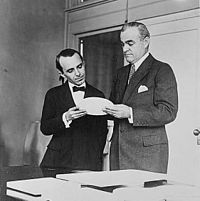
Anthony de Francisci
(left) and
Mint Director
Raymond T. Baker
(right) inspecting
a plaster model of the new silver dollar
The Treasury announced the new design on December 19, 1921. Photographs of
Baker and de Francisci examining the final plaster model appeared in newspapers,
along with written descriptions of the designs, since the Treasury at that time
took the position that it was illegal for photographs of a United States coin to
be printed in a newspaper. Secretary Mellon gave formal approval to the design
on December 20. As it would take the Mint several days to produce working dies,
the first strike of the new coins was scheduled for December 29.
The new design was widely reported in newspapers, and was the source of
intense public attention. A Mint
press release
described the reverse as “a large
figure of an eagle perched on a broken sword, and clutching an olive branch
bearing the word, ‘peace‘“. On December
21, the
New York Herald
ran a scathing editorial
against the new design,
If the artist had sheathed the blade or blunted it there could be no
objection. Sheathing is symbolic of peace, of course; the blunted sword
implies mercy. But a broken sword carries with it only unpleasant
associations.
A sword is broken when its owner has disgraced himself. It is broken when
a battle is lost and breaking is the alternative to surrendering. A sword is
broken when the man who wears it can no longer render allegiance to his
sovereign. But America has not broken its sword. It has not been cashiered
or beaten; it has not lost allegiance to itself. The blade is bright and
keen and wholly dependable. It is regrettable that the artist should have
made such an error in symbolism. The sword is emblematic of Justice as well
as of Strength. Let not the world be deceived by this new dollar. The
American effort to limit armament and to prevent war or at least reduce its
horror does not mean that our sword is broken.
At the time, according to Burdette, given the traumas of the Great War,
Americans were highly sensitive about their national symbols, and unwilling to
allow artists any leeway in interpretation. The Mint, the Treasury, and the Fine
Arts Commission began to receive large numbers of letters from the public
objecting to the design. De Francisci attempted to defend his design, stating,
“with the sword there is the olive branch of peace and the combination of the
two renders it impossible to conceive of the sword as a symbolization of
defeat”. Baker had left Washington to visit the
San Francisco Mint
, a transcontinental journey
of three days. Acting Mint Director
Mary Margaret O’Reilly
sent him a telegram on
December 23, urgently seeking his approval to remove the sword from the reverse,
as had been recommended by Moore and Fraser at a meeting the previous afternoon.
Due to the tight timeline for 1921 strikings of the dollar, it was not possible
to await Baker’s response, so on the authority of Treasury Undersecretary
Seymour Parker Gilbert
, who was approached by
O’Reilly, the Mint proceeded with the redesign. To satisfy Harding’s executive
order, the Fine Arts Commission quickly approved the change, and by the time
Baker wired his approval on December 24, without being able to see the
revisions, Gilbert had already approved the revised design in Secretary Mellon’s
absence. A press release was issued late on December 24, stating that the broken
sword which had appeared on de Francisci’s alternate reverse would not appear on
the issued coin. In its December 25 edition, the Herald took full credit
for the deletion of the broken sword from the coin’s design.
Farran Zerbe, whose paper to the ANA convention helped launch the dollar
proposal, saw de Francisci’s defense and the press release, and suggested that
the sculptor had mistakenly thought his alternate design had been approved.
Production
Initial release
The removal of the sword from the coinage hub, which had already been
produced by reduction from the plaster models, was accomplished by painstaking
work by Mint Chief Engraver Morgan, using extremely fine engraving tools under
magnification. Morgan did the work on December 23 in the presence of de
Francisci, who had been summoned to the
Philadelphia Mint
to ensure the work met with
his approval. It was insufficient merely to remove the sword, as the rest of the
design had to be adjusted. Morgan had to hide the excision; he did so by
extending the olive branch, previously half-hidden by the sword, but had to
remove a small length of stem that showed to the left of the eagle’s talons.
Morgan also strengthened the rays, and sharpened the appearance of the eagle’s
leg. The chief engraver did his work with such skill that the work on the dollar
was not known for over 85 years.
On December 28, Philadelphia Mint Superintendent Freas Styer wired Baker in
San Francisco, reporting the first striking of the Peace dollar. The Mint later
reported that 1,006,473 pieces were struck in 1921, a rate of output for the
four days remaining in the year that Burdette calls “amazing”; he speculates
that minting of 1921 Peace dollars continued into 1922. The first coin struck
was to be sent to President Harding, but what became of it is something of a
mystery: O’Reilly indicated that she had the coin sent to Harding, but the
inventory of Harding’s estate, prepared after the President died in office less
than two years later, does not mention it, nor is there any mention of the coin
in Harding’s papers. Breen, in his earlier book on U.S. coins, stated that the
coin was delivered to Harding by messenger on January 3, 1922, but does not
state the source of his information. A few
proofs
of the 1921 production were struck early
in the run, in both satin and matte finishes, but it is unknown exactly how many
with either finish were created; numismatic historians Leroy Van Allen and A.
George Mallis estimate the mintage totals at 24 of the former and five of the
latter.
The Peace dollar was released into circulation on January 3, 1922. In common
with all silver and copper-nickel dollar coins struck from 1840 to 1978, the
Peace dollar had a diameter of 1.5 inches (38 mm), which was larger than the
Mint’s subsequently struck modern dollar coins.Its issuance completed the
redesign of United States coinage that had begun with issues in 1907. Long lines
formed at the Sub-Treasury Building in New York the following day when
that city’s Federal Reserve Bank
received a
shipment; the 75,000 coins initially sent by the Mint were “practically
exhausted” by the end of the day. Rumors that the coins did not stack well were
contradicted by bank cashiers, who demonstrated for
The New York Times
that the coins stacked
about as well as the Morgan dollars. De Francisci had paid Morgan for fifty of
the new dollars; on January 3, Morgan sent him the pieces. According to his
wife, de Francisci had bet several people that he would lose the design
competition; he used the pieces to pay off the bets and did not keep any.
According to one Philadelphia newspaper,
Liberty is getting younger. Take it from the new ‘Peace Dollar,’ put in
circulation yesterday, the young woman who has been adorning silver currency
for many years, never looked better than in the ‘cart wheel’ that the
Philadelphia Mint has just started to turn out. The young lady, moreover,
has lost her Greek profile. Helenic beauty seems to have been superseded by
the newer ‘flapper’ type.
Modification and
production
From the start, the Mint found that excessive pressure had to be applied to
fully bring out the design of the coin, and the dies broke rapidly. On January
10, 1922, O’Reilly, still serving as Acting Mint Director in Baker’s absence,
ordered production halted. Dies had been sent to
the Denver
and
San Francisco mints
in anticipation of
beginning coinage there; they were ordered not to begin work until the
difficulties had been resolved. The Commission of Fine Arts was asked to advise
what changes might solve the problems. Both Fraser and de Francisci were called
to Philadelphia, and after repeated attempts to solve the problem without
reducing the relief failed, de Francisci agreed to modify his design to reduce
the relief. The plaster models he prepared were reduced to coin size using the
Mint’s Janvier reducing lathe
. However, even after
fifteen years of possessing the
pantograph
-like device, the Mint had no expert
in its use on its staff, and, according to Burdette, “[h]ad a technician from
Tiffany’s or Medallic Art [Company] been called in, the 1922 low relief coins
might have turned out noticeably better than they did”.
Approximately 32,400 coins on which Morgan had tried to keep a higher relief
were struck in January 1922. While all were believed to have been melted, one
circulated example has surfaced. The new low-relief coins, which Fraser accepted
on behalf of the Commission, though under protest, were given limited production
runs in Philadelphia in early February. When the results proved satisfactory,
San Francisco began striking its first Peace dollars using the low-relief design
on February 13, with Denver initiating production on February 21, and
Philadelphia on February 23. The three mints together struck over 84 million
pieces in 1922.
The 1926 Peace dollar, from all mints, has on the obverse the word “God”,
slightly boldened. The Peace dollar’s lettering tended to strike indistinctly,
and Burdette suggests that the new chief engraver,
John R. Sinnock
(who succeeded Morgan after his
1925 death), may have begun work in the middle of the motto “In God We Trust”,
and for reasons unknown, only the one word was boldened. No Mint records discuss
the matter, which was not discovered until 1999.
The Peace dollar circulated mainly in the Western United States, where coins
were preferred over paper money, and saw little circulation elsewhere. Aside
from this use, the coins were retained in vaults as part of bank reserves. They
would commonly be obtained from banks as Christmas presents, with most deposited
again in January. With the last of the Pittman Act silver struck into coins in
1928, the Mint ceased production of Peace dollars.
Production resumed in 1934, due to another congressional act; this one
requiring the Mint to purchase large quantities of domestic silver, a commodity
whose price was at a historic low. This Act assured producers of a ready market
for their product, with the Mint gaining a large profit in
seigniorage
, through monetizing cheaply
purchased silver—the Mint in fact paid for some shipments of silver
bullion
in silver dollars. Pursuant to this
authorization, over seven million silver Peace dollars were struck in 1934 and
1935. Mint officials gave consideration to striking 1936 silver dollars, and in
fact prepared working dies, but as there was no commercial demand for them, none
were actually struck. With Mint Chief Engraver Sinnock thinking it unlikely that
there would be future demand for the denomination, the master dies were ordered
destroyed in January 1937.
|