|
Germany. Weimar Republic
1000th Anniversary of Nordhausen
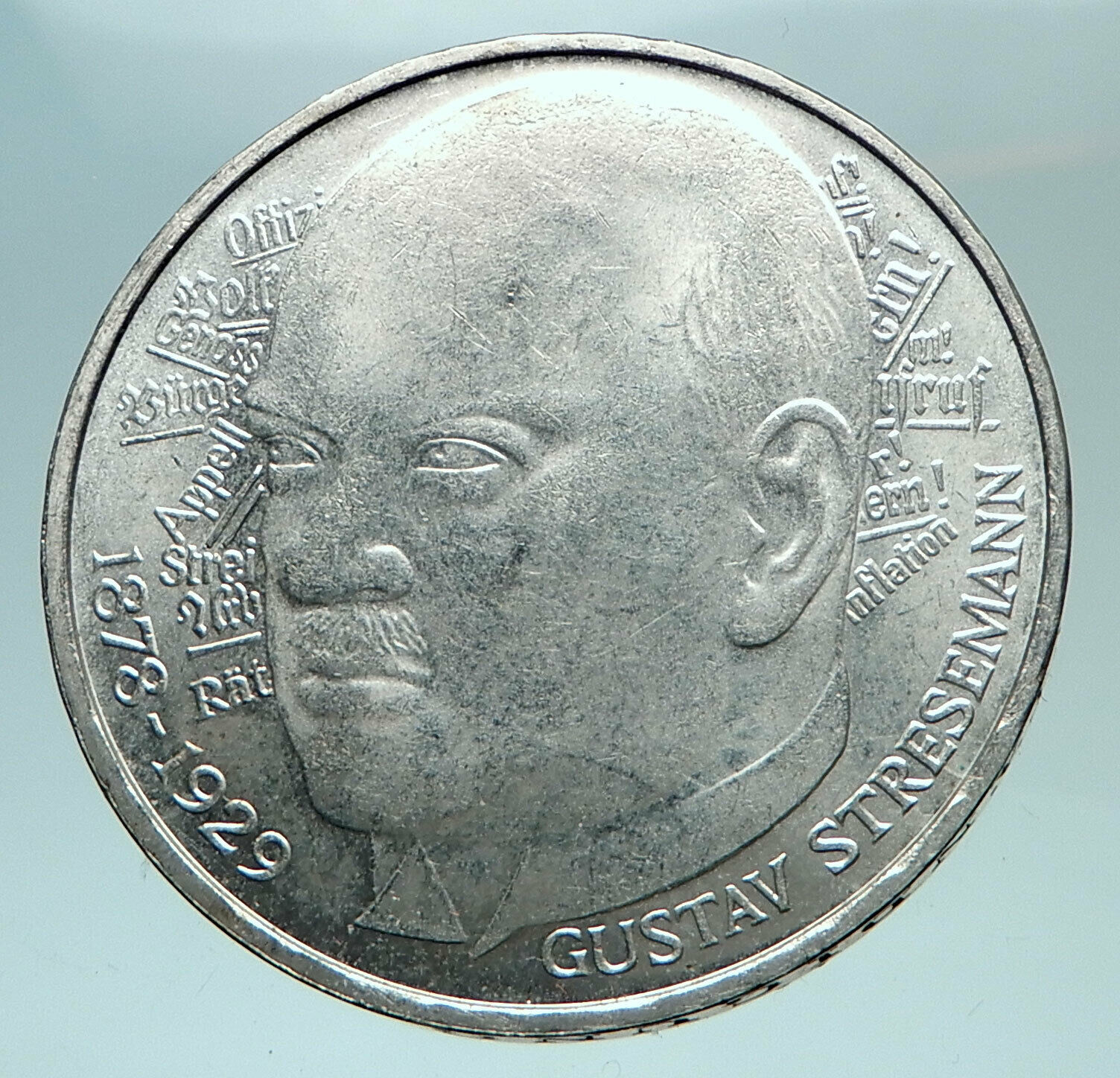
1927 A Silver 3 Mark 30mm (15.00 grams) 0.500 Silver (0.2411 oz. ASW)
Reference: KM# 52, J# 327 | Mintage: 100,000
·JAHRTAUSENDFEIER·DER·REICHSSTADT·NORDHAUSEN·
927 19 27, Heinrich I and Mathilde.
·DEUTSCHES REICH·3 REICHSMARK.
. Nordhausen itself is first mentioned in a 13 May 927 document of King Henry the Fowler.
You are bidding on the exact item pictured, provided with a Certificate of Authenticity and Lifetime Guarantee of Authenticity.
Nordhausen (is a city in Thuringia, Germany. It is the capital of the Nordhausen district and the urban centre of northern Thuringia and the southern Harz region; its population is 42,000. Nordhausen is located approximately 60 km (37 miles) north of Erfurt, 80 km (50 miles) west of Halle, 85 km (53 miles) south of Braunschweig and 60 km (37 miles) east of Göttingen.
Nordhausen was first mentioned in records in the year 927 and became one of the most important cities in central Germany during the later Middle Ages. The city is situated on the Zorge river, a tributary of the Helme within the fertile region of Goldene Aue (golden floodplain) at the southern edge of the Harz mountains. In the early 13th century, it became a free imperial city, so that it was an independent and republican self-ruled member of the Holy Roman Empire. Due to its long-distance trade, Nordhausen was prosperous and influential, with a population of 8,000 around 1500. It was the third-largest city in Thuringia after Erfurt, today’s capital, and Mühlhausen, the other free imperial city in the land.
Nordhausen was once known for its tobacco industry and is still known for its distilled spirit, Nordhäuser Doppelkorn. Industrialization accompanied railway construction that linked the cities to major markets in the mid-19th century. In the late 19th century, narrow-gauge railways were constructed in this region through the Harz mountains. In December 1898 the Nordhausen-Wernigerode Railway Company (Nordhausen-Wernigeroder Eisenbahn-Gesellschaft) or NWE added a line, with the full network operating by 1899. The Harz Narrow Gauge Railways are maintained today by local authorities and frequented primarily by tourists.
In the early 20th century, this became a centre of the engineering and arms industries. During World War II, the Nazi German government established and operated the nearby KZ Mittelbau-Dora concentration camp, where 60,000 forced labourers had to work in the arms industry. They were prisoners of war and persons from occupied territories. Some 20,000 persons died because of the bad conditions. In April 1945, most of the city was destroyed by Royal Air Force bombings, resulting in 8,800 casualties (more than 20% of the population). Most of the historic buildings in the city were destroyed; it suffered the most damage during the war of any city in Thuringia. A week later the United States troops occupied the city, followed weeks later by the Soviet Red Army. The city was within the Soviet zone of occupation, and later the territory was known as East Germany. Hundreds of German scientists and their families from Nordhausen were among thousands deported to the Soviet Union after the war to work on advanced rocket and other arms engineering projects.
Nordhausen is the birthplace of the mathematician Oswald Teichmüller, known for his groundbreaking work on the Teichmüller spaces �” which were named after him. It is the site of the Nordhausen University of Applied Sciences (Fachhochschule Nordhausen), founded in 1997 after the reunification of Germany. The university has 2,500 students.
Henry the Fowler (German: Heinrich der Vogler or Heinrich der Finkler; Latin: Henricus Auceps) (c. 876 – 2 July 936) was the Duke of Saxony from 912 and the King of East Francia from 919 until his death in 936. As the first non-Frankish king of East Francia, he established the Ottonian dynasty of kings and emperors, and he is generally considered to be the founder of the medieval German state, known until then as East Francia. An avid hunter, he obtained the epithet “the Fowler” because he was allegedly fixing his birding nets when messengers arrived to inform him that he was to be king.
He was born into the Liudolfing line of Saxon dukes. His father Otto I of Saxony died in 912 and was succeeded by Henry. The new duke launched a rebellion against the king of East Francia, Conrad I of Germany, over the rights to lands in the Duchy of Thuringia. They reconciled in 915 and on his deathbed in 918, Conrad recommended Henry as the next king, considering the duke the only one who could hold the kingdom together in the face of internal revolts and external Magyar raids.
Henry was elected and crowned king in 919. He went on to defeat the rebellious dukes of Bavaria and Swabia, consolidating his rule. Through successful warfare and a dynastic marriage, Henry acquired Lotharingia as a vassal in 925. Unlike his Carolingian predecessors, Henry did not seek to create a centralized monarchy, ruling through federated autonomous stem duchies instead. Henry built an extensive system of fortifications and mobile heavy cavalry across Germany to neutralize the Magyar threat and in 933 routed them at the Battle of Riade, ending Magyar attacks for the next 21 years and giving rise to a sense of German nationhood. Henry greatly expanded German hegemony in Europe with his defeat of the Slavs in 929 at the Battle of Lenzen along the Elbe river, by compelling the submission of Duke Wenceslaus I of Bohemia through an invasion of the Duchy of Bohemia the same year and by conquering Danish realms in Schleswig in 934. Henry’s hegemonic status north of the Alps was acknowledged by the kings Rudolph of West Francia and Rudolph II of Upper Burgundy, who both accepted a place of subordination as allies in 935. Henry planned an expedition to Rome to be crowned emperor by the pope, but the design was thwarted by his death. Henry prevented a collapse of royal power, as had happened in West Francia, and left a much stronger kingdom to his successor Otto I. He was buried at Quedlinburg Abbey, established by his wife Matilda in his honour.
Germany, officially the Federal Republic of  Germany is a federal parliamentary republic in western-central Europe. It includes 16 constituent states and covers an area of 357,021 square kilometres (137,847 sq mi) with a largely temperate seasonal climate. Its capital and largest city is Berlin. With 81 million inhabitants, Germany is the most populous member state in the European Union. After the United States, it is the second most popular migration destination in the world.
Various Germanic tribes have occupied northern Germany since classical antiquity. A region named Germania was documented before 100 CE. During the Migration Period the Germanic tribes expanded southward. Beginning in the 10th century, German territories formed a central part of the Holy Roman Empire. During the 16th century, northern German regions became the centre of the Protestant Reformation.
The rise of Pan-Germanism inside the German Confederation resulted in the unification of most of the German states in 1871 into the Prussian-dominated German Empire. After World War I and the German Revolution of 1918-1919, the Empire was replaced by the parliamentary Weimar Republic. The establishment of the Third Reich in 1933 led to World War II and the Holocaust. After 1945, Germany split into two states, East Germany and West Germany. In 1990, the country was reunified.
 In the 21st century, Germany is a great power and has the world’s fourth-largest economy by nominal GDP, as well as the fifth-largest by PPP. As a global leader in several industrial and technological sectors, it is both the world’s third-largest exporter and importer of goods. Germany is a developed country with a very high standard of living sustained by a skilled and productive society. It upholds a social security and universal health care system, environmental protection and a tuition free university education.
Germany was a founding member of the European Union in 1993. It is part of the Schengen Area, and became a co-founder of the Eurozone in 1999. Germany is a member of the United Nations, NATO, the G8, the G20, and the OECD. The national military expenditure is the 9th highest in the world. Known for its rich cultural history, Germany has been continuously the home of influential artists, philosophers, musicians, sportsmen, entrepreneurs, scientists and inventors.
|