|
Bahrain – FAO – Development of Fishing Commemorative issue
1969 Copper-nickel 250 Fils 32mm (15.0 grams)
Reference: KM# 7; Y# 9
1969-1389 GOVERNMENT OF BAHRAIN, A traditional sail boat moored behind a palm tree. State name and dates in Arabic and English around.
FAO logo (grain sprig). Denomination in Arabic and English below; Translation: Let’s work on providing food for all FAO Let there be bread 250 Fils
You are bidding on the exact item pictured, provided with a Certificate of Authenticity and Lifetime Guarantee of Authenticity.
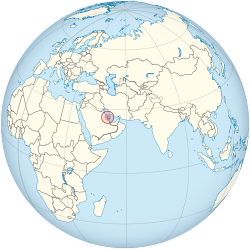
 Bahrain, officially the Kingdom of Bahrain, is an island country in the Persian Gulf. The sovereign state comprises a small archipelago centered around Bahrain Island, situated between the Qatar peninsula and the north eastern coast of Saudi Arabia, to which it is connected by the 25-kilometre (16 mi) King Fahd Causeway. Bahrain’s population is 1,234,571 (c. 2010), including 666,172 non-nationals. It is 765.3 square kilometres (295.5 sq mi) in size, making it the third-smallest nation in Asia after the Maldives and Singapore.
 Bahrain is the site of the ancient Dilmun civilisation. It has been famed since antiquity for its pearl fisheries, which were considered the best in the world into the 19th century. Bahrain was one of the earliest areas to convert to Islam, in 628 CE. Following a period of Arab rule, Bahrain was occupied by the Portuguese in 1521, who in turn were expelled in 1602 by Shah Abbas I of the Safavid dynasty under the Persian Empire. In 1783, the Bani Utbah clan captured Bahrain from Nasr Al-Madhkur and it has since been ruled by the Al Khalifa royal family, with Ahmed al Fateh as Bahrain’s first hakim.
 In the late 1800s, following successive treaties with the British, Bahrain became a protectorate of the United Kingdom. In 1971, Bahrain declared independence. Formerly an emirate, the Arab constitutional monarchy of Bahrain was declared a kingdom in 2002. In 2011, the country experienced protests inspired by the regional Arab Spring. Bahrain’s ruling al-Khalifa royal family has been accused and criticized for human rights abuses, including imprisonment, torture and execution of dissidents, political opposition figures and its Shia Muslim population.
Bahrain had the first post-oil economy in the Persian Gulf. Since the late 20th century, Bahrain has invested in the banking and tourism sectors. Many large financial institutions have a presence in Manama, the country’s capital. It has a high Human Development Index and is recognised by the World Bank as a high-income economy. Bahrain is a member of the United Nations, Non-Aligned Movement, Arab League, Organisation of Islamic Cooperation and the Gulf Cooperation Council.
In the early 19th century, Bahrain was invaded by both the Omanis and the Al Sauds. In 1802 it was governed by a 12-year-old child, when the Omani ruler Sayyid Sultan installed his son, Salim, as governor in the Arad Fort. In 1816, the British political resident in the Gulf, William Bruce, received a letter from the Sheikh of Bahrain who was concerned about a rumour that Britain would support an attack on the island by the Imam of Muscat. He sailed to Bahrain to reassure the Sheikh that this was not the case and drew up an informal agreement assuring the Sheikh that Britain would remain a neutral party.
In 1820, the Al Khalifa tribe were recognised by Great Britain as the rulers (“Al-Hakim” in Arabic) of Bahrain after signing a treaty relationship. However, ten years later they were forced to pay yearly tributes to Egypt despite seeking Persian and British protection.
In 1860, the Al Khalifas used the same tactic when the British tried to overpower Bahrain. Writing letters to the Persians and Ottomans, Al Khalifas agreed to place Bahrain under the latter’s protection in March due to offering better conditions. Eventually the Government of British India overpowered Bahrain when the Persians refused to protect it. Colonel Pelly signed a new treaty with Al Khalifas placing Bahrain under British rule and protection.
Following the Qatari-Bahraini War in 1868, British representatives signed another agreement with the Al Khalifas. It specified that the ruler could not dispose of any of his territory except to the United Kingdom and could not enter into relationships with any foreign government without British consent. In return the British promised to protect Bahrain from all aggression by sea and to lend support in case of land attack. More importantly the British promised to support the rule of the Al Khalifa in Bahrain, securing its unstable position as rulers of the country. Other agreements in 1880 and 1892 sealed the protectorate status of Bahrain to the British.
Unrest amongst the people of Bahrain began when Britain officially established complete dominance over the territory in 1892. The first revolt and widespread uprising took place in March 1895 against Sheikh Issa bin Ali, then ruler of Bahrain. Sheikh Issa was the first of the Al Khalifa to rule without Persian relations. Sir Arnold Wilson, Britain’s representative in the Persian Gulf and author of The Persian Gulf, arrived in Bahrain from Muscat at this time. The uprising developed further with some protesters killed by British forces.
Before the development of petroleum, the island was largely devoted to pearl fisheries and, as late as the 19th century, was considered to be the finest in the world. In 1903, German explorer, Hermann Burchardt, visited Bahrain and took many photographs of historical sites, including the old Qaṣr es-Sheikh, photos now stored at the Ethnological Museum of Berlin. Prior to the First World War, there were about 400 vessels hunting pearls and an annual export of more than £30,000.
In 1911, a group of Bahraini merchants demanded restrictions on the British influence in the country. The group’s leaders were subsequently arrested and exiled to India. In 1923, the British introduced administrative reforms and replaced Sheikh Issa bin Ali with his son. Some clerical opponents and families such as al Dossari left or were exiled to Saudi Arabia and Iran. Three years later the British placed the country under the de facto rule of Charles Belgrave who operated as an adviser to the ruler until 1957. Belgrave brought a number of reforms such as establishment of the country’s first modern school in 1919, the Persian Gulf’s first girls’ school in 1928 and the abolition of slavery in 1937. At the same time, the pearl diving industry developed at a rapid pace.
|


