|
Greece
Kings of Greece: Constantine II
1970 Copper-Nickel Drachma 21mm (4.01 grams)
Reference: KM# 89, Schön# 32 | Engraver: V. Phalireas
ΚωΝCΤaΝΤῙΝΟC ΒaCΙλΕῪC ΤῶΝ ἙλλῊΝωΝ Β. ΦaλΗΡΕaC ··, The portrait of young Constantine II left.
ΒaCΊλΕΙΟΝ ΤἮC Ἑλλ’aΔΟC • 1 ΔΡaΧΜῊ•, Crowned arms (shield with cross) with the defenders of the Crown.
You are bidding on the exact item pictured, provided with a Certificate of Authenticity and Lifetime Guarantee of Authenticity.
 Constantine II (Greek: Κωνσταντίνος Βʹ, Konstantínos II, born 2 June 1940) reigned as the last King of Greece, from 6 March 1964 until the abolition of the monarchy on 1 June 1973.
Constantine is the only son of King Paul and Queen Frederica of Greece. As his family was forced into exile during the Second World War, he spent the first years of his childhood in Egypt and South Africa. He returned to Greece with his family in 1946 during the Greek Civil War. King George II died in 1947, and Constantine’s father became the new king, making Constantine the crown prince.
He acceded as king in 1964 following the death of his father, King Paul. Later that year he married Princess Anne-Marie of Denmark with whom he eventually had five children. Although the accession of the young monarch was initially regarded auspiciously, his reign saw political instability that culminated in the Colonels’ Coup of 21 April 1967. The coup left Constantine, as the head of state, little room to manoeuvre since he had no loyal military forces on which to rely. As a result, he reluctantly agreed to inaugurate the junta on the condition that it be made up largely of civilian ministers. On 13 December 1967, Constantine was forced to flee the country, following an unsuccessful countercoup against the junta. He remained (formally) the head of state in exile until the junta abolished the monarchy on 1 June 1973. The 1973 Greek republic referendum on 29 July, ratified the abolition. There were questions concerning the validity of this referendum and whether people were pressured to vote for a republic. Therefore a fresh referendum was held after the restoration of democracy in 1974. This second referendum was held after the fall of the junta as the 1974 Greek republic referendum on 8 December 1974 and confirmed the abolition of the monarchy and the establishment of the Third Hellenic Republic. Constantine, who was not allowed to return to Greece to campaign, accepted the results of the plebiscite.
Constantine is also a former competitive sailor and Olympian, winning a gold medal in the 1960 Rome Olympics in the Dragon class, and later serving on the International Olympic Committee. Along with his fellow crew members of the Nireus sailing vessel, he was named one of the 1960 Greek Athletes of the Year.
 Greece (Greek: Ελλάδα), officially the Hellenic Republic (Greek: Ελληνική Δημοκρατία), historically also known as Hellas, is a country in Southern Europe, with a population of approximately 11 million as of 2016. Athens is the nation’s capital and largest city, followed by Thessaloniki.
Greece is located at the crossroads of Europe, Asia, and Africa. Situated on the southern tip of the Balkan peninsula, it shares land borders with Albania to the northwest, the Republic of Macedonia and Bulgaria to the north, and Turkey to the northeast. The Aegean Sea lies to the east of the mainland, the Ionian Sea to the west, the Cretan Sea and the Mediterranean Sea to the south. Greece has the longest coastline on the Mediterranean Basin and the 11th longest coastline in the world at 13,676 km (8,498 mi) in length, featuring a large number of islands, of which 227 are inhabited. Eighty percent of Greece is mountainous, with Mount Olympus being the highest peak at 2,918 metres (9,573 ft). The country consists of nine geographic regions: Macedonia, Central Greece, the Peloponnese, Thessaly, Epirus, the Aegean Islands (including the Dodecanese and Cyclades), Thrace, Crete, and the Ionian Islands.
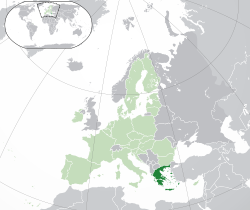 Greece is considered the cradle of Western civilization,[a] being the birthplace of democracy, Western philosophy, the Olympic Games, Western literature, historiography, political science, major scientific and mathematical principles, and Western drama.[12] From the eighth century BC, the Greeks were organised into various independent city-states, known as polis, which spanned the entire Mediterranean region and the Black Sea. Philip of Macedon united most of the Greek mainland in the fourth century BC, with his son Alexander the Great rapidly conquering much of the ancient world, spreading Greek culture and science from the eastern Mediterranean to the Indus River. Greece was annexed by Rome in the second century BC, becoming an integral part of the Roman Empire and its successor, the Byzantine Empire, wherein the Greek language and culture were dominant. The Greek Orthodox Church also shaped modern Greek identity and transmitted Greek traditions to the wider Orthodox World. Falling under Ottoman dominion in the mid-15th century, the modern nation state of Greece emerged in 1830 following a war of independence. Greece’s rich historical legacy is reflected by its 18 UNESCO World Heritage Sites, among the most in Europe and the world.
Greece is a democratic and developed country with an advanced high-income economy, a high quality of life, and a very high standard of living. A founding member of the United Nations, Greece was the tenth member to join the European Communities (precursor to the European Union) and has been part of the Eurozone since 2001. It is also a member of numerous other international institutions, including the Council of Europe, the North Atlantic Treaty Organization (NATO), the Organisation for Economic Co-operation and Development (OECD), the World Trade Organization (WTO), the Organization for Security and Co-operation in Europe (OSCE), and the Organisation internationale de la Francophonie (OIF). Greece’s unique cultural heritage, large tourism industry, prominent shipping sector and geostrategic importance[b] classify it as a middle power. It is the largest economy in the Balkans, where it is an important regional investor.
|


