|
Switzerland – Swiss Canton of Valais: Zermatt
1971 Proof Silver Thaler 37mm (28.03 grams) .835 Silver
Reference: XM# 14 | Engravers: Huguenin Freres, Neuchatel
1 SILBERTALER 1971, Swiss arms (cross) surrounded by 22 shields
ZERMATT, Zermatt city view, Coat-of-arms below.
You are bidding on the exact item pictured, provided with a Certificate of Authenticity and Lifetime Guarantee of Authenticity.
 Zermatt is a municipality in the district of Visp in the German-speaking section of the canton of Valais in Switzerland. It has a year-round population of about 5,800 and is classified as a town by the Swiss Federal Statistical Office (FSO).
It lies at the upper end of Mattertal at an elevation of 1,620 m (5,310 ft), at the foot of Switzerland’s highest peaks. It lies about 10 km (6.2 mi) from the over 3,292 m (10,801 ft) high Theodul Pass bordering Italy.
Zermatt is famed as a mountaineering and ski resort of the Swiss Alps. Until the mid-19th century, it was predominantly an agricultural community; the first and tragic ascent of the Matterhorn in 1865 was followed by a rush on the mountains surrounding the village, leading to the construction of many tourist facilities. The year-round population (as of December 2020) is 5,820, though there may be several times as many tourists in Zermatt at any one time. Much of the local economy is based on tourism, with about half of the jobs in town in hotels or restaurants and just under half of all apartments are vacation apartments. Just over one-third of the permanent population was born in the town, while another third moved to Zermatt from outside Switzerland.
 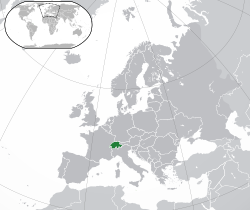 Switzerland, officially the Swiss Confederation (Latin: Confoederatio Helvetica, hence its abbreviation CH), is a federal parliamentary republic consisting of 26 cantons, with Bern as the seat of the federal authorities, the so-called Bundesstadt (“federal city”). The country is situated in Western and Central Europe, where it is bordered by Italy to the south, France to the west, Germany to the north, and Austria and Liechtenstein to the east. Switzerland is a landlocked country geographically divided between the Alps, the Swiss Plateau and the Jura, spanning an area of 41,285 km2 (15,940 sq mi). While the Alps occupy the greater part of the territory, the Swiss population of approximately 8 million people is concentrated mostly on the Plateau, where the largest cities are to be found. Among them are the two global cities and economic centres of Zürich and Geneva.
The establishment of the Swiss Confederation is traditionally dated to 1 August 1291, which is celebrated annually as Swiss National Day. It has a long history of armed neutrality-it has not been in a state of war internationally since 1815-and did not join the United Nations until 2002. It pursues, however, an active foreign policy and is frequently involved in peace-building processes around the world. Switzerland is also the birthplace of the Red Cross and home to numerous international organizations, including the second largest UN office. On the European level, it is a founding member of the European Free Trade Association and is part of the Schengen Area – although it is notably not a member of the European Union, nor the European Economic Area. Switzerland comprises four main linguistic and cultural regions: German, French, Italian and the Romansh-speaking valleys. Therefore, the Swiss, although predominantly German-speaking, do not form a nation in the sense of a common ethnic or linguistic identity; rather, the strong sense of identity and community is founded on a common historical background, shared values such as federalism and direct democracy, and Alpine symbolism.
Switzerland has the highest nominal wealth per adult (financial and non-financial assets) in the world according to Credit Suisse and eighth-highest per capita gross domestic product on the IMF list. However, Switzerland is also the most expensive country in the world to live in, as measured by the price level index.
Swiss citizens have the second-highest life expectancy in the world on the UN DESA list. Switzerland is tied with the Netherlands for the top rank on the Bribe Payers Index indicating very low levels of business corruption. Moreover, for the last five years the country has been ranked first in economic and tourist competitiveness according to the Global Competitiveness Report and the Travel and Tourism Competitiveness Report respectively, both developed by the World Economic Forum. Zürich and Geneva have each been ranked among the top cities with the highest quality of life in the world, with the former coming second globally according to Mercer. However, Mercer also rates those two cities as the fifth- and sixth- most expensive cities in the world to live in.
|


