|
Belize – Keel-billed toucan Commemorative
1974 FM Proof Silver 5 Dollars 37.8mm (26.40 grams) 0.925 Silver (0.7851 oz. ASW)
Reference: KM# 44a; N#21400 | Mintage: 31,000
BELIZE SUB UMBRA FLOREO 1974 FM, Coat of arms of Belize within wreath. Beaded circle around the rim.
FIVE DOLLARS, Keel-billed toucan (Ramphastos sulfuratus) on tree branch facing right. Beaded circle around the rim.
EDGE LETTERING: STERLING SILVER PROOF
Issued by Franklin Mint (The Franklin Mint), Wawa, Pennsylvania, United States (1964-2003)
You are bidding on the exact item pictured, provided with a Certificate of Authenticity and Lifetime Guarantee of Authenticity.
 The keel-billed toucan (Ramphastos sulfuratus), also known as rainbow-billed toucan or sulphur-breasted toucan, is a species of toucan native to southern Mexico, Central America and the far northwest of South America, and is found in tropical forests. It is the national bird of Belize. It is an omnivorous forest bird that feeds on fruit, seeds, insects, invertebrates, lizards, snakes, and small birds and their eggs.
Including its bill, the length of the keel-billed toucan ranges from around 42 to 55 cm (17 to 22 in), while its wing length typically ranges from 189.4 to 208.4 mm (7.46 to 8.20 in). The bird typically weighs about 380–500 g (13–18 oz).
The large and brightly coloured bill averages around 12–15 cm (4.7–5.9 in), about one third of the bird’s total length. The bill is mainly green with a red tip and orange sides. While the bill seems large and cumbersome, it is in fact a spongy, hollow bone covered in keratin, a very light and hard protein. It has been suggested that the bill colour may also help regulate body temperature, using the many blood vessels running through it.
The plumage of the keel-billed toucan is mainly black, with a yellow neck and chest, red under-tail coverts, and a narrow red band at the base of the yellow on the chest. Moulting occurs once per year. It has blue feet and red feathers at the tip of its tail.
As with almost all birds in the order Piciformes, keel-billed toucans have zygodactyl feet, with toes 2 and 3 facing forwards, and toes 1 and 4 facing backwards, so two toes face forward and two face back. Because toucans spend a large portion of time in the trees, this may help the birds to stay on the branches of the trees and jump from one branch to another.[citation needed]
Other than size, males and females of the species look similar.
 Belize is a country located on the eastern coast of Central America. Belize is bordered on the northwest by Mexico, on the east by the Caribbean Sea, and on the south and west by Guatemala. It has an area of 22,970 square kilometres (8,867 sq mi) and a population of 387,879 (2017). Its mainland is about 180 mi (290 km) long and 68 mi (110 km) wide. It has the lowest population and population density in Central America. The country’s population growth rate of 1.87% per year (2015) is the second highest in the region and one of the highest in the Western Hemisphere.
 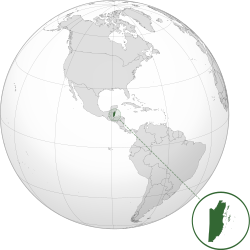 The Mayan civilization spread into the area of Belize between 1500 B.C. and 300 A.D. and flourished until about 1200. European exploration campaigns began in 1502 when Christopher Columbus sailed along the Gulf of Honduras. European settlement was begun by English settlers in 1638. This period was also marked by Spain and Britain both laying claim to the land until Britain defeated the Spanish in the Battle of St. George’s Caye (1798). It became a British colony in 1840, known as British Honduras, and a Crown colony in 1862. Independence was achieved from the United Kingdom on 21 September 1981.
Belize has a very diverse society that is composed of many cultures and languages that reflect its rich history. English is the official language of Belize, while Belizean Creole is an unofficial native language. Over half the population is multilingual, with Spanish being the second most common spoken language. It is known for its September Celebrations, its extensive barrier reef coral reefs and punta music.
Belize’s abundance of terrestrial and marine species and its diversity of ecosystems give it a key place in the globally significant Mesoamerican Biological Corridor. It is considered a Central American and Caribbean nation with strong ties to both the American and Caribbean regions. It is a member of the Caribbean Community (CARICOM), the Community of Latin American and Caribbean States (CELAC), and the Central American Integration System (SICA), the only country to hold full membership in all three regional organisations. Belize is a Commonwealth realm, with Queen Elizabeth II as its monarch and head of state.
|


