|
Papua New Guinea
1975 Proof Copper-Nickel 20 Toea 28.65mm (11.30 grams)
Reference: KM# 5
PAPUA NEW GUINEA FM 1975, Coat-of-Arms of Papua New Guinea: a bird-of-paradise over a traditional spear and a kundu drum.
20t, A Bennett’s Cassowary.
You are bidding on the exact item pictured, provided with a Certificate of Authenticity and Lifetime Guarantee of Authenticity.
 The dwarf cassowary (Casuarius bennetti), also known as Bennett’s cassowary, little cassowary, mountain cassowary or muruk, is the smallest of the three extant species of cassowaries.
The scientific name commemorates the Australian naturalist George Bennett. He was the first scientist to examine these birds after a few were brought to Australia aboard a ship. Recognising them as a new species of cassowary, he sent specimens back to England, where other taxonomists confirmed his perception. On the west side of Cenderawasih Bay, western Papua, there is a distinctive form that may merit a split. C. papuanus is the tentative name. There are no officially recognised subspecies, however, some authors believe there should be.
The Karam or Kalam people of the New Guinea Highlands classify bats and flying birds as one group, yaket, and the dwarf cassowary, a very large, wingless, flightless bird as another, kobtiy. Yaket are bony with wings and fly in the air, while kobtiy are bony without wings and are terrestrial and of the forest. They distinguish kobtiy from other bony, wingless animals because kobtiy are not quadrupedal like dogs and lizards and are not limbless like snakes. (See Kalam languages.)
John Gould first identified the dwarf cassowary from a specimen from New Britain, in 1857.
The dwarf cassowary is a large bird but is smaller than other living cassowaries (the southern cassowary and northern cassowary). It is between 99 and 150 cm (3 ft 3 in and 4 ft 11 in) long and weighs between 17.6 and 26 kg (39 and 57 lb). It is a flightless bird with hard and stiff black plumage, a low triangular casque, pink cheek and red patches of skin on its blue neck. Compared to other cassowaries, the dwarf cassowary is shorter, with a tarsi length of 24.5 cm (9.6 in), with a slightly smaller bill, at 11 to 12.2 cm (4.3 to 4.8 in). The feet are large and powerful, equipped with dagger-like claws on the inner toe. Both sexes are similar. Females have longer casques, brighter bare skin colour and are larger in size.
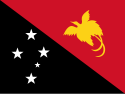 Papua New Guinea, officially the Independent State of Papua New Guinea, is an Oceanian country that occupies the eastern half of the island of New Guinea and its offshore islands in Melanesia, a region of the southwestern Pacific Ocean north of Australia. Its capital, located along its southeastern coast, is Port Moresby. The western half of New Guinea forms the Indonesian provinces of Papua and West Papua.
At the national level, after being ruled by three external powers since 1884, Papua New Guinea established its sovereignty in 1975. This followed nearly 60 years of Australian administration, which started during World War I. It became an independent Commonwealth realm in 1975 with Queen Elizabeth II as its head of state and became a member of the Commonwealth of Nations in its own right.

Papua New Guinea is one of the most culturally diverse countries in the world. It is also one of the most rural, as only 18 per cent of its people live in urban centres.[10] There are 852 known languages in the country, of which 12 now have no known living speakers. Most of the population of more than 8 million people lives in customary communities, which are as diverse as the languages. The country is one of the world’s least explored, culturally and geographically. It is known to have numerous groups of uncontacted peoples, and researchers believe there are many undiscovered species of plants and animals in the interior.
 Papua New Guinea is classified as a developing economy by the International Monetary Fund. Strong growth in Papua New Guinea’s mining and resource sector led to the country becoming the sixth-fastest-growing economy in the world in 2011. Growth was expected to slow once major resource projects came on line in 2015. Mining remains a major economic factor, however. Local and national governments are discussing the potential of resuming mining operations at the Panguna mine in Bougainville Province, which has been closed since the civil war in the 1980s-1990s. Nearly 40 per cent of the population lives a self-sustainable natural lifestyle with no access to global capital.
Most of the people still live in strong traditional social groups based on farming. Their social lives combine traditional religion with modern practices, including primary education. These societies and clans are explicitly acknowledged by the Papua New Guinea Constitution, which expresses the wish for “traditional villages and communities to remain as viable units of Papua New Guinean society” and protects their continuing importance to local and national community life.
|


