|
Trinidad and Tobago
1975 FM Proof Bronze 5 Cents 21.15mm (3.25 grams)
Reference: KM# 26, Schön# 21 (Mintage (Proof): 24,000)
TRINIDAD AND TOBAGO TOGETHER WE ASPIRE TOGETHER WE ACHIEVE FM 1975, Coat-of-arms of the nation.
Greater Bird of Paradise (Paradisaea apoda) introduced from New Guinea, now extinct in Trinidad, 5 CENTS below.
You are bidding on the exact item pictured, provided with a Certificate of Authenticity and Lifetime Guarantee of Authenticity.
 The greater bird-of-paradise (Paradisaea apoda) is a bird-of-paradise in the genus Paradisaea. Carl Linnaeus named the species Paradisaea apoda, or “legless bird-of-paradise”, because early trade skins to reach Europe were prepared without wings or feet by the indigenous New Guinean people; this led to the misconception that these birds were beautiful visitors from paradise that were kept aloft by their plumes and never touched the earth until death.
The greater bird-of-paradise was formally described by the Swedish naturalist Carl Linnaeus in 1758 in the tenth edition of his Systema Naturae under the current binomial name Paradisaea apoda. The genus name is from the Late Latin paradisus meaning “paradise”. The specific epithet apod combines the Ancient Greek a- meaning “lacking” and pous, podus meaning “foot”. Although several subspecies have been described, these are now not recognised and the greater bird-of-paradise is considered to be monotypic.
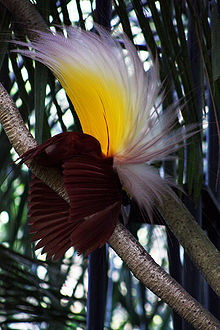 The greater bird-of-paradise is the largest member of the genus Paradisaea, with “the most glamorous display in the bird world”. With males measuring up to 43 cm (17 in) (excluding the long twin tail wires). The female is bigger, at 48 cm (19 in). The plumage of this species is also sexually dimorphic. The male has an iridescent green face and a yellow glossed with silver iridescent crown, head, and nape. The rest of the body plumage is maroon-brown. The flank plumes, used in displays, are yellow at the base, turning white and streaked with maroon. The female has unbarred maroon-brown plumage. In both sexes, the iris is yellow and the bill is blue.
The greater bird-of-paradise is distributed to lowland and hill forests of southwest New Guinea and Aru Islands, Indonesia. The diet consists mainly of fruits, seeds, and small insects. A small population was introduced by Sir William Ingram in 1909-1912 to Little Tobago Island of West Indies in an attempt to save the species from extinction due to overhunting for plume trades. The introduced populations survived until at least 1966,[10] but most likely are extinct now. The bird still appears on Trinidad and Tobago’s $100 bill.
 Tobago, is a twin island sovereign state that is the southernmost nation of the West Indies in the Caribbean. It is situated 130 kilometres (81 miles) south of Grenada off the northern edge of the South American mainland, 11 kilometres (6.8 miles) off the coast of northeastern Venezuela. It shares maritime boundaries with Barbados to the northeast, Grenada to the northwest, Guyana to the southeast, and Venezuela to the south and west.
 The island of Trinidad was a Spanish colony from the arrival of Christopher Columbus in 1498 until Spanish governor Don José María Chacón surrendered the island to a British fleet under the command of Sir Ralph Abercromby in 1797. During the same period, the island of Tobago changed hands among Spanish, British, French, Dutch and Courlander colonizers more times than any other island in the Caribbean. Trinidad and Tobago were ceded to Britain in 1802 under the Treaty of Amiens as separate states and unified in 1889. Trinidad and Tobago obtained independence in 1962 and became a republic in 1976.
 As of 2015, Trinidad and Tobago had the third highest GDP per capita based on purchasing power parity (PPP) in the Americas after the United States and Canada. It is recognised by the World Bank as a high-income economy. Unlike most of the English-speaking Caribbean, the economy is primarily industrial with an emphasis on petroleum and petrochemicals; much of the nation’s wealth is derived from its large reserves of oil and natural gas.
Trinidad and Tobago is known for its Carnival celebration and as the birthplace of steelpan, the limbo, and music styles such as calypso, soca, parang and chutney.
|


