|
Poland – Kazimierz Pulaski Commemorative issue
Hero to Poland and US Revolution
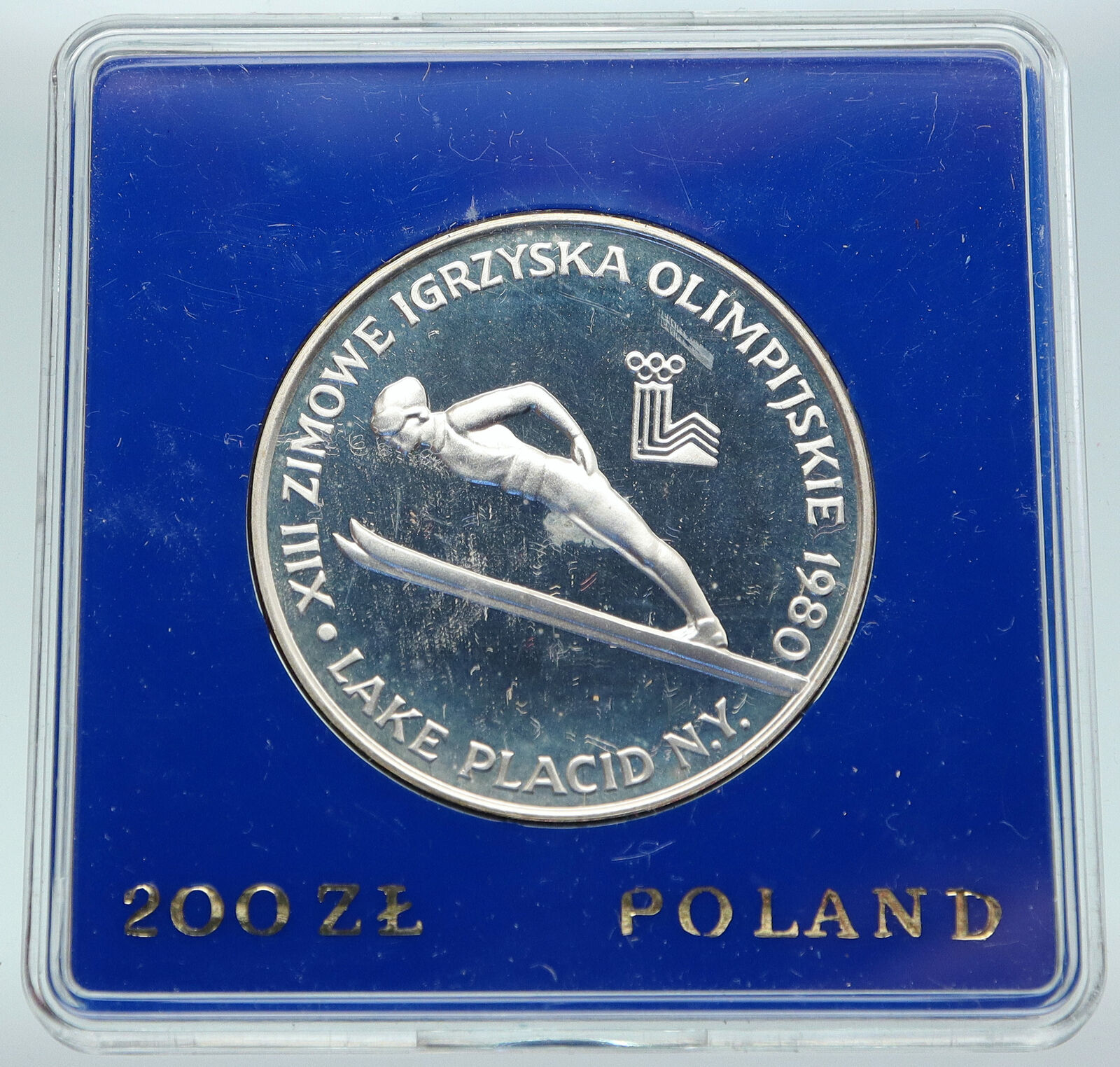
1976 Proof Silver 100 Zlotych 32mm (16.73 grams) 0.625 Silver (0.3316 oz. ASW)
Reference: Y# 84
POLSKA RZECZPOSPOLITA LUDOWA 1976 ZŁ 100 ZŁ around the coat-of-arms eagle of Poland.
KAZIMIERZ PUŁAWSKI 1747-1779, Bust of Kazimierz Pulaski left.,
You are bidding on the exact item pictured, provided with a Certificate of Authenticity and Lifetime Guarantee of Authenticity.
 Kazimierz Michał Władysław Wiktor Pułaski of Ślepowron (English: Casimir Pulaski; March 4 or March 6, 1745 – October 11, 1779) was a Polish noblemanb, soldier and military commander who has been called, together with his Hungarian friend Michael Kovats de Fabriczy, “the father of the American cavalry”.
Born in Warsaw and following in his father’s footsteps, he became interested in politics at an early age and soon became involved in the military and the revolutionary affairs in Poland (the Polish-Lithuanian Commonwealth). Pulaski was one of the leading military commanders for the Bar Confederation and fought against Russian domination of the Commonwealth. When this uprising failed, he was driven into exile. Following a recommendation by Benjamin Franklin, Pulaski immigrated to North America to help in the cause of the American Revolutionary War. He distinguished himself throughout the revolution, most notably when he saved the life of George Washington. Pulaski became a general in the Continental Army, created the Pulaski Cavalry Legion and reformed the American cavalry as a whole. At the Battle of Savannah, while leading a daring charge against British forces, he was gravely wounded, and died shortly thereafter.
Pulaski is remembered as a hero who fought for independence and freedom in both Poland and the United States. Numerous places and events are named in his honor, and he is commemorated by many works of art. Pulaski is one of only eight people to be awarded honorary United States citizenship. He never married and had no descendants. Despite his fame, there have been uncertainties and controversies surrounding both his place and date of birth and burial.

 Poland, officially the Republic of Poland, is a country in Central Europe, bordered by Germany to the west; the Czech Republic and Slovakia to the south; Ukraine and Belarus to the east; and the Baltic Sea, Kaliningrad Oblast (a Russian exclave) and Lithuania to the north. The total area of Poland is 312,679 square kilometres (120,726 sq mi), making it the 69th largest country in the world and the 9th largest in Europe. With a population of over 38.5 million people, Poland is the 34th most populous country in the world, the 8th most populous country in Europe and the sixth most populous member of the European Union, as well as the most populous post-communist member of the European Union. Poland is a unitary state divided into 16 administrative subdivisions.
The establishment of a Polish state can be traced back to 966, when Mieszko I, ruler of a territory roughly coextensive with that of present-day Poland, converted to Christianity. The Kingdom of Poland was founded in 1025, and in 1569 it cemented a longstanding political association with the Grand Duchy of Lithuania by signing the Union of Lublin. This union formed the Polish-Lithuanian Commonwealth, one of the largest and most populous countries of 16th and 17th-century Europe. The Commonwealth ceased to exist in the years 1772-1795, when its territory was partitioned among Prussia, the Russian Empire, and Austria. Poland regained its independence (as the Second Polish Republic) at the end of World War I, in 1918.
In September 1939, World War II started with the invasions of Poland by Nazi Germany and the Soviet Union (as part of the Molotov-Ribbentrop Pact). More than six million Polish citizens died in the war. In 1944, a Soviet-backed Polish Committee of National Liberation was formed which, after a falsified referendum in 1947 took control of the country and Poland became a satellite state of the Soviet Union, as People’s Republic of Poland. During the Revolutions of 1989 Poland’s Communist government was overthrown and Poland adopted a new constitution establishing itself as a democracy.
 Despite the large number of casualties and destruction the country experienced during World War II, Poland managed to preserve much of its cultural wealth. There are 14 heritage sites inscribed on the UNESCO World Heritage and 54 Historical Monuments and many objects of cultural heritage in Poland.
Since the beginning of the transition to a primarily market-based economy that took place in the early 1990s, Poland has achieved a “very high” ranking on the Human Development Index, as well as gradually improving economic freedom. Poland is a democratic country with an advanced high-income economy, a high quality of life and a very high standard of living. Moreover, the country is visited by nearly 16 million tourists every year (2013), which makes it one of the most visited countries in the world. Poland is the sixth largest economy in the European Union and among the fastest rising economic states in the world. The country is the sole member nation of the European Union to have escaped a decline in GDP and in recent years was able to “create probably the most varied GDP growth in its history” according to OANDA, a Canadian-based foreign exchange company. Furthermore, according to the Global Peace Index for 2014, Poland is one of the safest countries in the world to live in.
|