|
France
1994 Winter Olympics – Lillehammer
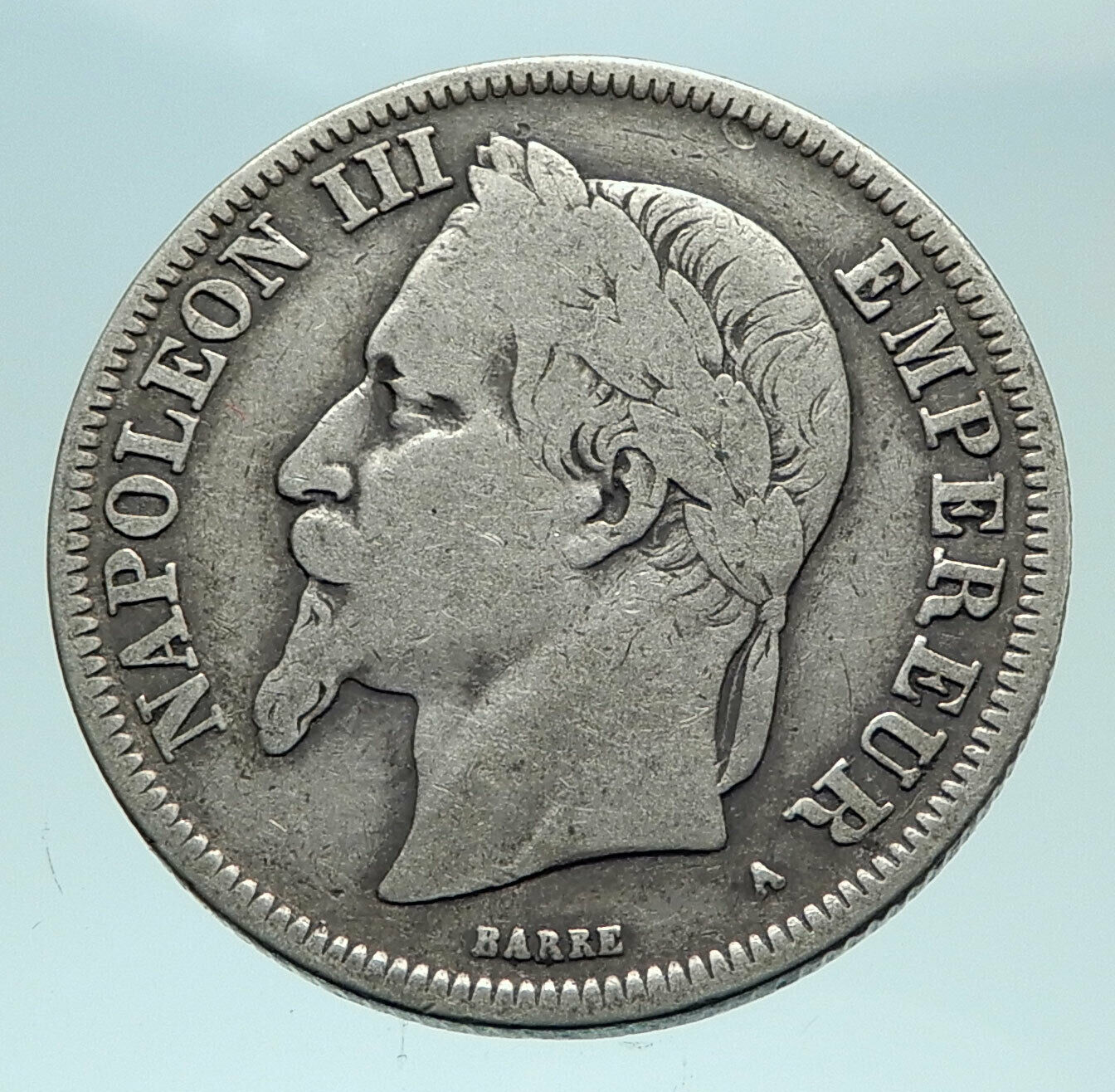
1994 Proof Silver 100 Francs 40mm (33.63 grams) 0.925 Silver (1.001 oz. ASW)
Reference: KM# 1048 | Engraver: Joaquin Jimenez
REPUBLIQUE FRANCAISE 100 FRANCS 1994, Marianne facing.
483 1896-1996 J. JIMENEZ, Javelin thrower aiming and running, Basilica behind.
Edge Lettering:
CITIUS ALTIUS FORTIU
You are bidding on the exact item pictured, provided with a Certificate of Authenticity and Lifetime Guarantee of Authenticity.
 The 1994 Winter Olympics, officially known as the XVII Olympic Winter Games (Norwegian: De 17. olympiske vinterleker; Nynorsk: Dei 17. olympiske vinterleikane) and commonly known as Lillehammer ’94, was an international winter multi-sport event held from 12 to 27 February 1994 in and around Lillehammer, Innlandet, Norway. Having lost the bid for the 1992 Winter Olympics to Albertville in France, Lillehammer was awarded the 1994 Winter Games on 15 September 1988, at the 94th IOC Session in Seoul, South Korea. This was the only Winter Olympics to take place two years after the previous edition of the Winter Games, and the first to be held in a different year from the Summer Olympics. This was the second Winter Games hosted in Norway — the first being the 1952 Winter Olympics in Oslo — and the fourth Olympics overall to be held in a Nordic country, after the 1912 Summer Olympics in Stockholm, Sweden, and the 1952 Summer Olympics in Helsinki, Finland. Lillehammer is the northernmost city ever to host the Olympic Games. This was the last of three consecutive Olympics held in Europe, with Albertville and Barcelona in Spain hosting the 1992 Winter and Summer Games, respectively.
Although many of the events took place in Lillehammer, the skating events were held in Hamar, some ice hockey matches were played in Gjøvik, and the Alpine skiing events were held in Øyer and Ringebu. Sixty-seven National Olympic Committees and 1,737 athletes participated in six sports and sixty-one events. Fourteen countries made their Winter Olympic debuts, of which nine were former Soviet republics. The Games also saw the introduction of stricter qualifying rules, reducing the number of under-performing participants from warm-weather countries. New events were two new distances in short track speed skating and aerials, while speed skating was moved indoors. Almost two million people spectated at the Games, which were the first to have the Olympic Truce in effect. The Olympics were succeeded by the 1994 Winter Paralympics from 10 to 19 March.
Manuela Di Centa and Lyubov Yegorova dominated women’s cross-country skiing, taking five and four medals for Italy and Russia respectively. A crowd of more than 100,000 saw Italy beat Norway by 0.4 seconds in the men’s 4 × 10 km relay. Vreni Schneider won a complete set of medals for Switzerland in Alpine skiing, while Norway took a podium sweep in the men’s combined competition. Figure skater Nancy Kerrigan won silver in ladies’ singles, despite being attacked a few weeks before the Games by Tonya Harding’s associate Shane Stant; 16-year-old Oksana Baiul edged Kerrigan to win the gold medal, marking the first time the Ukrainian national anthem was played at the Olympics. Johann Olav Koss won three speed skating golds for Norway, while 13-year-old Kim Yun-mi from South Korea became the youngest-ever Olympic gold medalist. Sweden defeated Canada in a dramatic penalty shootout in the ice hockey final. Russia won the most events, with 11 gold medals, while Norway collected the highest number of medals overall, winning 26.
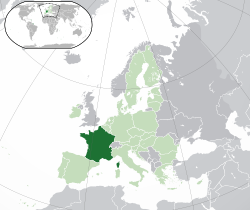
  France, officially the French Republic (French: République française), is a sovereign state comprising territory in western Europe and several overseas regions and territories . The European part of France, called Metropolitan France , extends from the Mediterranean Sea to the English Channel and the North Sea , and from the Rhine to the Atlantic Ocean . France spans 640,679 square kilometres (247,368 sq mi) and has a total population of 67 million. It is a unitary semi-presidential republic with the capital in Paris , the country’s largest city and main cultural and commercial centre. The Constitution of France establishes the state as secular and democratic, with its sovereignty derived from the people.
During the Iron Age , what is now Metropolitan France was inhabited by the Gauls , a Celtic people. The Gauls were conquered in 51 BC by the Roman Empire , which held Gaul until 486. The Gallo-Romans faced raids and migration from the Germanic Franks , who dominated the region for hundreds of years, eventually creating the medieval Kingdom of France . France emerged as a major European power in the Late Middle Ages , with its victory in the Hundred Years’ War (1337 to 1453) strengthening French state-building and paving the way for a future centralized absolute monarchy . During the Renaissance , France experienced a vast cultural development and established the beginning of a global colonial empire . The 16th century was dominated by religious civil wars between Catholics and Protestants (Huguenots).
France became Europe’s dominant cultural, political, and military power under Louis XIV . French philosophers played a key role in the Age of Enlightenment during the 18th century . In 1778, France became the first and the main ally of the new United States in the American Revolutionary War . In the late 18th century, the absolute monarchy was overthrown in the French Revolution . Among its legacies was the Declaration of the Rights of Man and of the Citizen , one of the earliest documents on human rights , which expresses the nation’s ideals to this day. France became one of modern history’s earliest republics until Napoleon took power and launched the First French Empire in 1804. Fighting against a complex set of coalitions during the Napoleonic Wars , he dominated European affairs for over a decade and had a long-lasting impact on Western culture. Following the collapse of the Empire, France endured a tumultuous succession of governments: the monarchy was restored , it was replaced in 1830 by a constitutional monarchy , then briefly by a Second Republic , and then by a Second Empire , until a more lasting French Third Republic was established in 1870. By the 1905 law , France adopted a strict form of secularism , called laïcité , which has become an important federative principle in the modern French society.
France reached its territorial height during the 19th and early 20th centuries, when it ultimately possessed the second-largest colonial empire in the world. In World War I , France was one of the main winners as part of the Triple Entente alliance fighting against the Central Powers . France was also one of the Allied Powers in World War II , but came under occupation by the Axis Powers in 1940. Following liberation in 1944, a Fourth Republic was established and later dissolved in the course of the Algerian War . The Fifth Republic , led by Charles de Gaulle , was formed in 1958 and remains to this day. Following World War II , most of the empire became decolonized .
Throughout its long history , France has been a leading global center of culture, making significant contributions to art , science , and philosophy . It hosts Europe’s third-largest number of cultural UNESCO World Heritage Sites (after Italy and Spain ) and receives around 83 million foreign tourists annually, the most of any country in the world. France remains a great power with significant cultural , economic , military , and political influence. It is a developed country with the world’s sixth-largest economy by nominal GDP and eight-largest by purchasing power parity . According to Credit Suisse, France is the fourth wealthiest nation in the world in terms of aggregate household wealth. It also possesses the world’s second-largest exclusive economic zone (EEZ), covering 11,035,000 square kilometres (4,261,000 sq mi).
French citizens enjoy a high standard of living , and the country performs well in international rankings of education , health care , life expectancy , civil liberties, and human development . France is a founding member of the United Nations , where it serves as one of the five permanent members of the UN Security Council . It is a member of the Group of 7 , North Atlantic Treaty Organization (NATO), Organisation for Economic Co-operation and Development (OECD), the World Trade Organization (WTO), and La Francophonie . France is a founding and leading member state of the European Union (EU).
|