|
Switzerland
100th Anniversary of the Death of Johanna Spyri
2001 Proof Silver 20 Francs Coin 31mm (20.00 grams) 0.835 Silver (0.5369 oz. ASW)
Reference: HMZ 2# 1221w, KM# 94 (Mintage: 15,000) | Designer: Sylvia Goeschke
CONFOEDERATIO HELVETICA FR 20 2001 B, Hand writing in eight lines behind inscription.
1827 – 1901 JOHANNA SPYRI SZLVIA GOESHKE, Bust of Swiss writer Johanna Spyri facing 1/2 right.
Edge Lettering:
★★ DOMINUS | PROVIDEBIT | ★★★★★★★★★★★
You are bidding on the exact item pictured, provided with a Certificate of Authenticity and Lifetime Guarantee of Authenticity.
 Johanna Louise Spyri (12 June 1827 – 7 July 1901) was a Swiss author of novels, notably children’s stories, and is best known for her book Heidi. Born in Hirzel, a rural area in the canton of Zurich, Switzerland, as a child she spent several summers near Chur in Graubünden, the setting she later would use in her novels.
In 1852, Johanna Heusser married Bernhard Spyri. Bernhard was a lawyer. Whilst living in the city of Zürich she began to write about life in the country. Her first story, A Leaf on Vrony’s Grave, which deals with a woman’s life of domestic violence, was published in 1880; the following year further stories for both adults and children appeared, among them the novel Heidi, which she wrote in four weeks. Heidi tells the story of an orphan girl who lives with her grandfather in the Swiss Alps, and is famous for its vivid portrayal of the landscape.
Her husband and her only child, both named Bernhard, both died in 1884. Alone, she devoted herself to charitable causes and wrote over fifty more stories before her death in 1901. She was interred in the family plot at the Sihlfeld-A Cemetery in Zürich. An icon in Switzerland, Spyri’s portrait was placed on a postage stamp in 1951 and on a 20 CHF commemorative coin in 2009.
In April 2010 a professor searching for children’s illustrations found a book written in 1830 by a German history teacher, Hermann Adam von Kamp, that Spyri may have used as a basis for Heidi. The 1830 story is titled Adelheide – das Mädchen vom Alpengebirge—translated, “Adelaide, the girl from the Alps”. The two stories were alleged to share many similarities in plot line and imagery. Spyri biographer Regine Schindler said it was entirely possible that Johanna may have been familiar with the story as she grew up in a literate household with many books. However, the professor’s claims have been examined and afterwards described as “un-scientific”, due to ‘superficial coincidences’ he brings up in descriptions and the many actual differences in the story, that he doesn’t, as well as the “Swiss disease” of homesickness already being a common trope in fiction in the eighteenth (nineteenth in the article) century (as well as, while not mentioned in the article, it being discovered before von Kamp was even born) and characters that are either drastically different or not in “Adelaide”, at all.
The following is a list of her main books:
- Heimatlos: Two stories for children, and for those who love children (1877)
- Heidi (1880-81)
- The Story of Rico (1882)
- Uncle Titus and His Visit to the Country (1883)
- Gritli’s Children (1883-84)
- Rico and Wiseli (1885)
- Veronica And Other Friends (1886)
- What Sami Sings with the Birds (1887)
- Toni, the Little Woodcarver (1890)
- Erick and Sally (1891)
- Mäzli (1891)
- Cornelli (1892)
- Vinzi: A Story of the Swiss Alps (1892)
- Moni the Goat-Boy (1897)
- Little Miss Grasshopper (1898)
Her books were originally written in German. The translations into English at the end of the 19th century, or the early 1900s, mention H. A. Melcon (1839–1910), Maria Louise Kirk (1860–1938), Emma Stelter Hopkins, Louise Brooks, Helen B. Dole and the couple Charles Wharton Stork and Elisabeth P. Stork.
 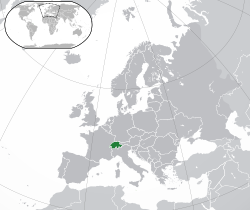 Switzerland, officially the Swiss Confederation (Latin: Confoederatio Helvetica, hence its abbreviation CH), is a federal parliamentary republic consisting of 26 cantons, with Bern as the seat of the federal authorities, the so-called Bundesstadt (“federal city”). The country is situated in Western and Central Europe, where it is bordered by Italy to the south, France to the west, Germany to the north, and Austria and Liechtenstein to the east. Switzerland is a landlocked country geographically divided between the Alps, the Swiss Plateau and the Jura, spanning an area of 41,285 km2 (15,940 sq mi). While the Alps occupy the greater part of the territory, the Swiss population of approximately 8 million people is concentrated mostly on the Plateau, where the largest cities are to be found. Among them are the two global cities and economic centres of Zürich and Geneva.
The establishment of the Swiss Confederation is traditionally dated to 1 August 1291, which is celebrated annually as Swiss National Day. It has a long history of armed neutrality-it has not been in a state of war internationally since 1815-and did not join the United Nations until 2002. It pursues, however, an active foreign policy and is frequently involved in peace-building processes around the world. Switzerland is also the birthplace of the Red Cross and home to numerous international organizations, including the second largest UN office. On the European level, it is a founding member of the European Free Trade Association and is part of the Schengen Area – although it is notably not a member of the European Union, nor the European Economic Area. Switzerland comprises four main linguistic and cultural regions: German, French, Italian and the Romansh-speaking valleys. Therefore, the Swiss, although predominantly German-speaking, do not form a nation in the sense of a common ethnic or linguistic identity; rather, the strong sense of identity and community is founded on a common historical background, shared values such as federalism and direct democracy, and Alpine symbolism.
Switzerland has the highest nominal wealth per adult (financial and non-financial assets) in the world according to Credit Suisse and eighth-highest per capita gross domestic product on the IMF list. However, Switzerland is also the most expensive country in the world to live in, as measured by the price level index.
Swiss citizens have the second-highest life expectancy in the world on the UN DESA list. Switzerland is tied with the Netherlands for the top rank on the Bribe Payers Index indicating very low levels of business corruption. Moreover, for the last five years the country has been ranked first in economic and tourist competitiveness according to the Global Competitiveness Report and the Travel and Tourism Competitiveness Report respectively, both developed by the World Economic Forum. Zürich and Geneva have each been ranked among the top cities with the highest quality of life in the world, with the former coming second globally according to Mercer. However, Mercer also rates those two cities as the fifth- and sixth- most expensive cities in the world to live in.
|


