|
United States of America
Shawnee Tribe Sovereign Nation – Chief “Shooting Star” Tecumseh
2002 Proof Silver Dollar 39mm (31.11 grams) .999 Silver (1.00 oz. ASW)
Reference: KM# 1
THE SOVEREIGN NATION OF THE SHAWNEE TRIBE 2002, Shawnee Coat-of-Arms.
CHIEF “SHOOTING STAR” TECUMSEH 1768 1813 ONE DOLLAR, Portrait of Chief Tecumseh, with text around the outside.
You are bidding on the exact item pictured, provided with a Certificate of Authenticity and Lifetime Guarantee of Authenticity.
 Tecumseh (c. 1768 – October 5, 1813) was a Shawnee chief and warrior who promoted resistance to the expansion of the United States onto Native American lands. A persuasive orator, Tecumseh traveled widely, forming a Native American confederacy and promoting intertribal unity. Even though his efforts to unite Native Americans ended with his death in the War of 1812, he became an iconic folk hero in American, Indigenous, and Canadian popular history.
Tecumseh was born in what is now Ohio, at a time when the far-flung Shawnees were reuniting in their Ohio Country homeland. During his childhood, the Shawnees lost territory to the expanding American colonies in a series of border conflicts. Tecumseh’s father was killed in battle against American colonists in 1774. Tecumseh was thereafter mentored by his older brother Cheeseekau, a noted war chief who died fighting Americans in 1792. As a young war leader, Tecumseh joined Shawnee Chief Blue Jacket’s armed struggle against further American encroachment, which ended in defeat at the Battle of Fallen Timbers in 1794 and with the loss of most of Ohio in the 1795 Treaty of Greenville.
In 1805, Tecumseh’s younger brother Tenskwatawa, who came to be known as the Shawnee Prophet, founded a religious movement that called upon Native Americans to reject European influences and return to a more traditional lifestyle. In 1808, Tecumseh and Tenskwatawa established Prophetstown, a village in present-day Indiana, that grew into a large, multi-tribal community. Tecumseh traveled constantly, spreading the Prophet’s message and eclipsing his brother in prominence. Tecumseh proclaimed that Native Americans owned their lands in common and urged tribes not to cede more territory unless all agreed. His message alarmed American leaders as well as Native leaders who sought accommodation with the United States. In 1811, when Tecumseh was in the South recruiting allies, Americans under William Henry Harrison defeated Tenskwatawa at the Battle of Tippecanoe and destroyed Prophetstown.
In the War of 1812, Tecumseh joined his cause with the British, recruited warriors, and helped capture Detroit in August 1812. The following year he led an unsuccessful campaign against the United States in Ohio and Indiana. When U.S. naval forces took control of Lake Erie in 1813, Tecumseh reluctantly retreated with the British into Upper Canada, where American forces engaged them at the Battle of the Thames on October 5, 1813, in which Tecumseh was killed. His death caused his confederacy to collapse. The lands he had fought to defend were eventually ceded to the U.S. government. His legacy as one of the most celebrated Native Americans in history grew in the years after his death, although details of his life have often been obscured by mythology.
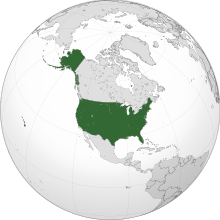
 The United States of America (USA), commonly known as the United States (U.S. or US) or America, is a country composed of 50 states, a federal district, five major self-governing territories, and various possessions. At 3.8 million square miles (9.8 million km2), the United States is the world’s third or fourth largest country by total area and is slightly smaller than the entire continent of Europe’s 3.9 million square miles (10.1 million km2
 Paleo-Indians migrated from Siberia to the North American mainland at least 12,000 years ago. European colonization began in the 16th century. The United States emerged from the thirteen British colonies established along the East Coast. Numerous disputes between Great Britain and the colonies following the French and Indian War led to the American Revolution, which began in 1775, and the subsequent Declaration of Independence in 1776. The war ended in 1783 with the United States becoming the first country to gain independence from a European power. The current constitution was adopted in 1788, with the first ten amendments, collectively named the Bill of Rights, being ratified in 1791 to guarantee many fundamental civil liberties. The United States embarked on a vigorous expansion across North America throughout the 19th century, acquiring new territories, displacing Native American tribes, and gradually admitting new states until it spanned the continent by 1848.
 During the second half of the 19th century, the Civil War led to the abolition of slavery. By the end of the century, the United States had extended into the Pacific Ocean, and its economy, driven in large part by the Industrial Revolution, began to soar. The Spanish-American War and World War I confirmed the country’s status as a global military power. The United States emerged from World War II as a global superpower, the first country to develop nuclear weapons, the only country to use them in warfare, and a permanent member of the United Nations Security Council. During the Cold War, the United States and the Soviet Union competed in the Space Race, culminating with the 1969 Moon landing. The end of the Cold War and the collapse of the Soviet Union in 1991 left the United States as the world’s sole superpower.
The United States is the world’s oldest surviving federation. It is a federal republic and a representative democracy, “in which majority rule is tempered by minority rights protected by law”. The United States is a founding member of the United Nations, World Bank, International Monetary Fund, Organization of American States (OAS), and other international organizations. The United States is a highly developed country, with the world’s largest economy by nominal GDP and second-largest economy by PPP, accounting for approximately a quarter of global GDP. The U.S. economy is largely post-industrial, characterized by the dominance of services and knowledge-based activities, although the manufacturing sector remains the second-largest in the world. The United States is the world’s largest importer and the second largest exporter of goods, by value. Although its population is only 4.3% of the world total, the U.S. holds 33% of the total wealth in the world, the largest share of global wealth concentrated in a single country. It also suffers from growing levels of income inequality and wealth inequality.
The United States ranks among the highest nations in several measures of socioeconomic performance, including human development, per capita GDP, and productivity per person. The United States is the foremost military power in the world, making up a third of global military spending, and is a leading political, cultural, and scientific force internationally.
|


