|
Liberia
Milestones of Aviation – Parachute
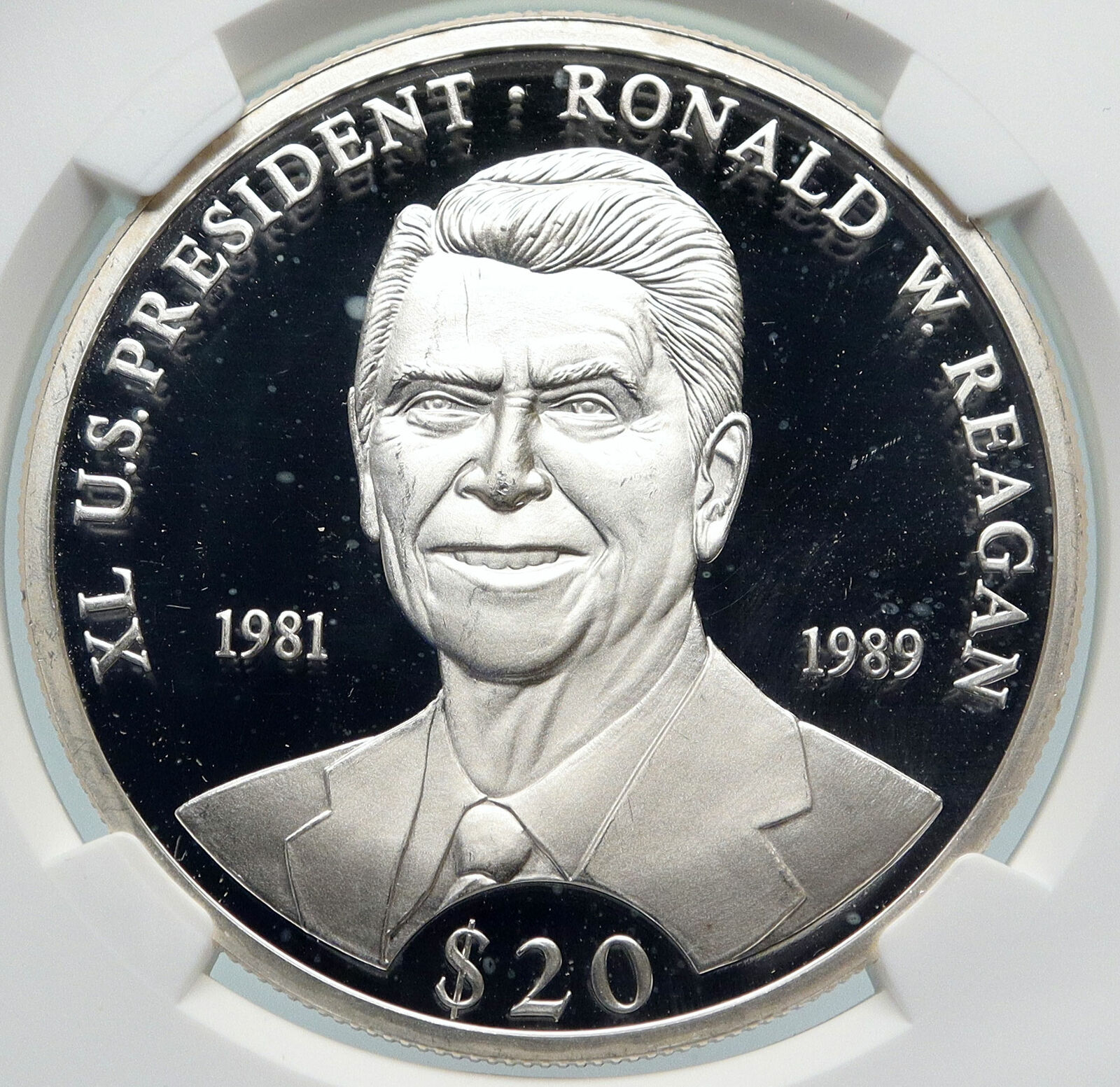
2003 Proof Silver 10 Dollars 38.61mm (25.00 grams) 0.925 Silver (0.7435 oz. ASW)
Reference: KM# 603
REPUBLIC OF LIBERIA THE LOVE OF LIBERTY BROUGHT US HERE REPUBLIC OF LIBERIA, Seal of Liberia.
MILESTONES OF AVIATION – PARACHUTE 1485 2003, Old parachute.
You are bidding on the exact item pictured, provided with a Certificate of Authenticity and Lifetime Guarantee of Authenticity.
 A parachute is a device used to slow the motion of an object through an atmosphere by creating drag (or in the case of ram-air parachutes, aerodynamic lift). Parachutes are usually made out of light, strong fabric, originally silk, now most commonly nylon. They are typically dome-shaped, but vary, with rectangles, inverted domes, and others found. A variety of loads are attached to parachutes, including people, food, equipment, space capsules, and bombs.
The earliest evidence for the true parachute dates back to the Renaissance period. The oldest parachute design appears in an anonymous manuscript from 1470s Renaissance Italy (British Library, Add MS 34113, fol. 200v), showing a free-hanging man clutching a crossbar frame attached to a conical canopy. As a safety measure, four straps ran from the ends of the rods to a waist belt. The design is a marked improvement over another folio (189v), which depicts a man trying to break the force of his fall using two long cloth streamers fastened to two bars, which he grips with his hands. Although the surface area of the parachute design appears to be too small to offer effective air resistance and the wooden base-frame is superfluous and potentially harmful, the basic concept of a working parachute is apparent.
Shortly after, a more sophisticated parachute was sketched by the polymath Leonardo da Vinci in his Codex Atlanticus (fol. 381v) dated to ca. 1485. Here, the scale of the parachute is in a more favorable proportion to the weight of the jumper. Leonardo’s canopy was held open by a square wooden frame, which alters the shape of the parachute from conical to pyramidal. It is not known whether the Italian inventor was influenced by the earlier design, but he may have learned about the idea through the intensive oral communication among artist-engineers of the time. The feasibility of Leonardo’s pyramidal design was successfully tested in 2000 by Briton Adrian Nicholas and again in 2008 by the Swiss skydiver Olivier Vietti-Teppa. According to the historian of technology Lynn White, these conical and pyramidal designs, much more elaborate than early artistic jumps with rigid parasols in Asia, mark the origin of “the parachute as we know it.” Fausto Veranzio’s parachute design, titled Homo Volans (“Flying Man”), from his Machinae Novae (“New Contraptions”, published in 1615 or 1616)
The Venetian polymath and inventor Fausto Veranzio (1551–1617) examined da Vinci’s parachute sketch and kept the square frame but replaced the canopy with a bulging sail-like piece of cloth that he came to realize decelerates a fall more effectively. A now-famous depiction of a parachute that he dubbed Homo Volans (Flying Man), showing a man parachuting from a tower, presumably St Mark’s Campanile in Venice, appeared in his book on mechanics, Machinae Novae (“New Machines”, published in 1615 or 1616), alongside a number of other devices and technical concepts.
It was once widely believed that in 1617, Veranzio, then aged 65 and seriously ill, implemented his design and tested the parachute by jumping from St Mark’s Campanile, from a bridge nearby, or from St Martin’s Cathedral in Bratislava. In various publications it was incorrectly claimed the event was documented some thirty years later by John Wilkins, founder and secretary of the Royal Society in London, in his book Mathematical Magick or, the Wonders that may be Performed by Mechanical Geometry, published in London in 1648. However, Wilkins wrote about flying, not parachutes, and does not mention Veranzio, a parachute jump, or any event in 1617. Doubts about this test, which include a lack of written evidence, suggest it never occurred, and was instead a misreading of historical notes.
A drogue chute is used to aid horizontal deceleration of a vehicle including fixed-wing aircraft and drag racers, provide stability, as to assist certain types of light aircraft in distress, tandem free-fall; and as a pilot triggering deployment of a larger parachute.
The modern parachute was invented in the late 18th century by Louis-Sébastien Lenormand in France, who made the first recorded public jump in 1783. Lenormand also sketched his device beforehand.
Two years later, in 1785, Lenormand coined the word “parachute” by hybridizing an Italian prefix para, an imperative form of parare = to avert, defend, resist, guard, shield or shroud, from paro = to parry, and chute, the French word for fall, to describe the aeronautical device’s real function.
Also in 1785, Jean-Pierre Blanchard demonstrated it as a means of safely disembarking from a hot-air balloon. While Blanchard’s first parachute demonstrations were conducted with a dog as the passenger, he later claimed to have had the opportunity to try it himself in 1793 when his hot air balloon ruptured and he used a parachute to descend. (This event was not witnessed by others).
Subsequent development of the parachute focused on it becoming more compact. While the early parachutes were made of linen stretched over a wooden frame, in the late 1790s, Blanchard began making parachutes from folded silk, taking advantage of silk’s strength and light weight. In 1797, André Garnerin made the first descent of a “frameless” parachute covered in silk. In 1804 Jérôme Lalande introduced a vent in the canopy to eliminate violent oscillations.
 Liberia officially the Republic of Liberia, is a country on the West African coast. Liberia means “Land of the Free” in Latin. It is bordered by Sierra Leone to its west, Guinea to its north and Ivory Coast to its east. It covers an area of 111,369 square kilometres (43,000 sq mi) and is home to 4,503,000 people. English is the official language and over 20 indigenous languages are spoken, representing the numerous tribes who make up more than 95% of the population.
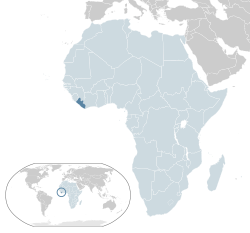 Forests on the coastline are composed mostly of salt-tolerant mangrove trees, while the more sparsely populated inland has forests opening onto a plateau of drier grasslands. The climate is equatorial, with significant rainfall during the May-October rainy season and harsh harmattan winds the remainder of the year. Liberia possesses about forty percent of the remaining Upper Guinean rainforest. It was an important producer of rubber in the early 20th century.
The Republic of Liberia, beginning as a settlement of the American Colonization Society (ACS), declared its independence on July 26, 1847. The United States did not recognize Liberia’s independence until after the American Civil War on February 5, 1862. Between January 7, 1822 and the American Civil War, more than 15,000 freed and free-born Black Americans from United States and 3,198 Afro-Caribbeans relocated to the settlement. The Black American settlers carried their culture with them to Liberia. The Liberian constitution and flag were modeled after the United States. In January 3, 1848 Joseph Jenkins Roberts, a wealthy free-born Black American from Virginia who settled in Liberia, was elected as Liberia’s first president after the people proclaimed independence.
Unlike other African countries, Liberia is the only African republic to have self-proclaimed independence without gaining independence through revolt from any other nation, being Africa’s first and oldest republic. Although it is said that neither Liberia nor Ethiopia, which was a kingdom, were controlled or colonized by foreign powers, this seems contradictory since the country was actually started by the American Colonization Society (ACS). Liberia maintained and kept its independence during the European colonial era.
During World War II, Liberia supported the United States war efforts against Germany and in turn the United States invested in considerable infrastructure in Liberia to help its war effort, which also aided the country in modernizing and improving its major air transportation facilities. In addition, President William Tubman encouraged economic changes. Internationally, Liberia was a founding member of League of Nations, United Nations and the Organisation of African Unity.
Longstanding political tensions from the 27 year rule of William Tubman resulted in a military coup in 1980 that overthrew the leadership soon after his death, marking the beginning of political instability. Five years of military rule by the People’s Redemption Council and five years of civilian rule by the National Democratic Party of Liberia were followed by two civil wars – the First and Second Liberian Civil Wars. These resulted in the deaths and displacement of more than half a million people and devastated Liberia’s economy. A peace agreement in 2003 led to democratic elections in 2005. Recovery proceeds but about 85% of the population live below the international poverty line.
|