|
Germany – Eduard Mörike
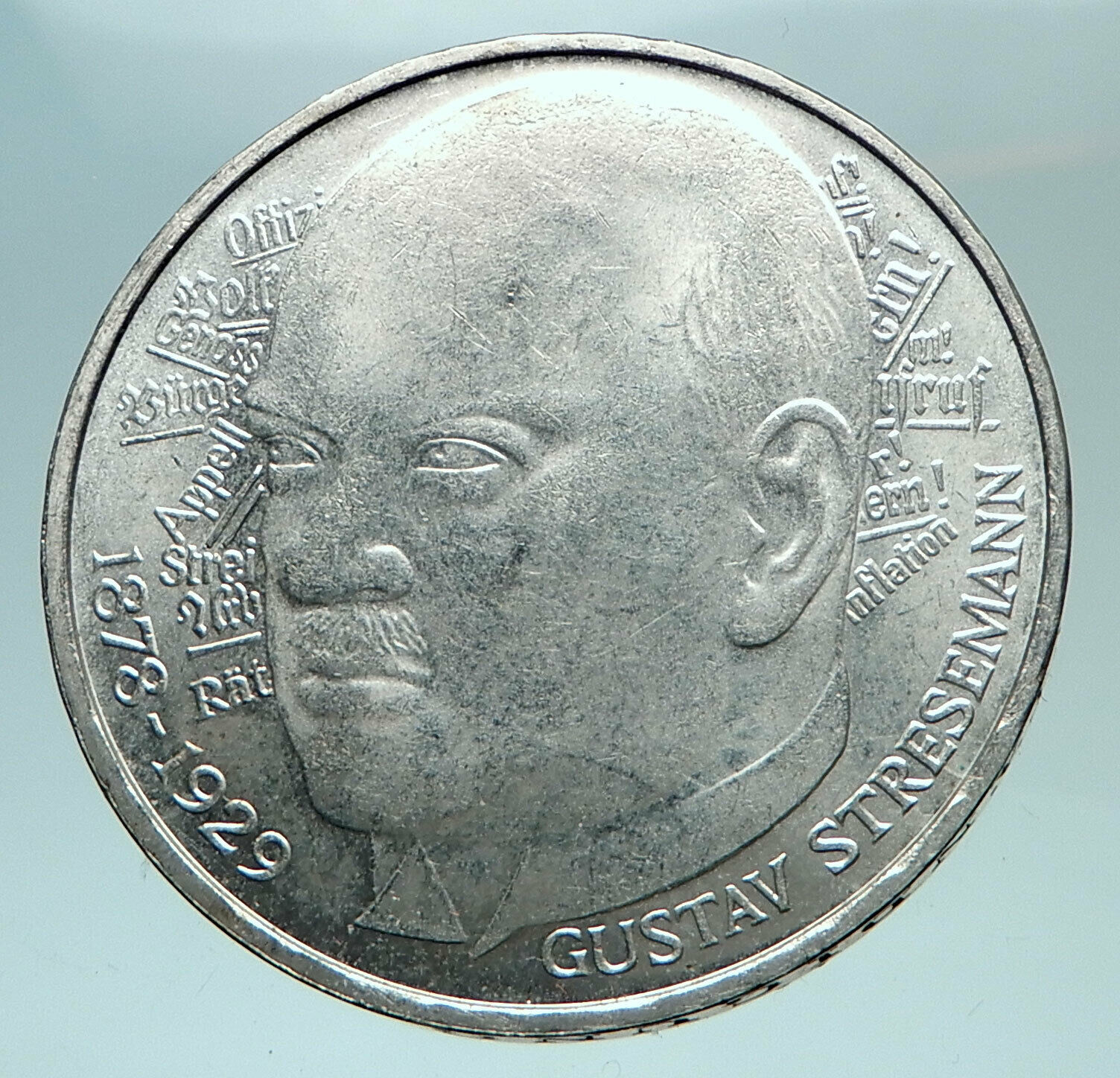
2004 F Proof Silver 10 Euros 32.5mm (18.07 grams) 0.925 Silver (0.5319 oz. ASW)
Reference: KM# 233
BUNDESREPUBLIK DEUTSCHLAND 2004 F 10 EURO, Stylized eagle.
200. GEBURTSTAG DES DICHTERS · EDUARD MÖRIKE ·, Bust facing 3/4 left within oval.
Edge Lettering: OHNE DAS SCHÖNE WAS SOLL DER GEWINN
You are bidding on the exact item pictured, provided with a Certificate of Authenticity and Lifetime Guarantee of Authenticity.
 Eduard Friedrich Mörike (8 September 1804 – 4 June 1875) was a German Romantic poet and writer of novellas and novels.
Mörike was born in Ludwigsburg. His father was Karl Friedrich Mörike (died 1817), a district medical councilor; his mother was Charlotte Bayer. After the death of his father, in 1817, he went to live with his uncle Eberhard Friedrich Georgii in Stuttgart, who intended his nephew to become a clergyman. Therefore, after one year at the Stuttgart Gymnasium illustre, Mörike joined the Evangelical Seminary Urach, a humanist grammar school, in 1818 and from 1822 to 1826 attended the Tübinger Stift. There, he scored low grades and failed the admission test to Urach Seminary, yet was accepted anyhow. At the Seminary he went on to study the classics, something that was to become a major influence on his writing, and he made the acquaintance of Wilhelm Hartlaub and Wilhelm Waiblinger. Afterwards he studied theology at the Seminary of Tübingen where he met Ludwig Bauer, David Friedrich Strauss and Friedrich Theodor Vischer. Many of these friendships were long-lasting. In Tübingen, with Bauer, he invented the fairyland Orplid – see the poem Song Weylas (You are Orplid) dating from 1831.
Mörike became a Lutheran pastor and, in 1834, he was appointed vicar of Cleversulzbach near Weinsberg. In the Autumn of 1843 he stayed for over half a year with his friend Pastor Wilhelm Hartlaub (1804-1885) in the village of Wermutshausen, situated in the state of Baden-Württemberg in southern Germany. During this time he produced a drawing of the Wermutshausen Petruskirche, dating from the early 1800s. This drawing is speculated, due to the perspective, to be from a top-floor room of a local brewery, distillery, and guesthouse at the edge of town, which remains in operation today as Gasthaus und Manufaktur Krone Wermutshausen. In town there is also a Museum commemorating this visit, in which guests can see the room in which Mörike lived. For reasons of health, Mörike retired quite early, and in 1851 became professor of German literature at the Katharinenstift in Stuttgart. This office he held until he retired in 1866. He continued to live in Stuttgart until his death.
Mörike was a member of the so-called Swabian school of writers around Ludwig Uhland. His poems (Gedichte, 1838), are mostly lyrical, yet often humorous and written in simple and seemingly everyday German. His ballad “Schön Rotraut” – opening with the line “Wie heisst König Ringangs Töchterlein?” – became a popular favorite.
His first published work was the novel Maler Nolten (“The painter Nolten”, 1832), a tale about the life of a painter, and which revealed his imaginative power; it became fairly popular. The novella Mozart auf der Reise nach Prag (“Mozart on the way to Prague”, 1856) was a humorous examination of the problems of artists in a world uncongenial to art. It is frequently cited as his finest achievement. He also wrote a somewhat fantastic Idylle vom Bodensee, oder Fischer Martin und die Glockendiebe (1846), the fairy tale Das Stuttgarter Hutzelmännlein (1855), and published a collection of hymns, odes, elegies, and idylls of the Greeks and Romans, entitled Klassische Blumenlese (1840). He also translated Anacreon and Theocritus into German.
Mörike’s Gesammelte Schriften (“Collected Writings”) were first published posthumously in 1878 (4 vols.). Later editions are those edited by R. Krauss (6 vols., 1905), and the Volksausgabe (“Popular edition”), published by Göschen (4 vols., 1905). Selections from his literary estate were published by R. Krauss in Eduard Mörike als Gelegenheitsdichter (1895), and his correspondence with Hermann Kurz, Moritz von Schwind, and Theodor Storm, by J. Bachtold (1885-1891); an edition of Mörike’s Ausgewählte Briefe (“Selected letters”), in 2 vols., appeared 1903-1904.
His work was greatly praised by the philosopher Ludwig Wittgenstein who recommended him to Bertrand Russell as
really a great poet and his poems are among the best things we have…the beauty of Mörike’s work is very closely related to Goethe’s.
Many of his lyrics were set to music by Hugo Wolf, Ludwig Hetsch and Fritz Kauffmann. Ignaz Lachner set to music his opera Die Regenbrüder. Many of his poems became established folksongs. Wilhelm Killmayer set several of his poems in his song cycle Mörike-Lieder in 2003.
Mörike was also known to produce drawings in his time, though it is not the subject of much discussion. While staying in the town of Wermutshausen in the Autumn of 1843, Mörike produced a drawing of the Persuskirche, a small church built in the early 1800s.
 Germany, officially the Federal Republic of Germany is a federal parliamentary republic in western-central Europe. It includes 16 constituent states and covers an area of 357,021 square kilometres (137,847 sq mi) with a largely temperate seasonal climate. Its capital and largest city is Berlin. With 81 million inhabitants, Germany is the most populous member state in the European Union. After the United States, it is the second most popular migration destination in the world.
 Various Germanic tribes have occupied northern Germany since classical antiquity. A region named Germania was documented before 100 CE. During the Migration Period the Germanic tribes expanded southward. Beginning in the 10th century, German territories formed a central part of the Holy Roman Empire. During the 16th century, northern German regions became the centre of the Protestant Reformation.
 The rise of Pan-Germanism inside the German Confederation resulted in the unification of most of the German states in 1871 into the Prussian-dominated German Empire. After World War I and the German Revolution of 1918-1919, the Empire was replaced by the parliamentary Weimar Republic. The establishment of the Third Reich in 1933 led to World War II and the Holocaust. After 1945, Germany split into two states, East Germany and West Germany. In 1990, the country was reunified.
In the 21st century, Germany is a great power and has the world’s fourth-largest economy by nominal GDP, as well as the fifth-largest by PPP. As a global leader in several industrial and technological sectors, it is both the world’s third-largest exporter and importer of goods. Germany is a developed country with a very high standard of living sustained by a skilled and productive society. It upholds a social security and universal health care system, environmental protection and a tuition free university education.
Germany was a founding member of the European Union in 1993. It is part of the Schengen Area, and became a co-founder of the Eurozone in 1999. Germany is a member of the United Nations, NATO, the G8, the G20, and the OECD. The national military expenditure is the 9th highest in the world. Known for its rich cultural history, Germany has been continuously the home of influential artists, philosophers, musicians, sportsmen, entrepreneurs, scientists and inventors.
|