|
France
120th Anniversary of the Birth of Robert Schuman
2006 Proof Silver 1 1/2 Euro 37mm (22.20 grams) 0.900 Silver (0.6424 oz. ASW)
Reference: KM# 2037 | Engraver: Fabienne Courtiade
RF 1½ EURO 9 Mai LA JOURNÉE de L’EUROPE, Schuman giving speech.
€ € € € € € € € € € € € EUROPA 2006, Stylized Europa facing.
Edge Lettering:
EUROPA EUROPA EUROPA EUROPA
You are bidding on the exact item pictured, provided with a Certificate of Authenticity and Lifetime Guarantee of Authenticity.
 Jean-Baptiste Nicolas Robert Schuman (29 June 1886 – 4 September 1963) was a Luxembourg-born French statesman. Schuman was a Christian Democrat (Popular Republican Movement) political thinker and activist. Twice Prime Minister of France, a reformist Minister of Finance and a Foreign Minister, he was instrumental in building postwar European and trans-Atlantic institutions and was one of the founders of the European Union, the Council of Europe and NATO. The 1964–1965 academic year at the College of Europe was named in his honour. In 2021, Schuman was declared venerable by Pope Francis in recognition of his acting on Christian principles.
After the war, Schuman rose to great prominence. He initially had difficulties because of his 1940 vote for Petain and for being one of his ministers. In September 1944, General Jean de Lattre de Tassigny, the commander of the French First Army, sought him out to become a political advisor in the affairs of Alsace-Lorraine, the minister of war, Andre Diethelm demanded shortly later that “this product of Vichy be immediately kicked out”. Schuman had been a former minister of Pétain and a parliamentarian who had voted to grant him full powers and so, under the ordinance of 26 August 1944, he was considered ineligible for public office, stricken with indignité nationale. On 24 July 1945, Schuman wrote to Charles de Gaulle to ask him to intervene. De Gaulle answered favourably, and on 15 September, Schuman regained his full civic rights, becoming able to again play an active role in French politics.
Schuman was Minister of Finance in 1946 and Prime Minister from 1947 to 1948. He assured parliamentary stability during a period of revolutionary strikes and attempted insurrection. In the last days of his first administration, his government proposed plans that later resulted in the Council of Europe and the European Community single market. Becoming Foreign Minister in 1948, he retained the post in different governments until early 1953. When Schuman’s first government had proposed the creation of a European Assembly, it made the issue a governmental matter for Europe, not merely an academic discussion or the subject of private conferences, like The Hague Congress of the European Movements earlier in 1948.
Schuman later served as Minister of Justice before becoming the first President of the European Parliamentary Assembly (the successor to the Common Assembly), which bestowed on him by acclamation the title ‘Father of Europe’. He is considered one of the founding fathers of the European Union. He presided over the European Movement from 1955 to 1961. In 1958, he received the Karlspreis, an Award by the German city of Aachen to people who contributed to the European idea and European peace, commemorating Charlemagne, the ruler of what is now both France and Germany, who lived in and is buried at Aachen. Schuman was also made a knight of the Order of Pius IX.
Schuman was intensely religious and a Bible scholar. He commended the writings of Pope Pius XII, who condemned both fascism and communism. He was an expert in medieval philosophy, especially the writings of Thomas Aquinas, and he thought highly of the philosopher Jacques Maritain, a contemporary.
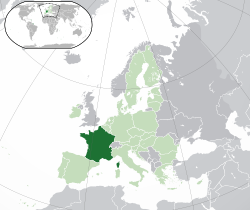
  France, officially the French Republic (French: République française), is a sovereign state comprising territory in western Europe and several overseas regions and territories. The European part of France, called Metropolitan France, extends from the Mediterranean Sea to the English Channel and the North Sea, and from the Rhine to the Atlantic Ocean. France spans 640,679 square kilometres (247,368 sq mi) and has a total population of 67 million. It is a unitary semi-presidential republic with the capital in Paris, the country’s largest city and main cultural and commercial centre. The Constitution of France establishes the state as secular and democratic, with its sovereignty derived from the people.
During the Iron Age, what is now Metropolitan France was inhabited by the Gauls, a Celtic people. The Gauls were conquered in 51 BC by the Roman Empire, which held Gaul until 486. The Gallo-Romans faced raids and migration from the Germanic Franks, who dominated the region for hundreds of years, eventually creating the medieval Kingdom of France. France emerged as a major European power in the Late Middle Ages, with its victory in the Hundred Years’ War (1337 to 1453) strengthening French state-building and paving the way for a future centralized absolute monarchy. During the Renaissance, France experienced a vast cultural development and established the beginning of a global colonial empire. The 16th century was dominated by religious civil wars between Catholics and Protestants (Huguenots).
France became Europe’s dominant cultural, political, and military power under Louis XIV. French philosophers played a key role in the Age of Enlightenment during the 18th century. In 1778, France became the first and the main ally of the new United States in the American Revolutionary War. In the late 18th century, the absolute monarchy was overthrown in the French Revolution. Among its legacies was the Declaration of the Rights of Man and of the Citizen, one of the earliest documents on human rights, which expresses the nation’s ideals to this day. France became one of modern history’s earliest republics until Napoleon took power and launched the First French Empire in 1804. Fighting against a complex set of coalitions during the Napoleonic Wars, he dominated European affairs for over a decade and had a long-lasting impact on Western culture. Following the collapse of the Empire, France endured a tumultuous succession of governments: the monarchy was restored, it was replaced in 1830 by a constitutional monarchy, then briefly by a Second Republic, and then by a Second Empire, until a more lasting French Third Republic was established in 1870. By the 1905 law, France adopted a strict form of secularism, called laïcité, which has become an important federative principle in the modern French society.
France reached its territorial height during the 19th and early 20th centuries, when it ultimately possessed the second-largest colonial empire in the world. In World War I, France was one of the main winners as part of the Triple Entente alliance fighting against the Central Powers. France was also one of the Allied Powers in World War II, but came under occupation by the Axis Powers in 1940. Following liberation in 1944, a Fourth Republic was established and later dissolved in the course of the Algerian War. The Fifth Republic, led by Charles de Gaulle, was formed in 1958 and remains to this day. Following World War II, most of the empire became decolonized.
Throughout its long history, France has been a leading global center of culture, making significant contributions to art, science, and philosophy. It hosts Europe’s third-largest number of cultural UNESCO World Heritage Sites (after Italy and Spain) and receives around 83 million foreign tourists annually, the most of any country in the world. France remains a great power with significant cultural, economic, military, and political influence. It is a developed country with the world’s sixth-largest economy by nominal GDP and eight-largest by purchasing power parity. According to Credit Suisse, France is the fourth wealthiest nation in the world in terms of aggregate household wealth. It also possesses the world’s second-largest exclusive economic zone (EEZ), covering 11,035,000 square kilometres (4,261,000 sq mi).
French citizens enjoy a high standard of living, and the country performs well in international rankings of education, health care, life expectancy, civil liberties, and human development. France is a founding member of the United Nations, where it serves as one of the five permanent members of the UN Security Council. It is a member of the Group of 7, North Atlantic Treaty Organization (NATO), Organisation for Economic Co-operation and Development (OECD), the World Trade Organization (WTO), and La Francophonie. France is a founding and leading member state of the European Union (EU).
|