|
United States of America
Poarch Creek Indians – Sovereign Nation
2007 Proof Silver Dollar 40mm (31.11 grams) .999 Silver (1.00 oz. ASW)
Reference: KM# 13 (Mintage: 10,000) | Engraver: Alex Shagin
CREEK NATION OF INDIANS POARCH CREEK INDIANS ONE DOLLAR, Tribal seal over value.
CHIEF OPOTHLE YOHOLO 2007, Chief facing 3/4 right.
You are bidding on the exact item pictured, provided with a Certificate of Authenticity and Lifetime Guarantee of Authenticity.
 Opothleyahola, also spelled Opothle Yohola, Opothleyoholo, Hu-pui-hilth Yahola, Hopoeitheyohola, and Hopere Yahvlv (c. 1778 – March 22, 1863) was a Muscogee Creek Indian chief, noted as a brilliant orator. He was a Speaker of the Upper Creek Council and supported traditional culture.
Although known as a diplomatic chief, as a Red Stick traditionalist he led Creek forces against the United States government during the Creek Wars. Later he tried to overturn the Treaty of Indian Springs, but was forced to make a new treaty with the federal government in 1832. He was commissioned as a colonel and led forces against remaining Lower Creek and the Seminole in Florida in the first two wars of the US against them. Despite his efforts, he and his people were among the Seminole and others forced to remove to Indian Territory in 1836, where they settled in the Unassigned Lands.
During the American Civil War, Opothleyahola was among the minority of Creek in Indian Territory who supported the Union. Because of rising conflict within the tribe, he led his followers to Kansas as a refuge. They engaged in three battles against the opposition along the way. Their journey became known as the Trail of Blood on Ice, because the people suffered harsh conditions. Some people were housed at a federal fort, others in refugee camps in Kansas. All suffered from inadequate supplies, disease, and harsh winters. Opothleyahola died during the war at one of the refugee camps in Kansas.
Later the young man developed as an influential and eloquent speaker. He was selected to the role as Speaker for the chiefs, which was a distinct position on the National Council. He later became a “diplomatic chief.”
Opothleyahola also became a wealthy trader and owned a 2,000-acre (8 km2) cotton plantation near North Fork Town. As did other Creek and members of the Five Civilized Tribes, he purchased and held enslaved African Americans as workers for his plantation. In other adaptations to European-American culture, Opothleyahola joined the Freemasons and accepted Christianity, becoming a Baptist. ]
Alarmed by the land cessions made by chiefs of the Lower Towns without tribal consensus, the National Council of the Creek Confederacy enacted a law that made further land cessions by tribal members a capital offense. In 1825, William McIntosh and several Lower Creek chiefs signed the second Treaty of Indian Springs with the US, by which they gave up most of the remaining Creek lands in Georgia in exchange for payment and removal to lands west of the Mississippi River. By then, McIntosh and others of the Treaty Party believed that removal was inevitable, given the increasing numbers of European-American settlers entering their region, and they wanted to get the best deal possible for the Creek Nation.
But the National Council had not given up on trying to resist United States encroachment. It passed a death sentence, supported by Opothleyahola, against McIntosh and other signatories of the 1825 Treaty. The chief Menawa led 200 warriors to attack McIntosh at his plantation. They killed him and another signatory chief, and burned down McIntosh’s mansion.
The Creek elders realized that they would need experienced negotiators to present their case to Federal authorities. While Opothleyahola was a persuasive speaker, he was not fluent in the English language. They turned to the Cherokee for assistance. Major Ridge, a Cherokee leader, recommended that the Creek retain his son, John Ridge, and David Vann, who were well-educated young men fluent in English, to travel with Opothleyahola and help prepare his negotiating positions.
The Creek National Council, led by Opothleyahola, went to Washington, D.C., to protest the illegality of the 1825 treaty, saying its signatories did not have consensus of the council. President John Quincy Adams was sympathetic. The US government and the chiefs made a new treaty with more favorable terms, the Treaty of Washington (1826).
But Georgia officials began forcibly removing the Indians from lands it claimed under the 1825 treaty. In addition, the state ignored the 1832 US Supreme Court ruling in Worcester v. Georgia, which said that the state’s legislation to regulate activities within American Indian territories was unconstitutional.
When the Alabama legislature also acted to abolish tribal governments and extend state laws over the Creek people, Opothleyahola appealed to the administration of President Andrew Jackson. But he had already signed the 1830 Indian Removal Act and wanted the Creek and other tribes to move west, to extinguish their land titles in the east. Given no relief, the Upper Creek signed the Treaty of Cusseta on March 24, 1832, which divided Creek lands into individual allotments. They could either sell their allotments and receive funds to remove to Indian Territory, or stay in Alabama as state and US citizens and submit to the state laws.
In 1834, Opothleyahola traveled to Nacogdoches, Texas, to try to purchase communal land for his people. After he had paid landowners $20,000, pressure from both the Mexican and American governments forced Opothleyahola to abandon the idea.
In 1836, Opothleyahola, commissioned as a colonel by the U.S. government, led 1,500 of his warriors against remaining rebellious Lower Creek, who had allied with Seminole in Florida in fighting European-American occupation. Soon after, the US Army rounded up the remaining Creek and other Southeast Indian peoples and forced their emigration to Indian Territory, on what was known as the “Trail of Tears.”
In 1837, Opothleyahola led 8,000 of his people from Alabama to lands north of the Canadian River in the Indian Territory, what were then called Unassigned Lands. (It is now part of the state of Oklahoma). Over time, they began to specialize in stock raising and grain production there, as neither the land nor climate were suitable for subsistence farming.
At the outbreak of the American Civil War, Opothleyahola and Creek remained loyal to the federal government. They believed the Southern populations in Georgia and Alabama had forced their removal. The Lower Creek and some of the other of the Southeastern tribes, who had specialized in cotton production, held numerous slaves and had more cultural contacts with white settlers. They supported the Confederacy, which promised them an Indian-controlled state if they won the war. Tensions within the Creek Nation increased during this period because the Confederacy tried to convince it and other Indian nations to tighten slave codes in Indian Territory.
Those Creek with African ancestry resented the restrictions of proposed “black codes,” and became more affiliated toward the Union. Refugee enslaved African Americans, free people of color, Chickasaw and Seminole Indians also began gathering at Opothleyahola’s plantation. They hoped to remain neutral in the conflict between the North and South.
On August 15, 1861, Opothleyahola and tribal chief Micco Hutko contacted President Abraham Lincoln to request help for the loyalists. On September 10, they received a positive response, saying that the United States government would assist them. The letter directed Opothleyahola to move his people to Fort Row in Wilson County, Kansas, where they would receive asylum and aid.
On November 15, Confederate Col. Douglas H. Cooper, a former US Indian Agent, led 1,400 men, including pro-Confederate Indians, northward; he intended either to convince Opothleyahola and his followers to support the Confederacy or to “drive him and his party from the country.” Believing Federal promises of assistance, Opothleyahola led his band (including Seminole under Halleck Tustenuggee) toward Kansas. Along the way, they had to fight three battles against their pursuers, and had lost many of their goods in their quick departure. At Round Mountain, Opothleyahola’s forces drove back the Confederates to Fort Gibson.
In December, the loyalists suffered a tactical loss at Chusto-Talasah and a crushing defeat at the Battle of Chustenahlah. He lost an estimated 2,000 of his 9,000 followers from the battles, disease, and bitter winter blizzards during their ill-fated trek to Fort Row. The fort had been unable to get extra supplies, and lacked adequate medical support and supplies to care for the refugees. The Creek were forced to move to Fort Belmont, but conditions were still very poor. The majority of the Creek had only the clothes on their backs and lacked proper footwear and shelter, as they had left in a hurry. Many Creek died that winter, among them Opothleyahola’s daughter.
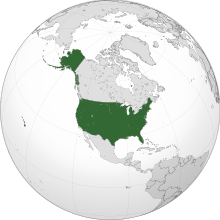
 The United States of America (USA), commonly known as the United States (U.S. or US) or America, is a country composed of 50 states, a federal district, five major self-governing territories, and various possessions. At 3.8 million square miles (9.8 million km2), the United States is the world’s third or fourth largest country by total area and is slightly smaller than the entire continent of Europe’s 3.9 million square miles (10.1 million km2
 Paleo-Indians migrated from Siberia to the North American mainland at least 12,000 years ago. European colonization began in the 16th century. The United States emerged from the thirteen British colonies established along the East Coast. Numerous disputes between Great Britain and the colonies following the French and Indian War led to the American Revolution, which began in 1775, and the subsequent Declaration of Independence in 1776. The war ended in 1783 with the United States becoming the first country to gain independence from a European power. The current constitution was adopted in 1788, with the first ten amendments, collectively named the Bill of Rights, being ratified in 1791 to guarantee many fundamental civil liberties. The United States embarked on a vigorous expansion across North America throughout the 19th century, acquiring new territories, displacing Native American tribes, and gradually admitting new states until it spanned the continent by 1848.
 During the second half of the 19th century, the Civil War led to the abolition of slavery. By the end of the century, the United States had extended into the Pacific Ocean, and its economy, driven in large part by the Industrial Revolution, began to soar. The Spanish-American War and World War I confirmed the country’s status as a global military power. The United States emerged from World War II as a global superpower, the first country to develop nuclear weapons, the only country to use them in warfare, and a permanent member of the United Nations Security Council. During the Cold War, the United States and the Soviet Union competed in the Space Race, culminating with the 1969 Moon landing. The end of the Cold War and the collapse of the Soviet Union in 1991 left the United States as the world’s sole superpower.
The United States is the world’s oldest surviving federation. It is a federal republic and a representative democracy, “in which majority rule is tempered by minority rights protected by law”. The United States is a founding member of the United Nations, World Bank, International Monetary Fund, Organization of American States (OAS), and other international organizations. The United States is a highly developed country, with the world’s largest economy by nominal GDP and second-largest economy by PPP, accounting for approximately a quarter of global GDP. The U.S. economy is largely post-industrial, characterized by the dominance of services and knowledge-based activities, although the manufacturing sector remains the second-largest in the world. The United States is the world’s largest importer and the second largest exporter of goods, by value. Although its population is only 4.3% of the world total, the U.S. holds 33% of the total wealth in the world, the largest share of global wealth concentrated in a single country. It also suffers from growing levels of income inequality and wealth inequality.
The United States ranks among the highest nations in several measures of socioeconomic performance, including human development, per capita GDP, and productivity per person. The United States is the foremost military power in the world, making up a third of global military spending, and is a leading political, cultural, and scientific force internationally.
|