|
France
Jacques Cartier
2010 Proof Silver 10 Euros 37mm (22.20 grams) 0.900 Silver (0.6424 oz. ASW)
Reference: KM# 1795
LA GRANDE HERMINE 10 EURO RF, Ship sailing 1/2 left, precise compass offset from upper left.
GRANDS EXPLORATEURS Jacques Cartier CANADA 2011, Jacques facing 7/8 left.
You are bidding on the exact item pictured, provided with a Certificate of Authenticity and Lifetime Guarantee of Authenticity.
 Jacques Cartier (31 December 1491 – 1 September 1557) was a French-Breton maritime explorer for France. Jacques Cartier was the first European to describe and map the Gulf of Saint Lawrence and the shores of the Saint Lawrence River, which he named “The Country of Canadas” after the Iroquoian names for the two big settlements he saw at Stadacona (Quebec City) and at Hochelaga (Montreal Island).
Jacques Cartier was born in 1491 in Saint-Malo, the port on the north-east coast of Brittany. Cartier, who was a respectable mariner, improved his social status in 1520 by marrying Mary Catherine des Granches, member of a leading aristocratic family. His good name in Saint-Malo is recognized by its frequent appearance in baptismal registers as godfather or witness.
In 1534, two years after the Duchy of Brittany was formally united with France in the Edict of Union, Cartier was introduced to King Francis I by Jean Le Veneur, bishop of Saint-Malo and abbot of Mont Saint-Michel, at the Manoir de Brion. The King had previously invited (although not formally commissioned) the Florentine explorer Giovanni da Verrazzano to explore the eastern coast of North America on behalf of France in 1524. Le Veneur cited voyages to Newfoundland and Brazil as proof of Cartier’s ability to “lead ships to the discovery of new lands in the New World”.
On April 20, 1534, Cartier set sail under a commission from the king, hoping to discover a western passage to the wealthy markets of Asia. In the words of the commission, he was to “discover certain islands and lands where it is said that a great quantity of gold and other precious things are to be found”.
It took him twenty days to sail across the ocean. Starting on May 10 of that year, he explored parts of Newfoundland, the Strait of Belle Isle and southern shore of the Labrador Peninsula, the Gaspé and North Shore coastlines on the Gulf of St. Lawrence, and some parts of the coasts of the Gulf’s main islands, including Prince Edward Island, Anticosti Island and the Magdalen Islands. During one stop at Îles aux Oiseaux (Islands of the Birds, now the Rochers-aux-Oiseaux federal bird sanctuary, northeast of Brion Island in the Magdalen Islands), his crew slaughtered around 1000 birds, most of them great auks (extinct since 1852). Cartier’s first two encounters with aboriginal peoples in Canada on the north side of Chaleur Bay, most likely the Mi’kmaq, were brief; some trading occurred.
His third encounter took place on the shores of Gaspé Bay with a party of St. Lawrence Iroquoians, where on July 24 he planted a cross to claim the land for France. The 10-metre cross bearing the words “Long Live the King of France” claimed possession of the territory in the King’s name. The change in mood was a clear indication that the Iroquoians understood Cartier’s actions. Here he kidnapped the two sons of their chief, Donnacona. Cartier wrote that they later told him this region where they were captured (Gaspé) was called by them Honguedo. The natives’ chief at last agreed that they could be taken, under the condition that they return with European goods to trade.
Cartier returned to France in September 1534, sure that he had reached an Asian land.
Jacques Cartier set sail for a second voyage on May 19 of the following year with three ships, 110 men, and his two Iroquoian captives. Reaching the St. Lawrence, he sailed upriver for the first time, and reached the Iroquoian capital of Stadacona, where Chief Donnacona ruled.
Cartier left his main ships in a harbour close to Stadacona, and used his smallest ship to continue on to Hochelaga (now Montreal), arriving on October 2, 1535. Hochelaga was far more impressive than the small and squalid village of Stadacona, and a crowd of over a thousand came to the river edge to greet the Frenchmen. The site of their arrival has been confidently identified as the beginning of the Sainte-Marie Sault – where the bridge named after him now stands. The expedition could proceed no further, as the river was blocked by rapids. So certain was Cartier that the river was the Northwest Passage and that the rapids were all that was preventing him from sailing to China, that the rapids and the town that eventually grew up near them came to be named after the French word for China, La Chine: the Lachine Rapids and the town of Lachine, Quebec.
After spending two days among the people of Hochelaga, Cartier returned to Stadacona on October 11. It is not known exactly when he decided to spend the winter of 1535–1536 in Stadacona, and it was by then too late to return to France. Cartier and his men prepared for the winter by strengthening their fort, stacking firewood, and salting down game and fish.
From mid-November 1535 to mid-April 1536, the French fleet lay frozen solid at the mouth of the St. Charles River, under the Rock of Quebec. Ice was over a fathom (1.8 m) thick on the river, with snow four feet (1.2 m) deep ashore. To add to the misery, scurvy broke out – first among the Iroquoians, and then among the French. Cartier estimated the number of dead Iroquoians at 50. On a visit by Domagaya to the French fort, Cartier inquired and learned from him that a concoction made from a tree known as annedda, probably Spruce beer, or arbor vitae, would cure scurvy. This remedy likely saved the expedition from destruction, allowing 85 Frenchmen to survive the winter. In his journal, Cartier states that by mid-February, “out of 110 that we were, not ten were well enough to help the others, a pitiful thing to see”. The Frenchmen used up the bark of an entire tree in a week on the cure, and the dramatic results prompted Cartier to proclaim it a Godsend, and a miracle.
Ready to return to France in early May 1536, Cartier decided to kidnap Chief Donnacona and take him to France, so that he might personally tell the tale of a country further north, called the “Kingdom of Saguenay”, said to be full of gold, rubies and other treasures. After an arduous trip down the St. Lawrence and a three-week Atlantic crossing, Cartier and his men arrived in Saint-Malo on July 15, 1536, concluding the second, 14-month voyage, which was to be Cartier’s most profitable.
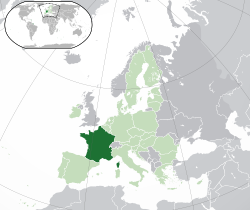
  France, officially the French Republic (French: République française), is a sovereign state comprising territory in western Europe and several overseas regions and territories . The European part of France, called Metropolitan France , extends from the Mediterranean Sea to the English Channel and the North Sea , and from the Rhine to the Atlantic Ocean . France spans 640,679 square kilometres (247,368 sq mi) and has a total population of 67 million. It is a unitary semi-presidential republic with the capital in Paris , the country’s largest city and main cultural and commercial centre. The Constitution of France establishes the state as secular and democratic, with its sovereignty derived from the people.
During the Iron Age , what is now Metropolitan France was inhabited by the Gauls , a Celtic people. The Gauls were conquered in 51 BC by the Roman Empire , which held Gaul until 486. The Gallo-Romans faced raids and migration from the Germanic Franks , who dominated the region for hundreds of years, eventually creating the medieval Kingdom of France . France emerged as a major European power in the Late Middle Ages , with its victory in the Hundred Years’ War (1337 to 1453) strengthening French state-building and paving the way for a future centralized absolute monarchy . During the Renaissance , France experienced a vast cultural development and established the beginning of a global colonial empire . The 16th century was dominated by religious civil wars between Catholics and Protestants (Huguenots).
France became Europe’s dominant cultural, political, and military power under Louis XIV . French philosophers played a key role in the Age of Enlightenment during the 18th century . In 1778, France became the first and the main ally of the new United States in the American Revolutionary War . In the late 18th century, the absolute monarchy was overthrown in the French Revolution . Among its legacies was the Declaration of the Rights of Man and of the Citizen , one of the earliest documents on human rights , which expresses the nation’s ideals to this day. France became one of modern history’s earliest republics until Napoleon took power and launched the First French Empire in 1804. Fighting against a complex set of coalitions during the Napoleonic Wars , he dominated European affairs for over a decade and had a long-lasting impact on Western culture. Following the collapse of the Empire, France endured a tumultuous succession of governments: the monarchy was restored , it was replaced in 1830 by a constitutional monarchy , then briefly by a Second Republic , and then by a Second Empire , until a more lasting French Third Republic was established in 1870. By the 1905 law , France adopted a strict form of secularism , called laïcité , which has become an important federative principle in the modern French society.
France reached its territorial height during the 19th and early 20th centuries, when it ultimately possessed the second-largest colonial empire in the world. In World War I , France was one of the main winners as part of the Triple Entente alliance fighting against the Central Powers . France was also one of the Allied Powers in World War II , but came under occupation by the Axis Powers in 1940. Following liberation in 1944, a Fourth Republic was established and later dissolved in the course of the Algerian War . The Fifth Republic , led by Charles de Gaulle , was formed in 1958 and remains to this day. Following World War II , most of the empire became decolonized .
Throughout its long history , France has been a leading global center of culture, making significant contributions to art , science , and philosophy . It hosts Europe’s third-largest number of cultural UNESCO World Heritage Sites (after Italy and Spain ) and receives around 83 million foreign tourists annually, the most of any country in the world. France remains a great power with significant cultural , economic , military , and political influence. It is a developed country with the world’s sixth-largest economy by nominal GDP and eight-largest by purchasing power parity . According to Credit Suisse, France is the fourth wealthiest nation in the world in terms of aggregate household wealth. It also possesses the world’s second-largest exclusive economic zone (EEZ), covering 11,035,000 square kilometres (4,261,000 sq mi).
French citizens enjoy a high standard of living , and the country performs well in international rankings of education , health care , life expectancy , civil liberties, and human development . France is a founding member of the United Nations , where it serves as one of the five permanent members of the UN Security Council . It is a member of the Group of 7 , North Atlantic Treaty Organization (NATO), Organisation for Economic Co-operation and Development (OECD), the World Trade Organization (WTO), and La Francophonie . France is a founding and leading member state of the European Union (EU).
|