|
Belarus
John The Baptist Catholic Church Series: Belarusian Architectural Monuments
2014 Proof Silver 20 Roubles 38.61mm (33.62 grams) 0.925 Silver (1.0001 oz. ASW)
Reference: KM# 467 (Mintage: 1,000) | Designer: S. Zaskevich
РЭСПУБЛІКА БЕЛАРУСЬ ДВАЦЦАЦЬ РУБЛЁЎ Ag 925 2014, Coat-of-Arms.
КАМАI ПОМНIКI АРХIТЭКТУРЫ БЕЛАРУСI XVII-XVIII КАСЦЁЛ ЯНА ХРЫСЦIЦЕЛЯ, Birds fly past Church facade.
You are bidding on the exact item pictured, provided with a Certificate of Authenticity and Lifetime Guarantee of Authenticity.
 The Church of Saint John the Baptist (Belarusian: Касьцёл Сьвятога Яна Хрысьціцеля) is a Catholic parish church in the village Kamai in the Pastavy District of Vitebsk Region, Belarus. The church is one of the fortified churches of the former Grand Duchy of Lithuania.
The church in Kamai was founded in 1603 by Jan Rudomin Dusicki and Jan Hajecki. The name of the architect is unknown. Construction took three years so in 1606 the church was opened and was active since then. In 1643 a hospital was founded by the church for the dwellers of the village and nearby area.
During the war against Russia the church was burnt down by the Russian army, but rebuilt soon afterwards. In the Great Northern War the church got under cannon fire from the Sweden army and was damaged again. During the reconstruction of the building cannonballs were planted inside the walls as a tribute to the tragic war events.
In 1778 a chapel and a crypt were built by the southern side of the church.
 The church was active even in Soviet times, which is a rare case as communists persecuted religion and closed or even ruined many churches around the country.
In 2010-2011 the church underwent a planned repair.
The church is a beautiful example of the defensive Gothic architecture once popular in the Grand Duchy of Lithuania. Only a limited number of fortified churches survived until now so it has a great historical and architectural value. Later Renaissance elements were added.
The church was initially built in a symmetrical way with three naves supported by four columns. After the church was damaged for the first time, the columns were removed and the church became a single-nave. Dimensionally it is close to the square and has an apse and a sacristy. The facade is flanked by two cylindrical towers with rounded embrasures. Both towers are sixteen meters tall and five meters in diameter with the walls over two meters in thickness.
The outer side of the church is almost free from the decorative elements except for four niches on the upper frontside.
There is an old cross near the church. It was installed about 15th-16th century. The cross is two and a half meters high and was carved of a single granite stone.
This site was added to the UNESCO World Heritage Tentative List on January 30, 2004, in the Cultural category.
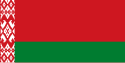 Belarus, officially the Republic of Belarus, is a landlocked country in Eastern Europe. It is bordered by Russia to the east and northeast, Ukraine to the south, Poland to the west, and Lithuania and Latvia to the northwest. Belarus covers an area of 207,600 square kilometres (80,200 sq mi), with a population of 9.4 million, and is the thirteenth-largest and the twentieth-most populous country in Europe. The country is administratively divided into seven regions, and is one of the world’s most urbanized, with over 40% of its total land area forested. Minsk is the country’s capital and largest city.
Until the 20th century, different states at various times controlled the lands of modern-day Belarus, including Kievan Rus’, the Principality of Polotsk, the Grand Duchy of Lithuania, the Polish–Lithuanian Commonwealth, and the Russian Empire. In the aftermath of the Russian Revolution in 1917, different states arose competing for legitimacy amidst the Civil War, ultimately ending in the rise of the Byelorussian SSR, which became a founding constituent republic of the Soviet Union in 1922. After the Polish-Soviet War, Belarus lost almost half of its territory to Poland. Much of the borders of Belarus took their modern shape in 1939, when some lands of the Second Polish Republic were reintegrated into it after the Soviet invasion of Poland, and were finalized after World War II. During WWII, military operations devastated Belarus, which lost about a quarter of its population and half of its economic resources. The republic was redeveloped in the post-war years. In 1945, the Byelorussian SSR became a founding member of the United Nations, along with the Soviet Union.
 The parliament of the republic proclaimed the sovereignty of Belarus on 27 July 1990, and during the dissolution of the Soviet Union, Belarus declared independence on 25 August 1991. Following the adoption of a new constitution in 1994, Alexander Lukashenko was elected Belarus’s first president in the country’s first and only free election post-independence, serving as president ever since. Lukashenko’s government is widely considered to be authoritarian and human rights groups consider human rights in the country to be poor. Belarus is the only country in Europe officially using the death penalty. Lukashenko continued a number of Soviet-era policies, such as state ownership of large sections of the economy. In 2000, Belarus and Russia signed a treaty for greater cooperation, forming the Union State.
Belarus is a developing country ranking very high in the Human Development Index. It has been a member of the United Nations since its founding; and a member of the CIS, the CSTO, the EAEU, and the Non-Aligned Movement, it has shown no aspirations for joining the European Union but nevertheless maintains a bilateral relationship with the Union, and likewise participates in two EU projects: the Eastern Partnership and the Baku Initiative.
|


