|
Greece
Europa Star – Baroque & Rococo – Adamantios Korais
2018 Proof Silver 10 Euro 28.25mm (31.10 grams) 0.925 Silver
Reference: KM# 308 (Mintage: 5,000) | Engraver: Geórgios Stamatópoulos
ΜΠΑΡΟΚ ΡΟΚΟΚΟ ΕΛΛΗΝΙΚΗ ΔΗΜΟΚΡΑΤΙΑ 2018, Portrait of Adamantios Korais (1748-1833), a great humanist scholar regarded as the maintainer of the Greek language.
Αδαμάντιος Κοραής 10 ΕΥΡΩ, The Greek Coat of Arms and the large and small Europa Star logos are shown.
Coin Notes:
The Baroque & Rococo period, which was marked in Europe by the Enlightenment and the French Revolution, found Greece under Ottoman rule and thus effectively cut off from the artistic and intellectual trends in the rest of Europe. However, the non-Ottoman occupied regions (such as the Venetian-ruled Ionian Islands), but also the Greek communities in major European cities, were in contact with Europe’s cultural developments and became centres of Modern Greek Enlightenment. The most emblematic figure of this movement was Adamantios Korais (1748-1833), born into a merchant family in Smyrna. After studying in Amsterdam and Montpellier, he settled in Paris and played a key role in spreading the ideas of the Enlightenment to the Greek people. He edited and published works of ancient Greek authors and wrote scientific, literary, theological and political treatises. Many of his views were pivotal in shaping the identity and ideology of the newly-established Greek State. His portrait features on the coin, surrounded by ornamental motifs from iconostases of Ionian Island churches.
You are bidding on the exact item pictured, provided with a Certificate of Authenticity and Lifetime Guarantee of Authenticity.
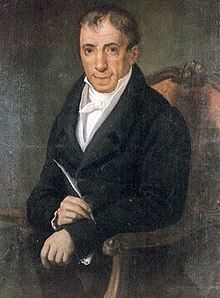 Adamantios Korais or Koraïs (Greek: Ἀδαμάντιος Κοραῆς 27 April 1748 – 6 April 1833) was a Greek scholar credited with laying the foundations of modern Greek literature and a major figure in the Greek Enlightenment. His activities paved the way for the Greek War of Independence and the emergence of a purified form of the Greek language, known as Katharevousa. Encyclopædia Britannica asserts that “his influence on the modern Greek language and culture has been compared to that of Dante on Italian and Martin Luther on German”.
Korais’s most lasting contributions were literary. Those who were instrumental in publishing, and presenting his work to the public were merchants from Chios. He felt eternally grateful to these merchants, since without them, it would have been financially impossible for him to publish his works. These works included Strabo in Greek, another on Marcus Aurelius, his translation of Herodotus, the translation of the Iliad, and his main literary work, the seventeen volumes of the “Library of Greek Literature”.
His political writing begins with the publication at the opening of the nineteenth century of Asma Polemistirion (“War Chant”) and Salpisma Polemistirion (“Military Bugal Call”), celebrating the presence of Greek troops fighting alongside the French in Egypt. Earlier he had confronted with his Adelphiki Didaskalia the Orthodox Patriarch of Jerusalem for urging the Sultan’s Christian subjects (with the religious brochure Patriki Didaskalia) to support the Ottomans in the war against the “atheistic” French. On contrary, he made a call to the Greeks to fight beside the French, “who have the military virtue of the ancient Greeks”, against the Ottoman tyranny.
Korais went on to publish in 1803 his Report on the Present State of Civilization in Greece, based on a series of lectures he had given in Paris, extolling the link between the rise of a new Greek mercantile class and the advance of the Greek Enlightenment or Diafotismos. In What should we Greeks do in the Present Circumstances?, a work of 1805, he tried to win his compatriots over to Napoleon and away from the cause of their Russian co-religionists. In later years, though, his enthusiasm for the French Emperor diminished, and he ended by referring to him as the ‘tyrant of tyrants.’
Away from contemporary politics, Korais did much to revive the idea of Greece with the creation of the Hellenic Library, devoted to new editions of some of the classic texts, starting with Homer in 1805. Over the following twenty years many others appeared, with lengthy prefaces by Korais entitled ‘Impromptu Reflections’, with his views on political, educational and linguistic matters. Although the broad mass of the Greek people was beyond his reach, he played an important part in the shaping of a new consciousness among the intelligentsia, which was to play a part in the creation of a new national movement.
With the breakout of the Greek revolution in 1821, he was too old to join the struggle. However his house in Paris became a centre for informations, meetings among the Parisian Greeks and financial aid. He wrote also many letters advising the revolutionaries. Initially a supporter of Kapodistrias, finally he opposed his policies.
 Greece, Hellenic Republic (Greek: Ελληνική Δημοκρατία), historically also known as Hellas, is a country in Southern Europe, with a population of approximately 11 million as of 2016. Athens is the nation’s capital and largest city, followed by Thessaloniki.
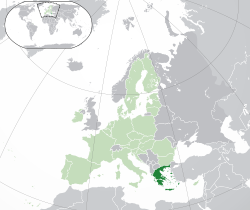
Greece is located at the crossroads of Europe, Asia, and Africa. Situated on the southern tip of the Balkan peninsula, it shares land borders with Albania to the northwest, the Republic of Macedonia and Bulgaria to the north, and Turkey to the northeast. The Aegean Sea lies to the east of the mainland, the Ionian Sea to the west, the Cretan Sea and the Mediterranean Sea to the south. Greece has the longest coastline on the Mediterranean Basin and the 11th longest coastline in the world at 13,676 km (8,498 mi) in length, featuring a large number of islands, of which 227 are inhabited. Eighty percent of Greece is mountainous, with Mount Olympus being the highest peak at 2,918 metres (9,573 ft). The country consists of nine geographic regions: Macedonia, Central Greece, the Peloponnese, Thessaly, Epirus, the Aegean Islands (including the Dodecanese and Cyclades), Thrace, Crete, and the Ionian Islands.
 Greece is considered the cradle of Western civilization,,[a] being the birthplace of democracy, Western philosophy, the Olympic Games, Western literature, historiography, political science, major scientific and mathematical principles, and Western drama.[12] From the eighth century BC, the Greeks were organised into various independent city-states, known as polis, which spanned the entire Mediterranean region and the Black Sea. Philip of Macedon united most of the Greek mainland in the fourth century BC, with his son Alexander the Great rapidly conquering much of the ancient world, spreading Greek culture and science from the eastern Mediterranean to the Indus River. Greece was annexed by Rome in the second century BC, becoming an integral part of the Roman Empire and its successor, the Byzantine Empire, wherein the Greek language and culture were dominant. The Greek Orthodox Church also shaped modern Greek identity and transmitted Greek traditions to the wider Orthodox World. Falling under Ottoman dominion in the mid-15th century, the modern nation state of Greece emerged in 1830 following a war of independence. Greece’s rich historical legacy is reflected by its 18 UNESCO World Heritage Sites, among the most in Europe and the world.
Greece is a democratic and developed country with an advanced high-income economy, a high quality of life, and a very high standard of living. A founding member of the United Nations, Greece was the tenth member to join the European Communities (precursor to the European Union) and has been part of the Eurozone since 2001. It is also a member of numerous other international institutions, including the Council of Europe, the North Atlantic Treaty Organization (NATO), the Organisation for Economic Co-operation and Development (OECD), the World Trade Organization (WTO), the Organization for Security and Co-operation in Europe (OSCE), and the Organisation internationale de la Francophonie (OIF). Greece’s unique cultural heritage, large tourism industry, prominent shipping sector and geostrategic importance[b] classify it as a middle power. It is the largest economy in the Balkans, where it is an important regional investor.
|