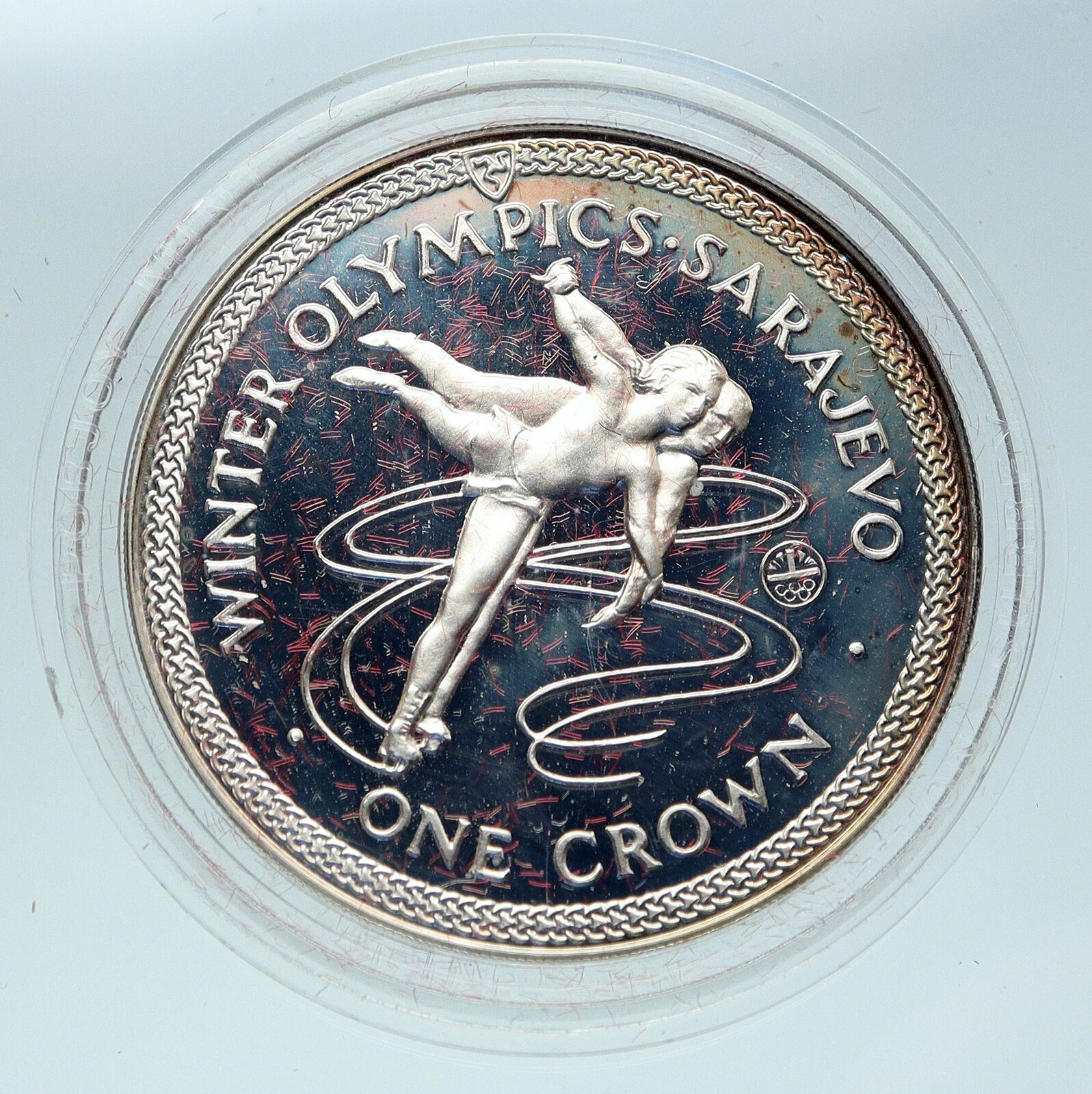
|
Isle of Man – ruled by Queen Elizabeth II (1952-2022)
‘St George’ – 200th anniversary of The Order of Saint Michael and Saint George
2018 Proof Silver 1 Angel 38.6mm (31.103g) 0.999 Silver (1.0 oz ASW)
Tower Mint, London Mintage: 15,500 Designer: Jody Clark
Reference: KM# 1612; N# 143974
QUEEN ELIZABETH II ISLE OF MAN JC 2018, Right facing, uncouped bust of Queen Elizabeth II, wearing the George IV State Diadem and the Victorian Coronation Necklace.
Ag. 999. 1 OUNCE ANGEL, Archangel Michael slaying a dragon.
You are bidding on the exact item pictured, provided with a Certificate of Authenticity and Lifetime Guarantee of Authenticity.
 Michael (Hebrew: מִיכָאֵל, translit. Micha’el or Mîkhā’ēl, lit. ‘Who is like God?’; Greek: Μιχαήλ, translit. Mikhaḗl; Latin: Michael or Michahel; Arabic: ميخائيل, translit. Mīkhā’īl) is an archangel in Judaism, Christianity, and Islam. In Roman Catholic, Eastern Orthodox, Anglican, and Lutheran traditions, he is called “Saint Michael the Archangel” and “Saint Michael”. In the Oriental Orthodox and Eastern Orthodox traditions, he is called “Taxiarch Archangel Michael” or simply “Archangel Michael”.
Michael is mentioned three times in the Book of Daniel, once as a “great prince who stands up for the children of your people”. The idea that Michael was the advocate of the Jews became so prevalent that, in spite of the rabbinical prohibition against appealing to angels as intermediaries between God and his people, Michael came to occupy a certain place in the Jewish liturgy.
In the New Testament Michael leads God’s armies against Satan’s forces in the Book of Revelation, where during the war in heaven he defeats Satan. In the Epistle of Jude Michael is specifically referred to as “the archangel Michael”. Christian sanctuaries to Michael appeared in the 4th century, when he was first seen as a healing angel, and then over time as a protector and the leader of the army of God against the forces of evil. By the 6th century, devotions to Archangel Michael were widespread both in the Eastern and Western Churches. Over time, teachings on Michael began to vary among Christian denominations.
 Elizabeth II (Elizabeth Alexandra Mary; 21 April 1926 – 8 September 2022) was Queen of the United Kingdom and other Commonwealth realms from 6 February 1952 until her death in 2022. She was queen regnant of 32 sovereign states over the course of her lifetime and remained the monarch of 15 realms by the time of her death. Her reign of over 70 years is the longest of any British monarch and the longest verified reign of any female head of state in history.
Elizabeth was born in Mayfair, London, during the reign of her paternal grandfather, King George V. She was the first child of the Duke and Duchess of York (later King George VI and Queen Elizabeth The Queen Mother). Her father acceded to the throne in 1936 upon the abdication of his brother Edward VIII, making the ten-year-old Princess Elizabeth the heir presumptive. She was educated privately at home and began to undertake public duties during the Second World War, serving in the Auxiliary Territorial Service. In November 1947, she married Philip Mountbatten, a former prince of Greece and Denmark, and their marriage lasted 73 years until his death in 2021. They had four children: Charles, Anne, Andrew, and Edward.
When her father died in February 1952, Elizabeth, then 25 years old, became queen of seven independent Commonwealth countries: the United Kingdom, Canada, Australia, New Zealand, South Africa, Pakistan, and Ceylon (known today as Sri Lanka), as well as head of the Commonwealth. Elizabeth reigned as a constitutional monarch through major political changes such as the Troubles in Northern Ireland, devolution in the United Kingdom, the decolonisation of Africa, and the United Kingdom’s accession to the European Communities and withdrawal from the European Union. The number of her realms varied over time as territories gained independence and some realms became republics. As queen, Elizabeth was served by more than 170 prime ministers across her realms. Her many historic visits and meetings included state visits to China in 1986, to Russia in 1994, and to the Republic of Ireland in 2011, and meetings with five popes and fourteen US presidents.
Significant events included Elizabeth’s coronation in 1953 and the celebrations of her Silver, Golden, Diamond, and Platinum jubilees in 1977, 2002, 2012, and 2022, respectively. Although she faced occasional republican sentiment and media criticism of her family “particularly after the breakdowns of her children’s marriages, her annus horribilis in 1992, and the death in 1997 of her former daughter-in-law Diana support for the monarchy in the United Kingdom remained consistently high throughout her lifetime, as did her personal popularity. Elizabeth died aged 96 at Balmoral Castle in September 2022, and was succeeded by her eldest son, Charles III.
  The Isle of Man, also known simply as Mann, is a self-governing Crown dependency in the Irish Sea between the islands of Great Britain and Ireland. The head of state is Queen Elizabeth II, who holds the title of Lord of Mann. The Lord of Mann is represented by a Lieutenant Governor. Foreign relations and defence are the responsibility of the British Government.
 The island has been inhabited since before 6500 BC. Gaelic cultural influence began in the 5th century and the Manx language, a branch of the Gaelic languages, emerged. In 627, Edwin of Northumbria conquered the Isle of Man along with most of Mercia. In the 9th century, Norsemen established the Kingdom of the Isles. Magnus III, King of Norway, was also known as King of Mann and the Isles between 1099 and 1103.
In 1266, the island became part of Scotland under the Treaty of Perth, after being ruled by Norway. After a period of alternating rule by the kings of Scotland and England, the island came under the feudal lordship of the English Crown in 1399. The lordship revested into the British Crown in 1765, but the island never became part of the Kingdom of Great Britain or its successor the United Kingdom: it retained its status as an internally self-governing Crown dependency.
|