|
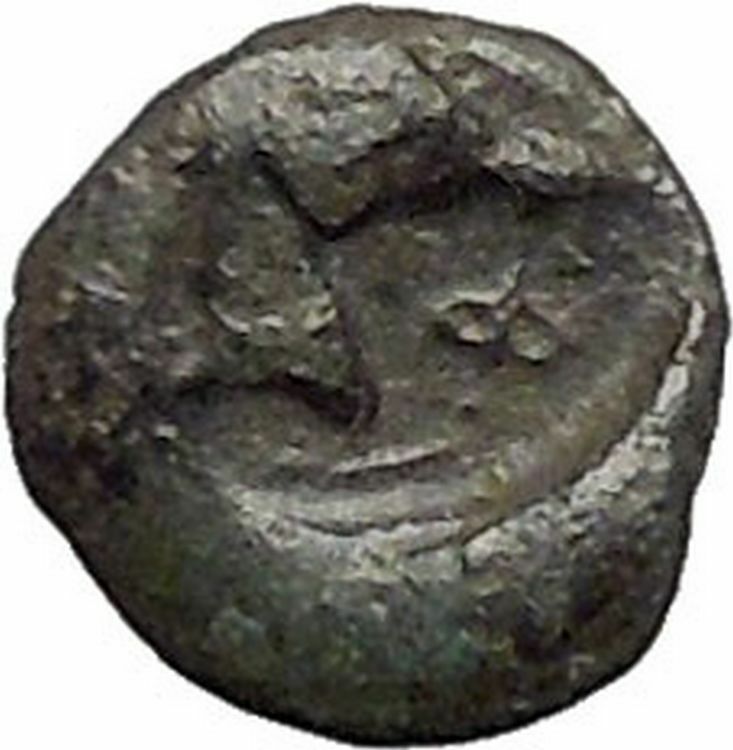
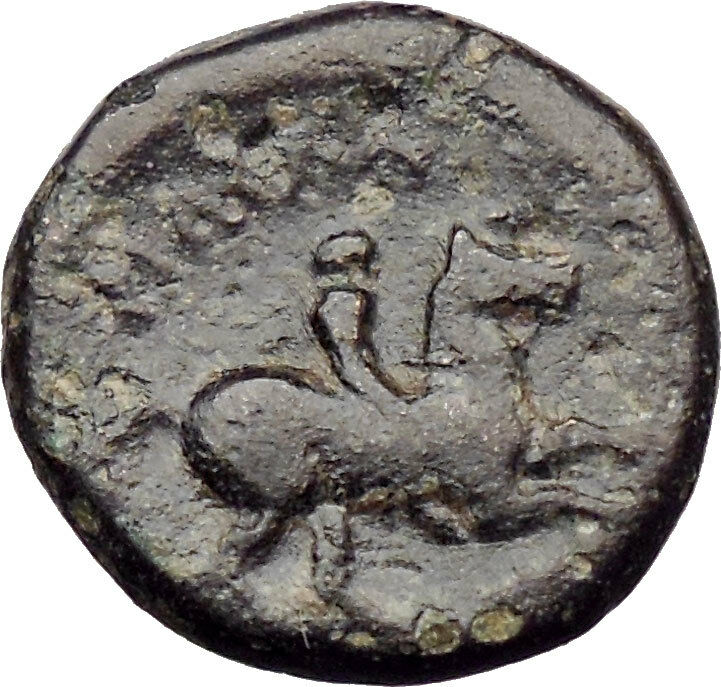
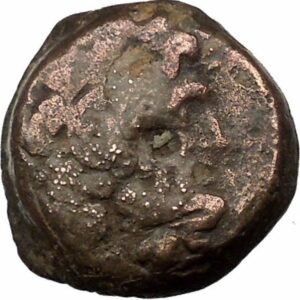
Greek city of Elaioussa (Elaiussa) Sebaste on Island off Cilicia
Bronze 18mm (6.58 grams) Struck 1st Century (circa 100 B.C. – 0 B.C.)
Reference: SNG France -; SNG Levante 828 corr. (reading ‘Σ’ behind head).
Certification: NGC Ancients Ch VF 6155925-010
Laureate head of Zeus right; KI behind.
EΛAIOYΣΙΩN, Nike advancing left, holding wreath; two monograms to outer left.
You are bidding on the exact item pictured, provided with a Certificate of Authenticity and Lifetime Guarantee of Authenticity.
 In Greek mythology, Nike was a goddess who personified victory, also known as the Winged Goddess of Victory. The Roman equivalent was Victoria. Depending upon the time of various myths, she was described as the daughter of Pallas (Titan) and Styx (Water) and the sister of Kratos (Strength), Bia (Force), and Zelus (Zeal). Nike and her siblings were close companions of Zeus, the dominant deity of the Greek pantheon. According to classical (later) myth, Styx brought them to Zeus when the god was assembling allies for the Titan War against the older deities. Nike assumed the role of the divine charioteer, a role in which she often is portrayed in Classical Greek art. Nike flew around battlefields rewarding the victors with glory and fame.
Nike is seen with wings in most statues and paintings. Most other winged deities in the Greek pantheon had shed their wings by Classical times. Nike is the goddess of strength, speed, and victory. Nike was a very close acquaintance of Athena, and is thought to have stood in Athena’s outstretched hand in the statue of Athena located in the Parthenon. Nike is one of the most commonly portrayed figures on Greek coins.
Names stemming from Nike include amongst others: Nicholas, Nicola, Nick, Nikolai, Nils, Klaas, Nicole, Ike, Niki, Nikita, Nika, Niketas, and Nico.
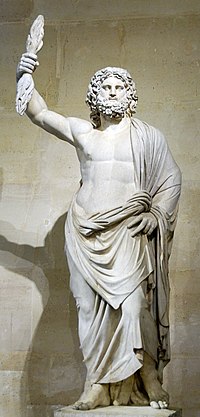 In the ancient Greek religion, Zeus was the “Father of Gods and men” who ruled the Olympians of Mount Olympus as a father ruled the family. He was the god of sky and thunder in Greek mythology. His Roman counterpart is Jupiter and Etruscan counterpart is Tinia.
Zeus was the child of Cronus and Rhea, and the youngest of his siblings. In most traditions he was married to Hera, although, at the oracle of Dodona, his consort was Dione: according to the Iliad, he is the father of Aphrodite by Dione. He is known for his erotic escapades. These resulted in many godly and heroic offspring, including Athena, Apollo and Artemis, Hermes, Persephone (by Demeter), Dionysus, Perseus, Heracles, Helen of Troy, Minos, and the Muses (by Mnemosyne); by Hera, he is usually said to have fathered Ares, Hebe and Hephaestus.
As Walter Burkert points out in his book, Greek Religion, “Even the gods who are not his natural children address him as Father, and all the gods rise in his presence.” For the Greeks, he was the King of the Gods, who oversaw the universe. As Pausanias observed, “That Zeus is king in heaven is a saying common to all men”. In Hesiod’s Theogony Zeus assigns the various gods their roles. In the Homeric Hymns he is referred to as the chieftain of the gods.
His symbols are the thunderbolt, eagle, bull, and oak. In addition to his Indo-European inheritance, the classical “cloud-gatherer” also derives certain iconographic traits from the cultures of the Ancient Near East, such as the scepter. Zeus is frequently depicted by Greek artists in one of two poses: standing, striding forward, with a thunderbolt leveled in his raised right hand, or seated in majesty.
Elaiussa Sebaste or Elaeousa Sebaste (Greek: Ελαιούσα Σεβαστή) was an ancient Roman town located 55 km (34 mi) from Mersin in the direction of Silifke in Cilicia on the southern coast of Anatolia (in the modern-day town of Ayaş (there is a like-named town in Ankara province), Turkey). Elaiussa, meaning olive, was founded in the 2nd century B.C. on a tiny island attached to the mainland by a narrow isthmus in the Mediterranean Sea.
Besides the cultivation of olives, the settlement here of the Cappadocian king Archelaus during the reign of the Roman Emperor Augustus played a role in the development of the city. Founding a new city on the isthmus, Archelaus called it Sebaste, which is the Greek equivalent word of the Latin “Augusta”. The city entered a golden age when the Roman Emperor Vespasian purged Cilicia of pirates in 74 AD. Towards the end of the 3rd century AD however its importance began to wane, owing in large part to incursions by the Sassanian King Shapur I in 260 and later by the Isaurians. The ancient sources tell the history of city’s existence and how the churches and basilicas survived into the late Roman and early Byzantine periods. When its neighbor Corycus began to flourish in the 6th century AD, Elaiussa Sebaste was slowly obliterated from the stage of history.
The island that was the site of the first settlement here, where excavations have been underway since 1995 headed by Italian archeologist Eugenia Equini Schneider, is almost completely buried under sand. The original settlement, at a location that provided security for the harbors on either side, is a peninsula today. The ruins of a bath, a cistern, a defense wall and a breakwater can be seen on the side overlooking the western bay of the peninsula. But the most important remains unearthed in the city are a bath whose floor is paved with mosaics and a small basilica on a circular base.

A building on the main street of city (east of the theater)
On the opposite side of the highway  D.400 that divides Elaiussa and Sebaste today stands a theater dating to the 2nd century AD, an extremely small structure with only 23 rows of seats, whose steps and decorations succumbed to centuries of plunder. Next to the theater is the agora, built in all great probability during the imperial period. At the entrance of the agora, which is surrounded by a semi-destroyed defense wall once rose two monumental fountains in the shape of lions. Inside the agora stands a large church, its floor is covered by sand to protect the mosaic pavement. Elaiussa’s only temple stands outside the city on a hill overlooking the sea. Only two of the Corinthian columns of this temple, which had 12 on the long and 6 on the short side originally, are standing today. A large bath complex among the lemon groves between the temple and the agora was built by a technique characteristic of the ancient Roman period and little used in Anatolia.
The ruins of Elaiussa Sebaste also harbor the richest and most impressive necropolis among the cities of ancient Cilicia. The “Avenue of Graves”, located on a hill to the north of the city, preserves close to a hundred graves of various shapes and sizes scattered among the lemon trees. The aesthetic forms of these monumental graves of Cilicia Tracheia are remarkable.
The ancient aqueducts that carried water to the ruins from the Lamos (“Lemon”) river also adorn the city’s two entrances. The aqueduct to the west of the city in particular is in relatively good condition. Centuries ago these aqueducts formed a canal system that ran all the way to Corycus.
A lidded sarcophagus lies on a small rise exactly opposite the aqueduct. Known as “the Grave of the Princess”, this sarcophagus is a prime example of the Anatolian tomb tradition.
In antiquity, Cilicia was the south coastal region of Asia Minor and existed as a political entity from Hittite times into the Armenian Kingdom of Cilicia during the late Byzantine Empire. Extending inland from the southeastern coast of modern Turkey, Cilicia is due north and northeast of the island of Cyprus and corresponds to the modern region of Çukurova in Turkey.

|