|
Greek city of
Seteisken
in
Iberia (Spain)
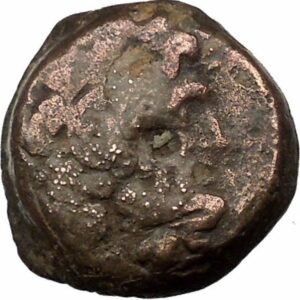
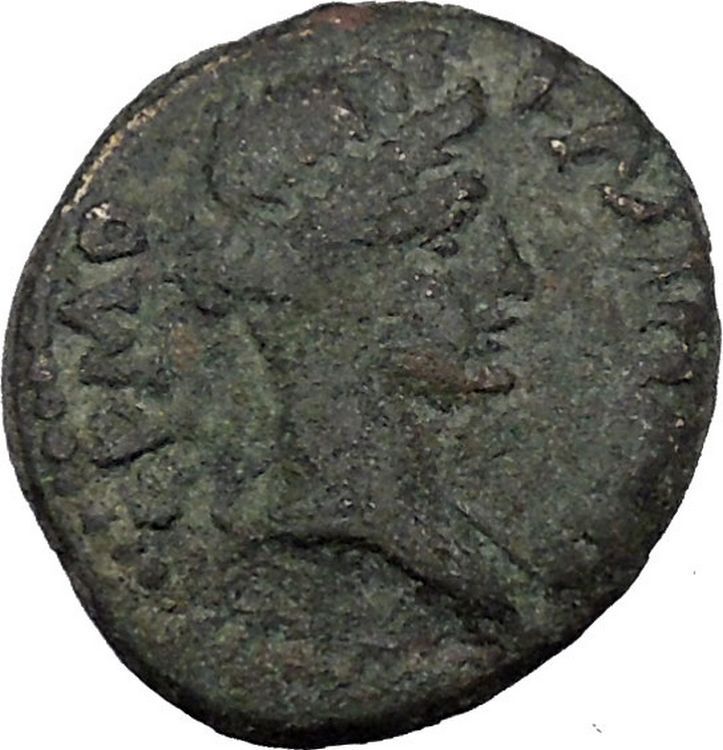
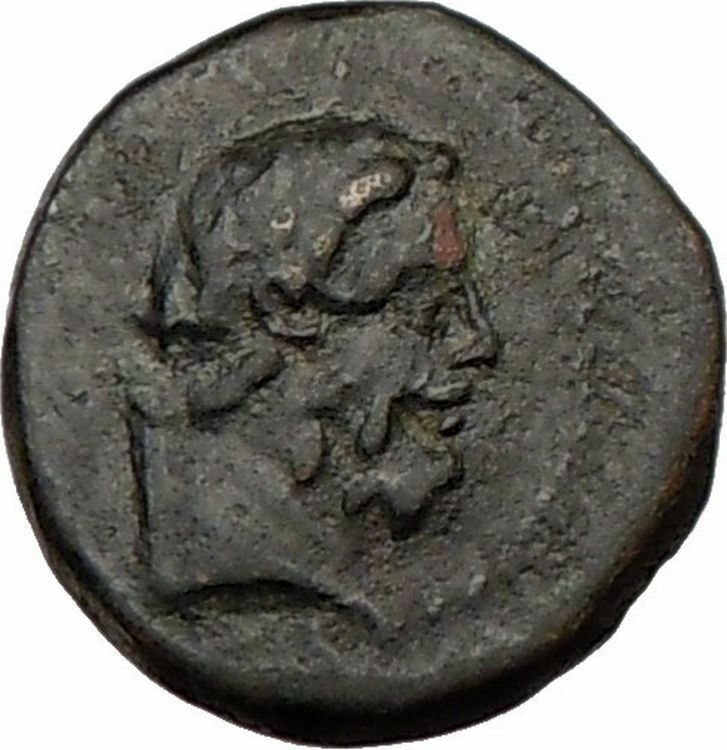
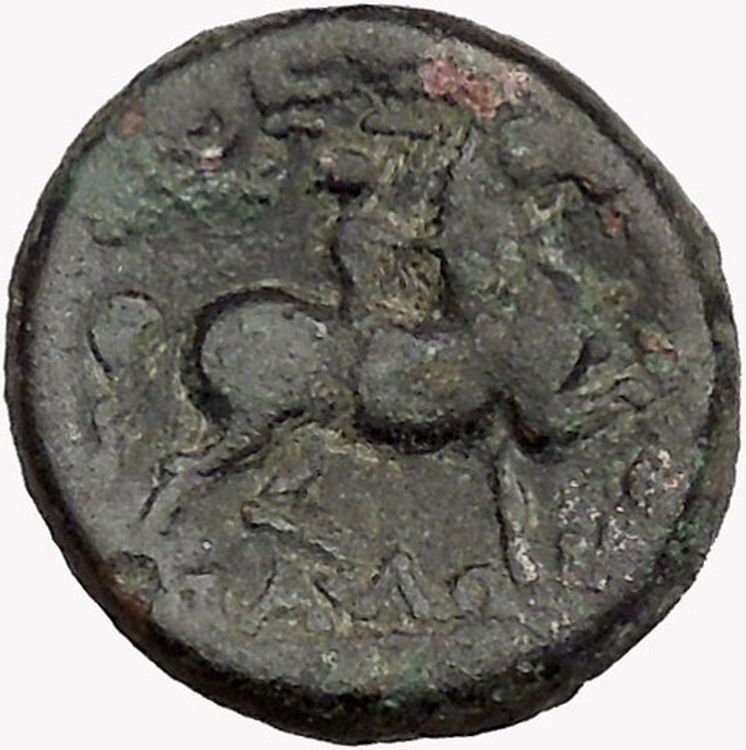
Bronze 24mm (10.07 grams) Struck circa 143-100 B.C.
Reference: ACIP 1461; SNG BM Spain 788-9
Male head
right; three dolphins around.
Warrior, holding palm frond, on horseback rearing right; Iberian legend below.
You are bidding on the exact item pictured,
provided with a Certificate of Authenticity and Lifetime Guarantee of
Authenticity.
The Iberian Peninsula (Asturian,
Galician
,
Leonese
,
Mirandese
,
Portuguese
,
Spanish
:
Península ibérica;
Catalan
:
Península Ibèrica;
Aragonese
,
Occitan
:
Peninsula Iberica;
French
:
Péninsule Ibérique;
Basque
:
Iberiar Penintsula), commonly called Iberia //,
is the third largest
European
peninsula
(after the
Scandinavian
and
Balkan
peninsulas); it is located in the
extreme southwest of the continent. The area is approximately 582,000 km2
(225,000 sq mi). There are three
countries
in it (in addition to sub-territories
of France and
Britain
):
Spain
,
Portugal
,
Andorra
, as well as a part of
France
and the
British Overseas Territory
of
Gibraltar
.
Geography
The Iberian Peninsula is the westernmost of the three major southern European
peninsulas—the Iberian,
Italian
, and
Balkan
. It is bordered on the south-east and
east by the
Mediterranean Sea
, and on the north, west, and
southwest by the
Atlantic Ocean
. The
Pyrenees
mountains form the north-east edge of
the peninsula, separating it from the rest of Europe. Its southern tip is very
close to the northwest coast of
Africa
, separated from it by the
Strait of Gibraltar
.
Name
Iberian Peninsula and southern France, satellite photo on a rare
cloudless day in March 2014
Greek name
The English word Iberia was adapted from the use of the
Ancient Greek
word Ιβηρία (Ibēría) by Greek
geographers under the rule of the
Roman Empire
to refer to what is known today in
English as the Iberian Peninsula.[1]
At that time, the name did not describe a single political entity or a distinct
population of people.[2]
Strabo’s Iberia was delineated from Keltikē (Gaul)
by the Pyrenees[3]
and included the entire land mass south-west (he says “west”) of there.[4]
The ancient Greeks discovered the Iberian Peninsula by voyaging westward.[5]
Hecataeus of Miletus
was the first known to use
the term around 500 BC.[6]
Herodotus
of Halicarnassus says of the
Phocaeans
that “it was they who made the Greeks
acquainted with … Iberia.”[7]
According to Strabo
,[8]
prior historians used Iberia to mean the country “this side of the Ἶβηρος
(Ibēros)” as far north as the river
Rhône
in
France
, but currently they set the
Pyrenees
as the limit.
Polybius
respects that limit,[9]
but identifies Iberia as the Mediterranean side as far south as
Gibraltar
, with the Atlantic side having no
name. Elsewhere[10]
he says that Saguntum
is “on the seaward foot of the range
of hills connecting Iberia and Celtiberia.”
Strabo[11]
refers to the Carretanians as people “of the Iberian stock” living in the
Pyrenees, who are to be distinguished from either Celts or Celtiberians.
Roman names
Main article:
Hispania
Generally, Greek authors used Iberia and Latin authors used
Hispania, but when the Romans encountered the writings of the Greek
geographers, they began to use the word Iberia and spoke occasionally of
the Iberi.[3][12]
The first mention in Roman literature was by the annalist poet
Quintus Ennius
in 200 BC.[13][14][15]
The Romans had broad experience with the peoples on the peninsula acquired
during the long conflict with
Carthage
.
Virgil
refers to the Ipacatos Hiberos
(“restless Iberi”) in his
Georgics
.[16]
The Roman geographers and other prose writers from the time of the late
Roman Republic
called the entire peninsula
Hispania
.
As they became politically interested in the former Carthaginian territories,
the Romans began to use the names Hispania Citerior and Hispania
Ulterior for ‘near’ and ‘far’ Hispania. Even at that time Hispania included
Lusitania
(Portugal
south of the Douro
river and
Extremadura
in western Spain),
Gallaecia
(Northern
Portugal and
Galicia
in Spain),
Celtiberia
(central Spain),
Baetica
(Andalusia),
Cantabria
(North-West Spain) and the territory
of the Vascones
, likely the ancestors of the
present-day Basques
. Strabo says[8]
that the Romans use Hispania and Iberia synonymously,
distinguishing between the near and the far. He was living in a
time when the peninsula was divided into Roman provinces, of which
Baetia
was supervised by the Senate, whereas
the others were governed directly on behalf of the Emperor. Whatever language
may generally have been spoken on the peninsula soon gave way to Latin, except
for that of the Vascones, which was preserved as a
language isolate
by the barrier of the
Pyrenees.
Etymology
Northeast Iberian script from
Huesca
.
The Iberian Peninsula has always been associated with the
Ebro River
, Ibēros in
ancient Greek
and Ibērus or Hibērus in
Latin
. The association was so well known it was
hardly necessary to state; for example, Ibēria was the country “this side of the
Ibērus” in Strabo.
Pliny
goes so far as to assert that the Greeks
had called “the whole of Spain” Hiberia because of the Hiberus River.[17]
The river appears in the
Ebro Treaty
of 226 BC between Rome and
Carthage, setting the limit of Carthaginian interest at the Ebro. The fullest
description of the treaty, stated in
Appian
,[18]
uses Ibērus. With reference to this border,
Polybius
[19]
states that the “native name” is Ibēr, apparently the original word,
stripped of its Greek or Latin -os or -us termination.
The early range of these natives, stated by the geographers and historians to
be from southern Spain to southern France along the Mediterranean coast, is
marked by instances of a readable script expressing a yet unknown language,
dubbed “Iberian.”
Whether this was the native name or was given to them by the Greeks for their
residence on the Ebro remains unknown. Credence in Polybius imposes certain
limitations on etymologizing: if the language remains unknown, the meanings of
the words, including Iber, must also remain unknown. In modern
Basque
, the word ibar[20]
means ‘valley’ or ‘watered meadow’, while ibai[20]
means ‘river’, but there is no proof relating the etymology of the Ebro River
with these Basque names.
Prehistory
Main article:
Prehistoric Iberia
Schematic rock art from the Iberian Peninsula.
Iberian Late Bronze Age since c. 1300 BC
Palaeolithic
The Iberian Peninsula has been inhabited for at least 1,000,000 years as
remains found in the sites at
Atapuerca
demonstrate. Among these sites is the
cave of
Gran Dolina
, where six
hominin
skeletons, dated between 780,000 and
one million years ago, were found in 1994. Experts have debated whether these
skeletons belong to the species
Homo erectus
,
Homo heidelbergensis
, or a new species
called
Homo antecessor
.
Around 200,000 BC, during the
Lower Paleolithic
period, Neanderthals first
entered the Iberian Peninsula. Around 70,000 BC, during the
Middle Paleolithic
period, the last glacial
event began and the Neanderthal
Mousterian
culture was established. Around
35,000 BC, during the
Upper Paleolithic
, the Neanderthal
Châtelperronian
cultural period began.
Emanating from
Southern France
, this culture extended into the
north of the peninsula. It continued to exist until around 28,000 BC, when
Neanderthal man faced extinction.
At about the
40th millennium BC
,
modern humans
entered the Iberian Peninsula
from
Southern France
.[21]
Here, this
genetically homogeneous population
(characterized by the M173
mutation
in the
Y-chromosome
), developed the
M343
mutation, giving rise to the
R1b
Haplogroup
, still the most common in modern
Portuguese
and
Spanish
males.[22]
On the Iberian Peninsula, modern Humans developed a series of different
cultures, such as the
Aurignacian
,
Gravettian
,
Solutrean
and
Magdalenian cultures
, some of them
characterized by complex forms of
Paleolithic art
.
Neolithic
During the
Neolithic expansion
, various
megalithic
cultures developed in the Iberian
Peninsula. An open seas navigation culture from the east Mediterranean, called
the
Cardium culture
, also extended its influence to
the eastern coasts of the peninsula, possibly as early as the 5th millennium BC.
These people may have had some relation to the subsequent development of the
Iberian civilization
.
Chalcolithic
In the
Chalcolithic
or Copper Age (c. 3000 BC), a
series of complex cultures developed that would give rise to the peninsula’s
first civilizations and to extensive exchange networks reaching to the
Baltic
,
Middle East
and
North Africa
. Around 2800 – 2700 BC, the
Bell Beaker culture
, which produced the
Maritime Bell Beaker, probably originated in the vibrant copper—using
communities of the Tagus
estuary in
Portugal
and spread from there to many parts of
western Europe.[23]
Bronze Age
Bronze Age
cultures developed beginning c.1800
BC, when the civilization of
Los Millares
was followed by that of
El Argar
. From this centre, bronze technology
spread to other areas, such as those of the
Bronze of Levante
,
South-Western Iberian Bronze
and
Cogotas I
.
In the Late Bronze Age, the urban civilisation of
Tartessos
developed in the area of modern
western Andalusia
, characterized by
Phoenician
influence and using the
Tartessian script
for its
Tartessian language
, not related to the
Iberian language
.
Early in the first millennium BC, several waves of Pre-Celts and
Celts
migrated from
Central Europe
, thus partially changing the
peninsula’s ethnic landscape to
Indo-European
in its northern and western
regions. In North-Western Iberia (Northern Portugal, Asturias and Galicia), a
Celtic culture developed, the
Castro culture
, with a large number of hill
forts and some fortified cities.
Proto-history
Main article:
Pre-Roman peoples of the Iberian Peninsula
By the Iron Age
, starting in the 7th century BC, the
Iberian Peninsula consisted of complex agrarian and urban civilizations, either
Pre-Celtic or Celtic (such as the
Lusitanians
,
Celtiberians
,
Gallaeci
,
Astur
,
Celtici
and others), the cultures of the
Iberians
in the eastern and southern zones and
the cultures of the
Aquitanian
in the western portion of the
Pyrenees
.
The seafaring
Phoenicians
,
Greeks
and
Carthaginians
successively settled along the
Mediterranean coast and founded trading colonies there over a period of several
centuries. Around 1100 BC, Phoenician merchants founded the trading colony of
Gadir
or Gades (modern day
Cádiz
) near
Tartessos
. In the 8th century BC, the first
Greek colonies
, such as Emporion (modern
Empúries
), were founded along the Mediterranean
coast on the East, leaving the south coast to the Phoenicians. The Greeks coined
the name Iberia, after the river Iber (Ebro).
In the 6th century BC, the
Carthaginians
arrived in the peninsula while
struggling with the Greeks for control of the Western Mediterranean. Their most
important colony was
Carthago Nova
(Latin name of modern day
Cartagena
).
History
Roman rule
Main article:
Hispania
Roman conquest of Hispania
In 218 B.C., during the
Second Punic war
against the Carthaginians, the
first Roman
troops invaded the Iberian Peninsula and
annexed it under
Augustus
after two centuries of war with the
Celtic and Iberian tribes and the Phoenician, Greek and Carthaginian colonies,
resulting in the creation of the province of
Hispania
. It was divided into
Hispania Ulterior
and
Hispania Citerior
during the late
Roman Republic
, and during the
Roman Empire
, it was divided into
Hispania Taraconensis
in the north-east,
Hispania Baetica
in the south and
Lusitania
in the south-west.
Hispania supplied the Roman Empire with food, olive oil, wine, and metal. The
emperors Trajan
,
Hadrian
, and
Theodosius I
, the philosopher
Seneca
, and the poets
Martial
and
Lucan
were born from families living on the
peninsula.
Germanic kingdoms
Main articles:
Visigothic Kingdom
and
Spania
In the early 5th century,
Germanic tribes
invaded the peninsula, namely
the Suebi
, the
Vandals
(Silingi
and Hasdingi
) and their allies, the
Sarmatian
Alans
. Only the kingdom of the Suebi (Quadi
and Marcomanni
) would endure after the arrival of
another wave of Germanic invaders, the
Visigoths
, who conquered all of the Iberian
Peninsula and expelled or partially integrated the Vandals and the Alans. The
Visigoths eventually conquered the Suebi kingdom and its capital city
Bracara
(modern day
Braga
) in 584–585. They would also conquer the
province
of the
Byzantine Empire
(552–624) of
Spania
in the south of the peninsula and the
Balearic Islands
.
Islamic rule
Main articles:
Al-Andalus
,
Islam in Spain
and
Islam in Portugal
In AD 711, a
Muslim army invaded
the
Visigothic Kingdom in Hispania
. Under
Tariq ibn-Ziyad
, the Islamic army landed at
Gibraltar
and brought most of the Iberian
Peninsula under Islamic control in an eight-year campaign.
Al-ʾAndalūs
(Arabic
الإندلس : possibly “Land of the Vandals”),[24][25]
is the Arabic name given the Iberian Peninsula by its
Muslim
Berber and Arab conquerors.
From the 8th–15th centuries, the Iberian Peninsula was incorporated into the
Islamic world and became a center of culture and learning, especially during the
Caliphate of Cordoba
, which reached its height
under the rule of
Abd ar-Rahman III
. The Muslims, which were
initially Arabs
and
Berbers
, included local Iberian converts, the
so-called Muladi
, who formed the majority of the Iberian
population by the year 1100. The Muslims were referred to by the generic name,
Moors
. Thus, before the so-called
Reconquista
gained momentum, the Iberian
Peninsula had been transformed from a mainly Romance-speaking Christian land
into a mainly
Arabic-speaking
Muslim land. However, pockets
of Arabic and
Romance-speaking
Christians called
Mozarabs
survived throughout al-Andalus, in
addition to a large minority of Arabic-speaking
Jews
.
Reconquest
Main article:
Reconquista
Many of the ousted Gothic
nobles took refuge in the unconquered
north
Asturian highlands
. From there, they aimed to
reconquer their lands from the Moors; this war of reconquest is known as the
Reconquista
. Christian and Muslim kingdoms
fought and allied among themselves. The Muslim
taifa
kings competed in patronage of the arts,
the
Way of Saint James
attracted pilgrims from all
Western Europe, and the
Jewish population
set the basis of
Sephardic
culture.[citation
needed]
During the Middle Ages, the peninsula housed many small states including
Castile
,
Aragon
,
Navarre
,
León
and
Portugal
. The peninsula was part of the Islamic
Almohad
empire until they were finally
uprooted. The last major Muslim stronghold was
Granada
, which was conquered by a combined
Castilian and Aragonese force in 1492. Muslims and Jews throughout the period
were variously tolerated or shown intolerance in different Christian kingdoms.
However, after the
conquest of Granada
, all Muslims and Jews were
ordered to convert to Christianity or face expulsion. Many Jews and Muslims fled
to North Africa
and the
Ottoman Empire
, while others publicly converted
to Christianity and became known respectively as
Marranos
and
Moriscos
. However, many of these continued to
practice their religion in secret. The Moriscos revolted several times and were
ultimately
forcibly expelled
from Spain in the early 17th
century.
Post reconquest
Main articles:
History of Andorra
,
History of Gibraltar
,
History of Portugal
and
History of Spain
Map of Spain and Portugal, Atlas historique, dated
approximately 1705–1739, of H.A. Chatelain.
The small states gradually amalgamated over time, with the exception of
Portugal, even if for a brief period (1580–1640) the whole peninsula was united
politically under the
Iberian Union
. After that point, the modern
position was reached and the peninsula now consists of the countries of
Spain
and
Portugal
(excluding their islands—the
Portuguese Azores
and
Madeira Islands
and the Spanish
Canary Islands
and
Balearic Islands
; and the Spanish
exclaves
of
Ceuta
and
Melilla
),
Andorra
,
French Cerdagne
and
Gibraltar
.
Geography and geology
Main articles:
Geography of Portugal
and
Geography of Spain
Overall
characteristics
An 18th-century map of the peninsula depicting various topographical
features of the land, as published in Robert Wilkinson’s General
Atlas, circa 1794.
Major rivers of the Iberian Peninsula:
Miño/Minho
,
Duero/Douro
,
Tajo/Tejo
,
Guadiana
,
Guadalquivir
,
Segura
,
Júcar/Xúquer
,
Ebro
.
The Iberian Peninsula extends from the southernmost extremity at
Punta de Tarifa
(36°00′15″N
5°36′37″W)
to the northernmost extremity at
Estaca de Bares Point
(43°47′38″N
7°41′17″W)
over a distance between lines of latitude of about 865 km (537 mi) based on a
degree length
of 111 km (69 mi) per degree, and
from the westernmost extremity at
Cabo da Roca
(38°46′51″N
9°29′54″W)
to the easternmost extremity at
Cap de Creus
(42°19′09″N
3°19′19″E)
over a distance between lines of longitude at 40° N latitude of about 1,155 km
(718 mi) based on an estimated degree length of about 90 km (56 mi) for that
latitude. The irregular, roughly octagonal shape of the peninsula contained
within this spherical
quadrangle
was compared to an ox-hide by the
geographer Strabo
.[26]
About three quarters of that rough octagon is the
Meseta Central
, a vast plateau ranging from 610
to 760 m in altitude.[27]
It is located approximately in the centre, staggered slightly to the east and
tilted slightly toward the west (the conventional centre of the Iberian
Peninsula has long been considered to be
Getafe
just south of
Madrid
). It is ringed by mountains and contains
the sources of most of the rivers, which find their way through gaps in the
mountain barriers on all sides.
Coastline
The coastline of the Iberian Peninsula is 3,313 km (2,059 mi), 1,660 km
(1,030 mi) on the Mediterranean side and 1,653 km (1,027 mi) on the Atlantic
side.[28]
The coast has been inundated over time, with sea levels having risen from a
minimum of 115–120 m (377–394 ft) lower than today at the
Last Glacial Maximum
(LGM) to its current level
at 4,000 years
BP
.[29]
The coastal shelf created by sedimentation during that time remains below the
surface; however, it was never very extensive on the Atlantic side, as the
continental shelf drops rather steeply into the depths. An estimated 700 km
(430 mi) length of Atlantic shelf is only 10–65 km (6.2–40.4 mi) wide. At the
500 m (1,600 ft)
isobath
, on the edge, the shelf drops off to
1,000 m (3,300 ft).[30]
The submarine topography of the coastal waters of the Iberian Peninsula has
been studied extensively in the process of drilling for oil. Ultimately, the
shelf drops into the
Bay of Biscay
on the north (an abyss), the
Iberian abyssal plain at 4,800 m (15,700 ft) on the west and Tagus abyssal plain
to the south. In the north, between the continental shelf and the abyss, is an
extension, the Galicia Bank, a plateau also containing the Porto, Vigo and Vasco
da Gama seamounts
, creating the Galicia interior basin.
The southern border of these features is marked by
Nazaré Canyon
, splitting the continental shelf
and leading directly into the abyss.
Rivers
Main articles:
List of rivers of Portugal
and
List of rivers of Spain
The major rivers flow through the wide valleys between the mountain systems.
These are the Ebro
,
Douro
,
Tagus
,
Guadiana
and
Guadalquivir
. All rivers in the Iberian
Peninsula are subject to seasonal variations in flow.
The Tagus is the longest river in the peninsula and, like the Douro, flows
westwards with its lower course in Portugal. The Guadiana bends southwards and
forms the border between Spain and Portugal in the last stretch of its course.
Mountains
Major Geologic Units of the Iberian Peninsula
The terrain of the Iberian Peninsula is largely
mountainous
. The major mountain systems are:
- The Pyrenees
and their foothills, the
Pre-Pyrenees
, crossing the isthmus of the
peninsula so completely as to allow no passage except by mountain road,
trail, coastal road or tunnel.
Aneto
in the
Maladeta
massif, at 3,404 m, is the highest
point.
- The
Cantabrian Mountains
along the northern
coast with the massive
Picos de Europa
.
Torre de Cerredo
, at 2,648 m, is the
highest point.
- The
Galicia/Trás-os-Montes Massif
in the
Northwest is made up of very old heavily eroded rocks.[31]
Pena Trevinca
, at 2,127 m, is the highest
point.
- The
Sistema Ibérico
, a complex system at the
heart of the Peninsula, in its central/eastern region. It contains a great
number of ranges and divides the watershed of the Tagus, Douro and Ebro
rivers.
Moncayo
, at 2,313 m, is the highest point.
- The
Sistema Central
, dividing the
Iberian Plateau
into a northern and a
southern half and stretching into Portugal (where the highest point of
Continental Portugal
(1,993 m) is located
in the
Serra da Estrela
).
Pico Almanzor
in the
Sierra de Gredos
is the highest point, at
2,592 m.
- The
Montes de Toledo
, which also stretches into
Portugal from the
La Mancha
natural region at the eastern
end. Its highest point, at 1,603 m, is
La Villuerca
in the
Sierra de Villuercas
,
Extremadura
.
- The
Sierra Morena
, which divides the watershed
of the Guadiana and Guadalquivir rivers. At 1,332 m,
Bañuela
is the highest point.
- The
Baetic System
, which stretches between
Cádiz
and
Gibraltar
and northeast towards
Alicante Province
. It is divided into three
subsystems:
-
Prebaetic System
, which begins west of
the
Sierra Sur de Jaén
, reaching the
Mediterranean Sea
shores in
Alicante Province
.
La Sagra
is the highest point at 2,382
m.
-
Subbaetic System
, which is in a central
position within the Baetic Systems, stretching from
Cape Trafalgar
in
Cádiz Province
across Andalusia to the
Region of Murcia
.[32]
The highest point, at 2,027 m (6,650 ft), is
Peña de la Cruz
in
Sierra Arana
.
-
Penibaetic System
, located in the far
southeastern area stretching between
Gibraltar
across the Mediterranean
coastal Andalusian provinces. It includes the highest point in the
peninsula, the 3,478 m high
Mulhacén
in the
Sierra Nevada
.[33]
Geology
Main article:
Geology of the Iberian Peninsula
The Iberian Peninsula contains rocks of every geological period from the
Ediacaran
to the
Recent
, and almost every kind of rock is
represented. World class
mineral deposits
can also be found there. The
core of the Iberian Peninsula consists of a
Hercynian
cratonic
block known as the
Iberian Massif
. On the northeast, this is
bounded by The Pyrenean fold belt
, and on the southeast it is
bounded by the
Betic Foldchain
. These twofold chains are part
of the
Alpine belt
. To the west, the peninsula is
delimited by the continental boundary formed by the
magma
poor opening of the
Atlantic Ocean
. The Hercynian Foldbelt is
mostly buried by Mesozoic and Tertiary cover rocks to the east, but nevertheless
outcrops through the
Iberian Chain
and the
Catalan Coastal Ranges
.
|