|
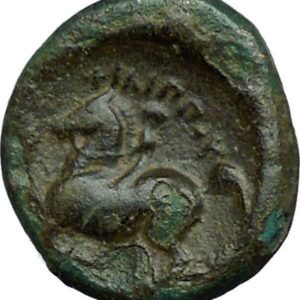
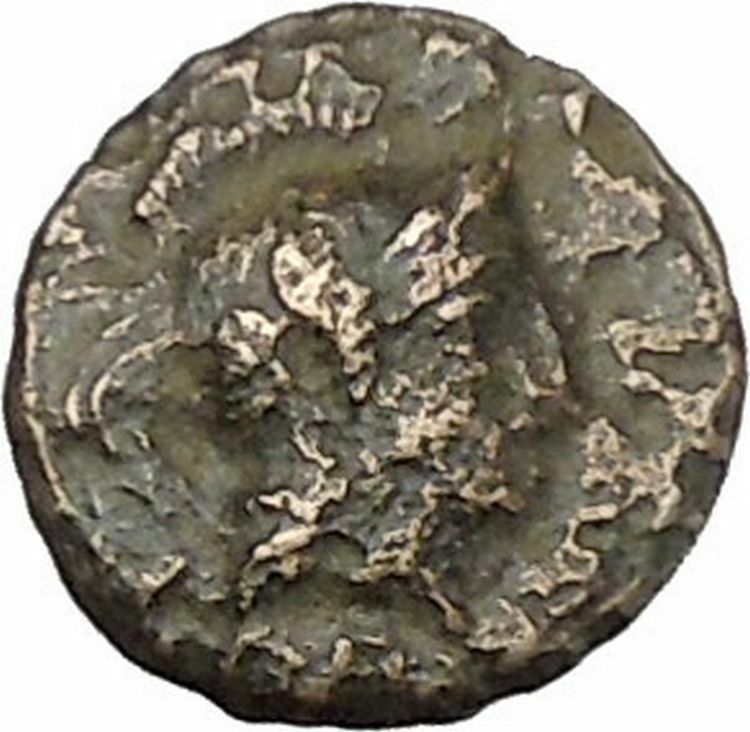
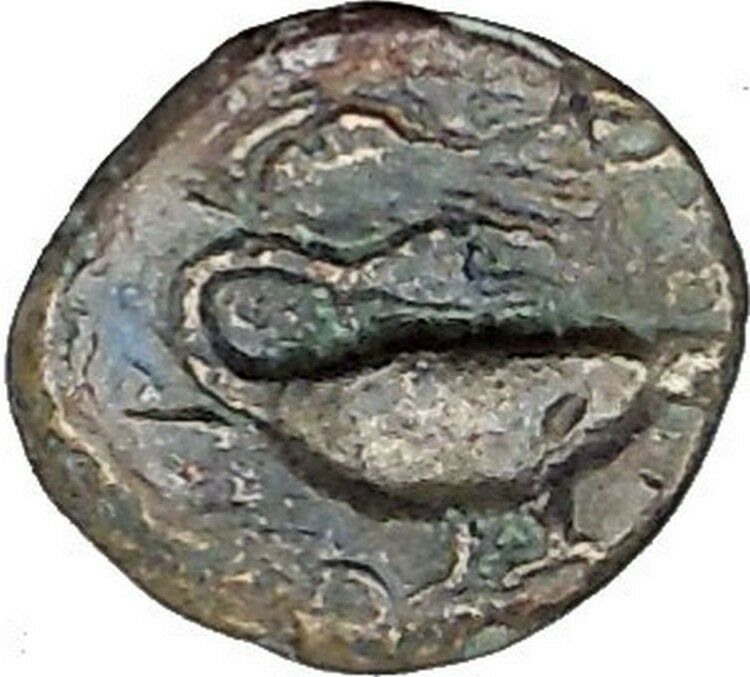
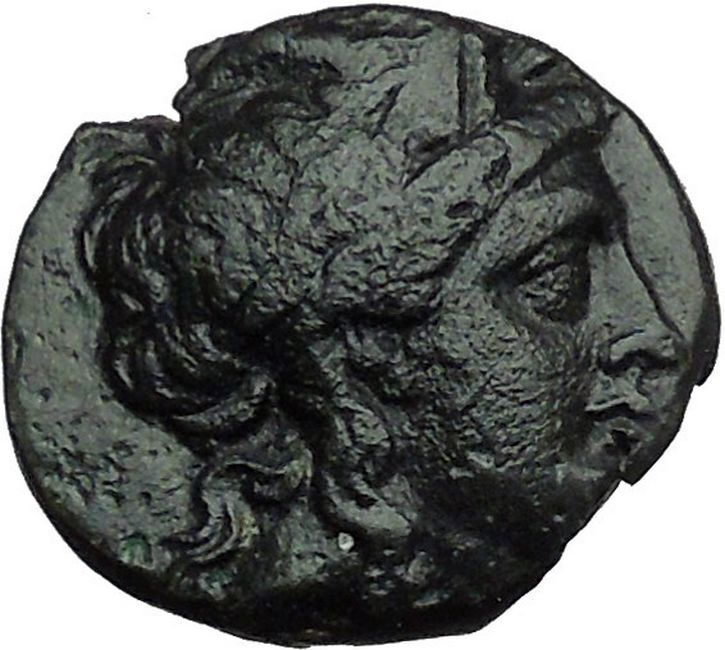
Greek city of Skepsis in Troas
Bronze 16mm (4.38 grams) Struck circa 400-310 B.C.
Reference: cf. Sear 4136; NG Ashmolean 1197–1200; SNG Copenhagen 478; SNG München 329
Certification: NGC Ancients Ch VF 6155927-005
Forepart of Pegasus (winged horse) left, body terminating in horn.
Σ – K either side of fir-tree; all within linear square.
You are bidding on the exact item pictured, provided with a Certificate of Authenticity and Lifetime Guarantee of Authenticity.
Pegasus is one of the best known fantastical creatures in Greek mythology. He is a winged divine horse, usually white in color. He was sired by Poseidon, in his role as horse-god, and foaled by the Gorgon Medusa. He was the  brother of Chrysaor, born at a single birthing when his mother was decapitated by Perseus. Greco-Roman poets write about his ascent to heaven after his birth and his obeisance to Zeus, king of the gods, who instructed him to bring lightning and thunder from Olympus. Friend of the Muses, Pegasus is the creator of Hippocrene, the fountain on Mt. Helicon. He was captured by the Greek hero Bellerophon near the fountain Peirene with the help of Athena and Poseidon. Pegasus allows the hero to ride him to defeat a monster, the Chimera, before realizing many other exploits. His rider, however, falls off his back trying to reach Mount Olympus. Zeus transformed him into the constellation Pegasus and placed him in the sky.
Hypotheses have been proposed regarding its relationship with the Muses, the gods Athena, Poseidon, Zeus, Apollo, and the hero Perseus.
The symbolism of Pegasus varies with time. Symbol of wisdom and especially of fame from the Middle Ages until the Renaissance, he became one symbol of the poetry and the creator of sources in which the poets come to draw inspiration, particularly in the 19th century. Pegasus is the subject of a very rich iconography, especially through the ancient Greek pottery and paintings and sculptures of the Renaissance. Personification of the water, solar myth, or shaman mount, Carl Jung and his followers have seen in Pegasus a profound symbolic esoteric in relation to the spiritual energy that allows to access to the realm of the gods on Mount Olympus.
In the 20th and 21st century, he appeared in movies, in fantasy, in video games and in role play, where by extension, the term Pegasus is often used to refer to any winged horse.
Skepsis or Scepsis (Ancient Greek: Σκῆψις) was an ancient settlement in the Troad, Asia Minor that is at the present site of the village of Kurşunlutepe, near the town of Bayramiç in Turkey. The settlement is notable for being the location where the famous library of Aristotle was kept before being moved to Pergamum and Alexandria. It was also home to Metrodorus of Scepsis and Demetrius of Scepsis.
The city of Skepsis was situated in two different, non-contemporary sites on Mount Ida, Palae-Skepsis and the settlement of Skepsis proper.
Palea-Skepsis
Palea-Skepsis (Old Skepsis) is notable for the native tradition that it was once the “capital of Aeneas’s dominions.” It was situated near the source of the Aesepus, high up on Mount Ida. William Vaux was able to note in 1877 that a village in the neighborhood still bore the name of Eski Skisepje, which in Turkish corresponds to “Palea-Skepsis.”
Dr. Andreas David Mordtmann, the discoverer of the settlement, is quoted on his discovery by Dr. Archibald Ross Colquhoun in a reference by Vaux.
| “ |
I did discover a most ancient city with its acropolis, towers and walls built of hewn stone, and furnished with four gates. The antiquity of the place was manifested by an oak having fixed its roots in the wall, and by its trunk having grown to a girth of 530 centimeters (about 17 feet). On reference to Strabo, I first became aware that I had discovered, probably, the most ancient ruin in Asia Minor, for I hold this can be no other than Palae-Scepsis. |
” |
Skepsis
The later Skepsis was about sixty stadia (7.5 miles) lower down Mount Ida from Palae-Skepsis. This later town of Scepsis is memorable for the discovery there, during the time of Sulla, of the works of Aristotle and Theophrastus, which had been buried by the illiterate relations of one Neleus (a pupil of Aristotle and friend of Theophrastus), so that they would not be carried off by Attalus I, who was then founding the Library of Pergamum.
Several times in its history, the citizens of Skepsis were forced to move elsewhere. When citizens of surrounding cities were forced to migrate to Troy, citizens of Skepsis were also forced to relocate. The city was again evacuated while the residents of surrounding cities were made to move to Alexandria Troas.
Certain traditions hold that Saint Cornelius the Centurion, the first Gentile convert to Christianity, became the first bishop of Skepsis in the early days of Christianity.
|