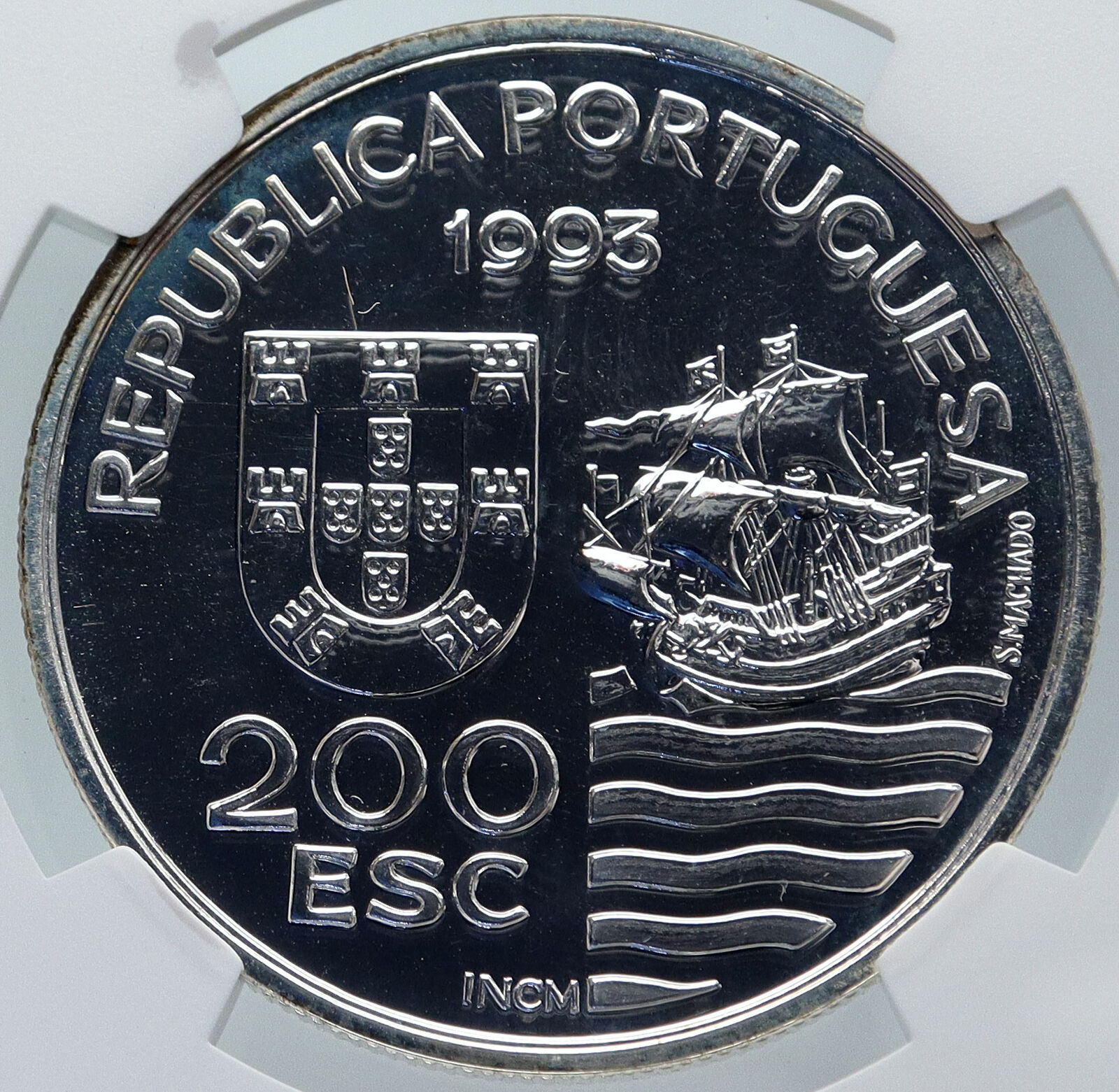
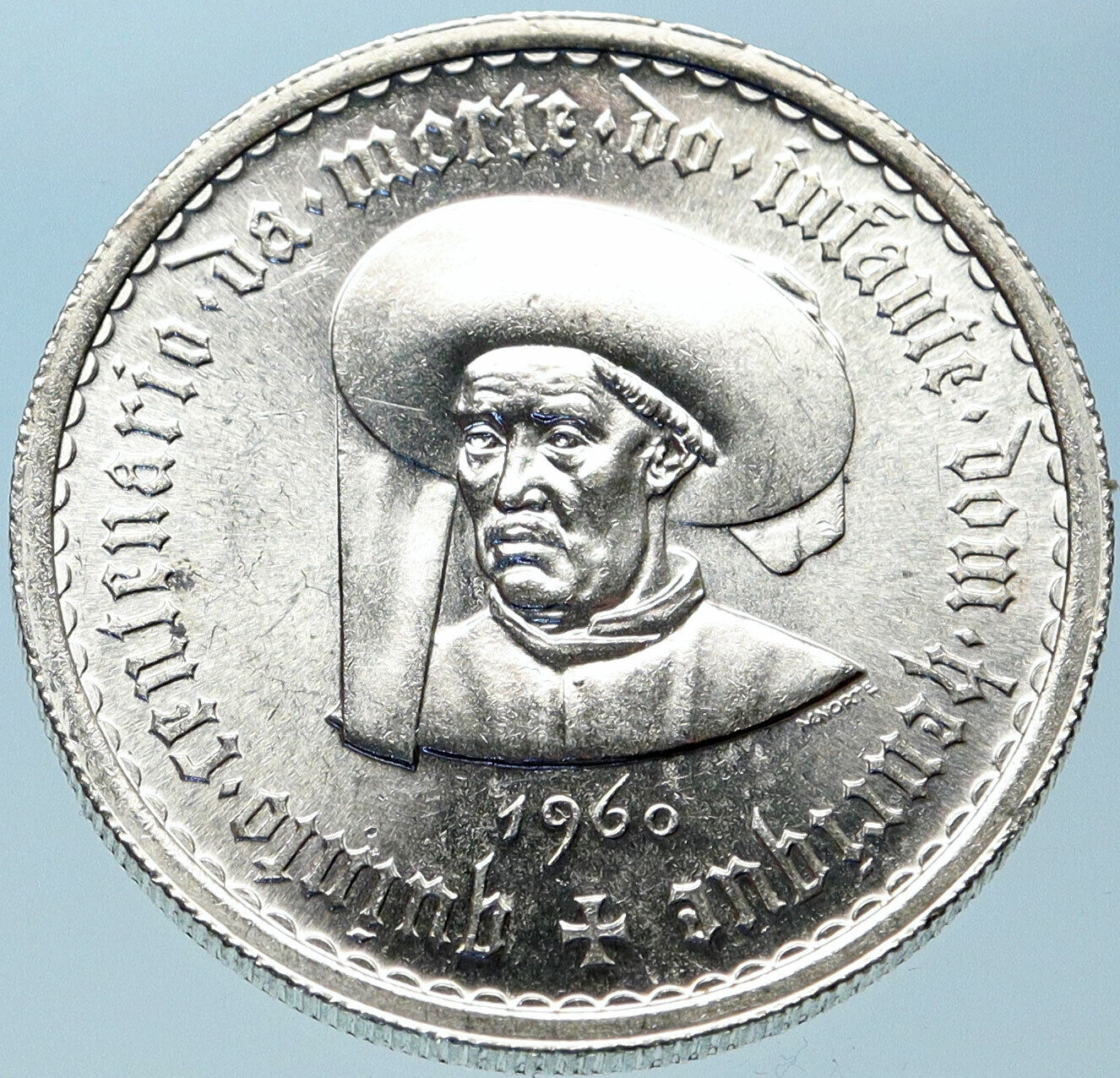
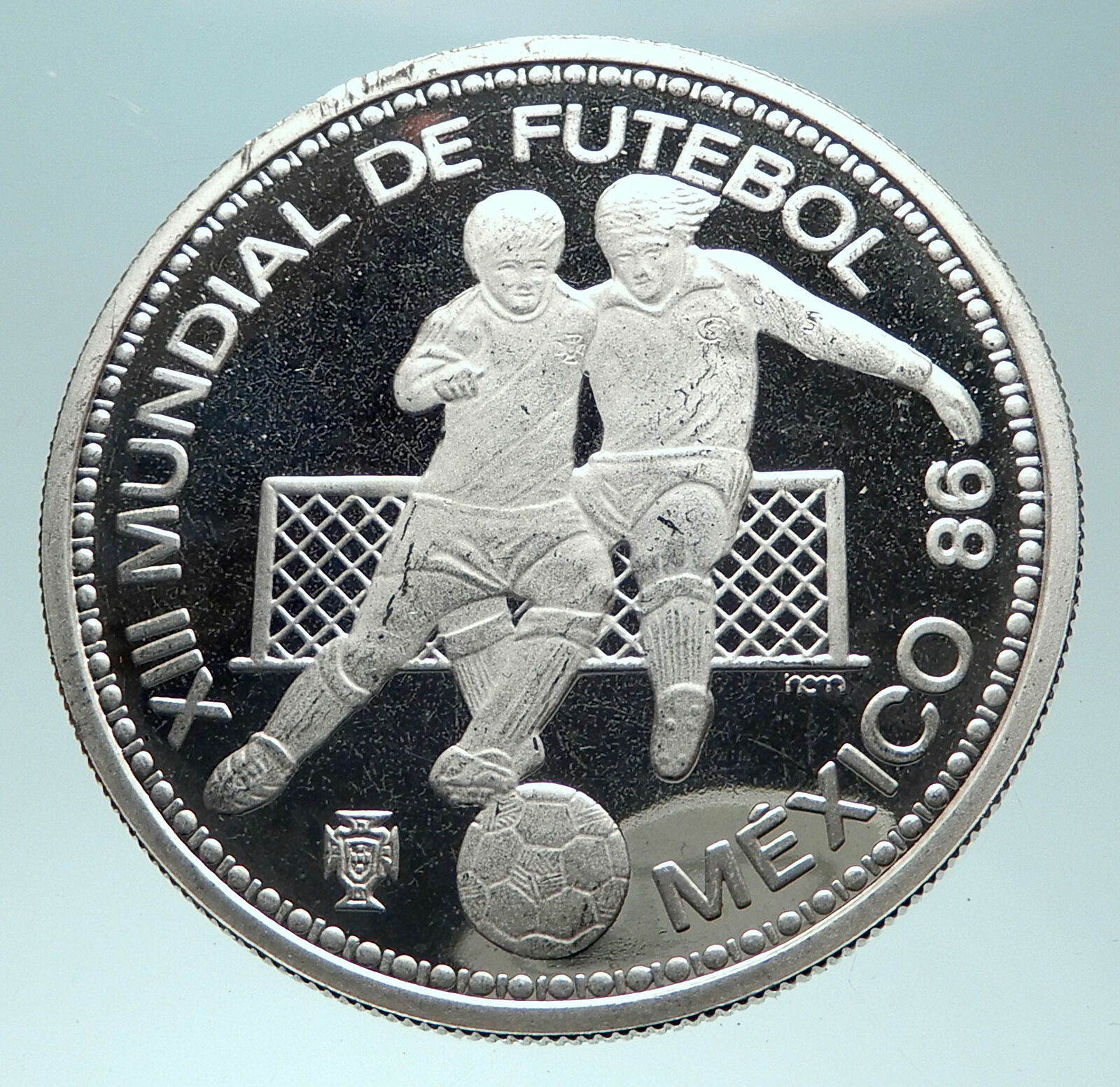
|
Portugal under João VI, King of Portugal: 20 March 1816 – 10 March 1826
1823 Bronze 40 Reis (Pataco) 35mm (33.43 grams)
Reference: KM# 370, Gomes# J6 05, Gomes# J6 04
JOANNES·VI·D·G·PORT·BR·ET·ALG·R, Joao facing right.
UTILITATI PUBLICAÆ 40, Crowned, shielded globe.
You are bidding on the exact item pictured, provided with a Certificate of Authenticity and Lifetime Guarantee of Authenticity.
 John VI (Portuguese: João VI; 13 May 1767 – 10 March 1826), nicknamed “the Clement“, was King of the United Kingdom of Portugal, Brazil and the Algarves from 1816 to 1825. Although the United Kingdom of Portugal, over which he ruled, ceased to exist de facto beginning in 1822, he remained its monarch de jure between 1822 and 1825. After the recognition of the independence of Brazil under the Treaty of Rio de Janeiro of 1825, he continued as King of Portugal until his death in 1826. Under the same treaty, he also became titular Emperor of Brazil for life, while his son, Pedro I of Brazil, was both de facto and de jure the monarch of the newly independent country.
Born in Lisbon in 1767, the son of Maria I and Peter III of Portugal, he was originally an infante (prince, but not heir to the throne) of Portugal. He only became heir to the throne when his older brother José, Prince of Brazil, died of smallpox in 1788 at the age of 27.
Before his accession to the Portuguese throne, John VI bore the titles Duke of Braganza and Duke of Beja, as well as Prince of Brazil. From 1799, he served as prince regent of Portugal (and later, from 1815, as prince regent of the United Kingdom of Portugal, Brazil and the Algarves), due to the mental illness of his mother, Queen Maria I. In 1816, he succeeded his mother as monarch of the Portuguese Empire, with no real change in his authority, since he already possessed absolute powers as regent.
One of the last representatives of absolute monarchy in Europe, he lived during a turbulent period; his reign never saw a lasting peace. Throughout his period of rule, major powers, such as Spain, France and Great Britain, continually intervened in Portuguese affairs. Forced to flee to South America across the Atlantic Ocean into Brazil when troops of the Emperor Napoleon I invaded Portugal, he found himself faced there with liberal revolts; he was compelled to return to Europe amid new conflicts. His marriage was no less conflictual, as his wife, Carlota Joaquina of Spain, repeatedly conspired against her husband in favor of personal interests or those of her native Spain. He lost Brazil when his son Pedro declared independence, and his other son Miguel (later Miguel I of Portugal) led a rebellion that sought to depose him. According to recent scholarly research, his death may well have been caused by arsenic poisoning.
Notwithstanding these tribulations he left a lasting mark, especially in Brazil, where he helped to create numerous institutions and services that laid a foundation for national autonomy, and he is considered by many historians to be a true mastermind of the modern Brazilian state. Still, he has been widely (if unjustly) viewed as a cartoonish figure in Portuguese-Brazilian history, accused of laziness, lack of political acumen and constant indecision, and is often portrayed as physically grotesque.
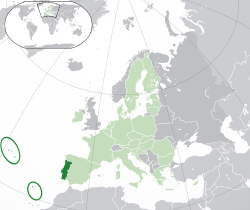  Portugal, officially the Portuguese Republic (Portuguese: República Portuguesa), is a country on the Iberian Peninsula, in Southwestern Europe. It is the westernmost country of mainland Europe, being bordered by the Atlantic Ocean to the west and south and by Spain to the north and east. The Portugal-Spain border is 1,214 km (754 mi) long and considered the longest uninterrupted border within the European Union. The republic also includes the Atlantic archipelagos of the Azores and Madeira, both autonomous regions with their own regional governments.
 The territory of modern Portugal has been continuously settled, invaded and fought over since prehistoric times. The Pre-Celts, Celts, Phoenicians, Carthaginians and the Romans were followed by the invasions of the Visigothic and the Suebi Germanic peoples, who were themselves later invaded by the Moors. These Muslim peoples were eventually expelled during the Christian Reconquista. Portuguese nationality can be traced back to the creation of the First County of Portugal, in 868. In 1139, Afonso Henriques was proclaimed King of Portugal, thus firmly establishing Portuguese independence, under the Portuguese House of Burgundy.
In the 15th and 16th centuries, under the House of Aviz, which took power following the 1383-85 Crisis, Portugal expanded Western influence and established the first global empire, becoming one of the world’s major economic, political and military powers. During this time, Portuguese explorers pioneered maritime exploration in the Age of Discovery, notably under royal patronage of Prince Henry the Navigator and King João II, with such notable discoveries as Vasco da Gama’s sea route to India (1497-98), Pedro Álvares Cabral’s discovery of Brazil (1500), and Bartolomeu Dias’s reaching of the Cape of Good Hope. Portugal monopolized the spice trade during this time, under royal command of the Casa da Índia, and the Portuguese Empire expanded with military campaigns led in Asia, notably under Afonso de Albuquerque, who was known as the “Caesar of the East”.
The destruction of Lisbon in a 1755 earthquake, the country’s occupation during the Napoleonic Wars, the independence of Brazil (1822), and the Liberal Wars (1828-1834), all left Portugal crippled from war and diminished in its world power. After the 1910 revolution deposed the monarchy, the democratic but unstable Portuguese First Republic was established, later being superseded by the “Estado Novo” right-wing authoritarian regime. Democracy was restored after the Portuguese Colonial War and the Carnation Revolution in 1974. Shortly after, independence was granted to all its colonies and East Timor, with the exception of Macau, which was handed over to China in 1999. This marked the end of the longest-lived European colonial empire, leaving a profound cultural and architectural influence across the globe and a legacy of over 250 million Portuguese speakers today.
Portugal is a developed country with a high-income advanced economy and high living standards. It is the 5th most peaceful country in the world, maintaining a unitary semi-presidential republican form of government. It has the 18th highest Social Progress in the world, putting it ahead of other Western European countries like France, Spain and Italy. It is a member of numerous international organizations, including the United Nations, the European Union, the eurozone, OECD, NATO and the Community of Portuguese Language Countries. Portugal is also known for having decriminalized the usage of all common drugs in 2001, the first country in the world to do so. However, the sale and distribution of these drugs is still illegal in Portugal.
|