|
Liberia
American civil war series – Bombardment of Fort Sumter
2000 Proof Silver 20 Dollars 40mm (20.04
grams) 0.999 Silver (0.6424 oz. ASW)
Reference: KM# 505
Certification: NGC
PF 69 ULTRA CAMEO 2864212-009
REPUBLIC OF LIBERIA THE LOVE OF LiBERTY BROUGHT US HERE 2000 REPUBLIC OF LIBERIA 20 DOLLARS, Coat of arms in the middle.
CIVIL WAR – THE BOMBARDEMENT OF FORT SUMTER 1861 $20, View of a burning
Fort Sumter.
You are bidding on the exact item pictured, provided with a Certificate of Authenticity and Lifetime Guarantee of Authenticity.
The Battle of Fort Sumter (April 12–13, 1861) was the bombardment of Fort Sumter near Charleston, South Carolina by the South Carolina militia. It ended with the surrender by the United States Army, beginning the American Civil War.
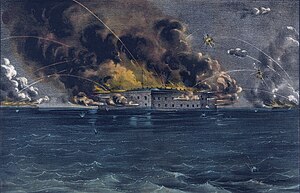 Following the declaration of secession by South Carolina on December 20, 1860, its authorities demanded that the U.S. Army abandon its facilities in Charleston Harbor. On December 26, Major Robert Anderson of the U.S. Army surreptitiously moved his small command from the vulnerable Fort Moultrie on Sullivan’s Island to Fort Sumter, a substantial fortress built on an island controlling the entrance of Charleston Harbor. An attempt by U.S. President James Buchanan to reinforce and resupply Anderson using the unarmed merchant ship Star of the West failed when it was fired upon by shore batteries on January 9, 1861. South Carolina authorities then seized all Federal property in the Charleston area except for Fort Sumter.
During the early months of 1861, the situation around Fort Sumter increasingly began to resemble a siege. In March, Brigadier General P. G. T. Beauregard, the first general officer of the newly formed Confederate States Army, was placed in command of Confederate forces in Charleston. Beauregard energetically directed the strengthening of batteries around Charleston harbor aimed at Fort Sumter. Conditions in the fort deteriorated due to shortages of men, food, and supplies as the Union soldiers rushed to complete the installation of additional guns.
The resupply of Fort Sumter became the first crisis of the administration of U.S. President Abraham Lincoln, inaugurated March 4, 1861, following his victory in the election of November 6, 1860. He notified the Governor of South Carolina, Francis W. Pickens, that he was sending supply ships, which resulted in an ultimatum from the Confederate government for the immediate evacuation of Fort Sumter, which Major Anderson refused. Beginning at 4:30 a.m. on April 12, the Confederates bombarded the fort from artillery batteries surrounding the harbor. Although the Union garrison returned fire, they were significantly outgunned and, after 34 hours, Major Anderson agreed to evacuate. There were no deaths on either side as a direct result of this engagement, although a gun explosion during the surrender ceremonies on April 14 caused the death of two U.S. Army soldiers. The event often regarded as the “First Bloodshed of the Civil War” was the Baltimore riot of 1861, one week later.
Following the battle, there was widespread support from both North and South
for further military action. Lincoln’s immediate call for 75,000 volunteers to
suppress the rebellion resulted in an additional four Southern states also
declaring their secession and joining the Confederacy. The battle is usually
recognized as the first battle of the American Civil War.
 Liberia officially the Republic of Liberia, is a country on the West African coast. Liberia means “Land of the Free” in Latin. It is bordered by Sierra Leone to its west, Guinea to its north and Ivory Coast to its east. It covers an area of 111,369 square kilometres (43,000 sq mi) and is home to 4,503,000 people. English is the official language and over 20 indigenous languages are spoken, representing the numerous tribes who make up more than 95% of the population.
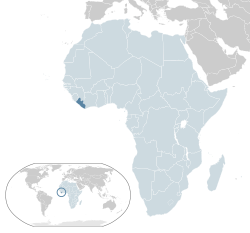 Forests on the coastline are composed mostly of salt-tolerant mangrove trees, while the more sparsely populated inland has forests opening onto a plateau of drier grasslands. The climate is equatorial, with significant rainfall during the May-October rainy season and harsh harmattan winds the remainder of the year. Liberia possesses about forty percent of the remaining Upper Guinean rainforest. It was an important producer of rubber in the early 20th century.
The Republic of Liberia, beginning as a settlement of the American Colonization Society (ACS), declared its independence on July 26, 1847. The United States did not recognize Liberia’s independence until after the American Civil War on February 5, 1862. Between January 7, 1822 and the American Civil War, more than 15,000 freed and free-born Black Americans from United States and 3,198 Afro-Caribbeans relocated to the settlement. The Black American settlers carried their culture with them to Liberia. The Liberian constitution and flag were modeled after the United States. In January 3, 1848 Joseph Jenkins Roberts, a wealthy free-born Black American from Virginia who settled in Liberia, was elected as Liberia’s first president after the people proclaimed independence.
Unlike other African countries, Liberia is the only African republic to have self-proclaimed independence without gaining independence through revolt from any other nation, being Africa’s first and oldest republic. Although it is said that neither Liberia nor Ethiopia, which was a kingdom, were controlled or colonized by foreign powers, this seems contradictory since the country was actually started by the American Colonization Society (ACS). Liberia maintained and kept its independence during the European colonial era.
During World War II, Liberia supported the United States war efforts against Germany and in turn the United States invested in considerable infrastructure in Liberia to help its war effort, which also aided the country in modernizing and improving its major air transportation facilities. In addition, President William Tubman encouraged economic changes. Internationally, Liberia was a founding member of League of Nations, United Nations and the Organisation of African Unity.
Longstanding political tensions from the 27 year rule of William Tubman resulted in a military coup in 1980 that overthrew the leadership soon after his death, marking the beginning of political instability. Five years of military rule by the People’s Redemption Council and five years of civilian rule by the National Democratic Party of Liberia were followed by two civil wars – the First and Second Liberian Civil Wars. These resulted in the deaths and displacement of more than half a million people and devastated Liberia’s economy. A peace agreement in 2003 led to democratic elections in 2005. Recovery proceeds but about 85% of the population live below the international poverty line.
|


