|
Germany – Expansion of the European Union
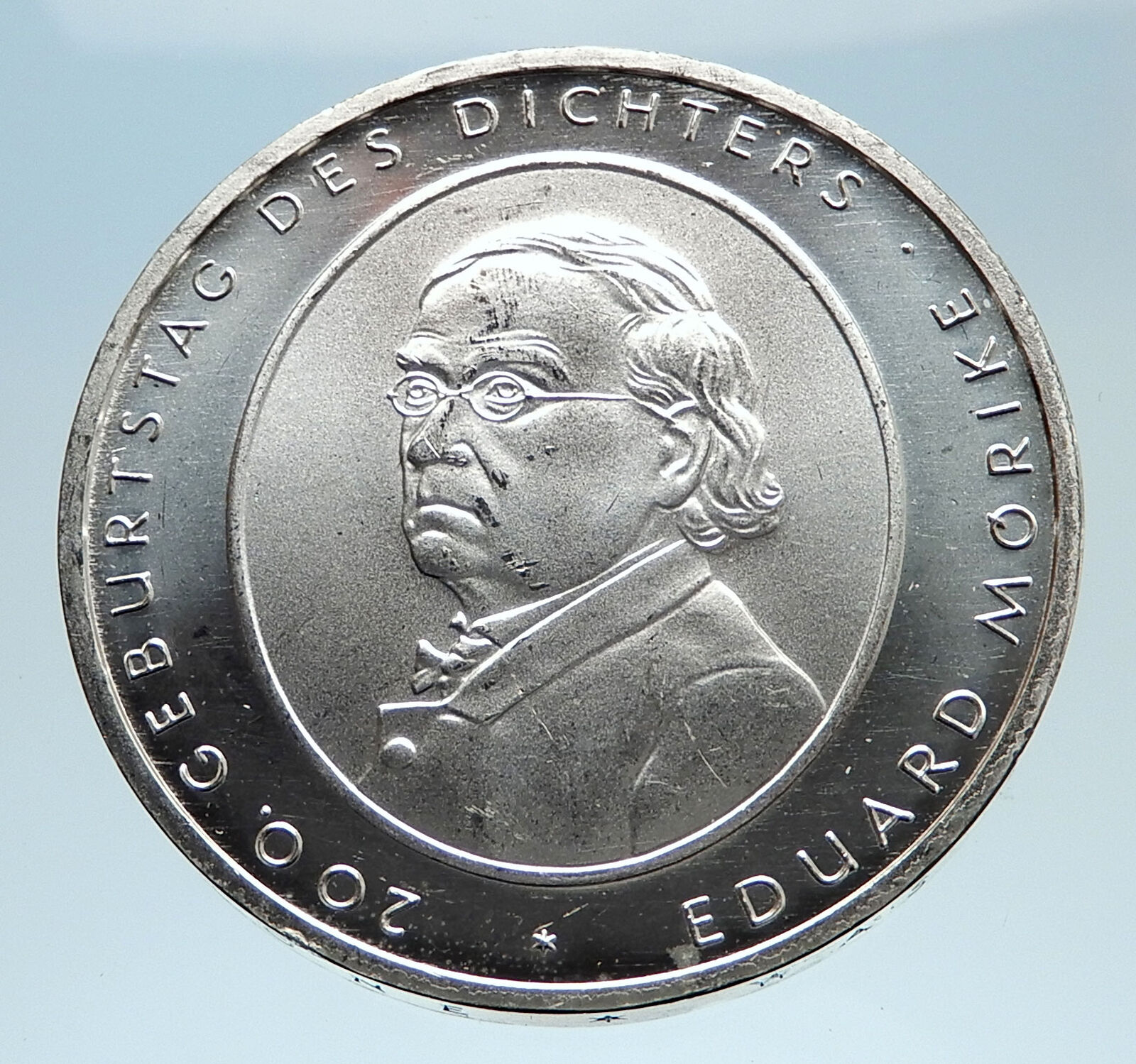
2004 G Proof Silver 10 Euros 32.5mm (18.08 grams) 0.925 Silver (0.5319 oz. ASW)
Reference: KM# 231
EURO 10 2004 G BUNDESREPUBLIK DEUTSCHLAND,
SCHUMANPLAN · EG 1950 ECKS SECHS GRÜNDUNGS MITGLIEDER 1952 BELGIEN·DEUTSCHLAND·FRANCE·ITALIA· LUXEMBOURG·NEDERLAND 1958 DANMARK·ÉIRE·UNITED KINGDOM·EΛΛΑΣ 1973-1981 ESPAÑA·PORTUGAL·ÔSTERREICH·SUOMI· SVERIGE 1986-1995 ČESKÁ REPUBLIKA·EESTI·CYPRUS·LATVIJA· LIETUVA·MAGYARORSZÁG·MALTA·POLSKA· SLOVENIJA·SLOVENSKO 2004 ERWEITERUNG DER EUROPÄISCHEN UNION
Edge Lettering: FREUDE SCHONER GOTTERFUNKEN
You are bidding on the exact item pictured, provided with a Certificate of Authenticity and Lifetime Guarantee of Authenticity.
 The European Union (EU) is a political and economic union of 28 member states that are located primarily in Europe. It has an area of 4,475,757 km2 (1,728,099 sq mi) and an estimated population of about 513 million. The EU has developed an internal single market through a standardised system of laws that apply in all member states in those matters, and only those matters, where members have agreed to act as one. EU policies aim to ensure the free movement of people, goods, services and capital within the internal market, enact legislation in justice and home affairs and maintain common policies on trade, agriculture, fisheries and regional development. For travel within the Schengen Area, passport controls have been abolished. A monetary union was established in 1999 and came into full force in 2002 and is composed of 19 EU member states which use the euro currency.
 The EU and European citizenship were established when the Maastricht Treaty came into force in 1993. The EU traces its origins to the European Coal and Steel Community (ECSC) and the European Economic Community (EEC), established, respectively, by the 1951 Treaty of Paris and 1957 Treaty of Rome. The original members of what came to be known as the European Communities were the Inner Six: Belgium, France, Italy, Luxembourg, the Netherlands, and West Germany. The Communities and its successors have grown in size by the accession of new member states and in power by the addition of policy areas to its remit. The latest major amendment to the constitutional basis of the EU, the Treaty of Lisbon, came into force in 2009. While no member state has left the EU or its antecedent organisations, the United Kingdom signified the intention to leave after a membership referendum in June 2016 and is negotiating its withdrawal on 29 March 2019.
Covering 7.3% of the world population, the EU in 2017 generated a nominal gross domestic product (GDP) of 19.670 trillion US dollars, constituting approximately 24.6% of global nominal GDP. Additionally, all 28 EU countries have a very high Human Development Index, according to the United Nations Development Programme. In 2012, the EU was awarded the Nobel Peace Prize. Through the Common Foreign and Security Policy, the EU has developed a role in external relations and defence. The union maintains permanent diplomatic missions throughout the world and represents itself at the United Nations, the World Trade Organization, the G7 and the G20. Because of its global influence, the European Union has been described as an emerging superpower.
 Germany, officially the Federal Republic of Germany is a federal parliamentary republic in western-central Europe. It includes 16 constituent states and covers an area of 357,021 square kilometres (137,847 sq mi) with a largely temperate seasonal climate. Its capital and largest city is Berlin. With 81 million inhabitants, Germany is the most populous member state in the European Union. After the United States, it is the second most popular migration destination in the world.
 Various Germanic tribes have occupied northern Germany since classical antiquity. A region named Germania was documented before 100 CE. During the Migration Period the Germanic tribes expanded southward. Beginning in the 10th century, German territories formed a central part of the Holy Roman Empire. During the 16th century, northern German regions became the centre of the Protestant Reformation.
 The rise of Pan-Germanism inside the German Confederation resulted in the unification of most of the German states in 1871 into the Prussian-dominated German Empire. After World War I and the German Revolution of 1918-1919, the Empire was replaced by the parliamentary Weimar Republic. The establishment of the Third Reich in 1933 led to World War II and the Holocaust. After 1945, Germany split into two states, East Germany and West Germany. In 1990, the country was reunified.
In the 21st century, Germany is a great power and has the world’s fourth-largest economy by nominal GDP, as well as the fifth-largest by PPP. As a global leader in several industrial and technological sectors, it is both the world’s third-largest exporter and importer of goods. Germany is a developed country with a very high standard of living sustained by a skilled and productive society. It upholds a social security and universal health care system, environmental protection and a tuition free university education.
Germany was a founding member of the European Union in 1993. It is part of the Schengen Area, and became a co-founder of the Eurozone in 1999. Germany is a member of the United Nations, NATO, the G8, the G20, and the OECD. The national military expenditure is the 9th highest in the world. Known for its rich cultural history, Germany has been continuously the home of influential artists, philosophers, musicians, sportsmen, entrepreneurs, scientists and inventors.
|