|
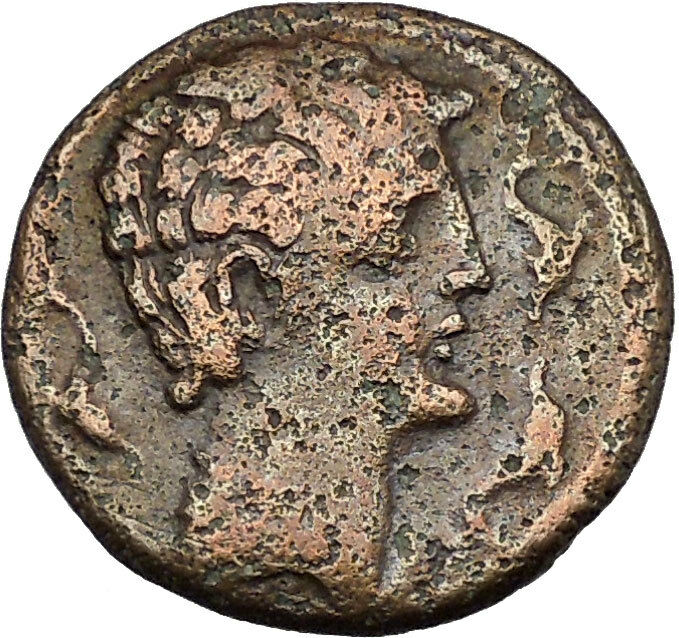
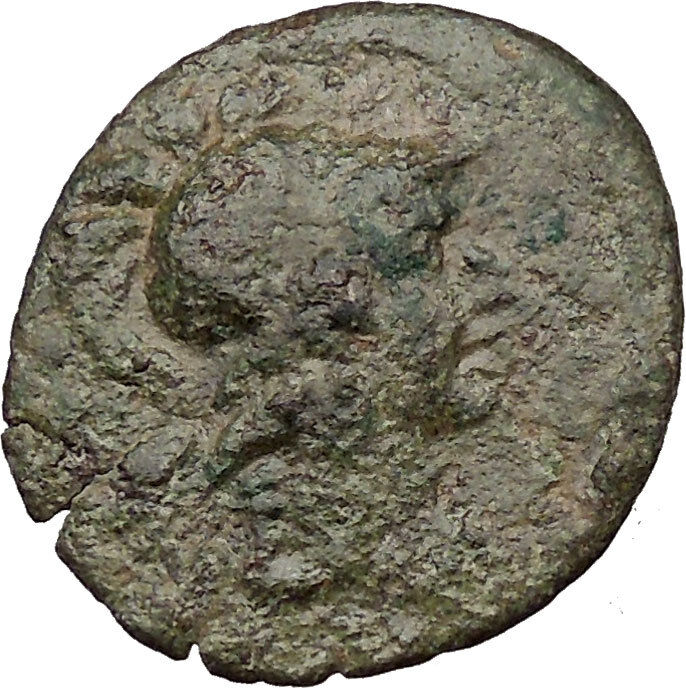
Greek Seleucid Kingdom – Antiochus I, Soter – King: 280-261
B.C.
Bronze 14mm (2.52 grams) Struck circa 280-261 B.C.
Reference: Sear 6878 var
Diademed head of Antiochos right.
ANTIOXOY either side of Apollo seated left on omphalos, holding arrow
and resting on bow; monograms in field to left and to right.
Seleukos was succeeded by his son, Antiochos, who had already been ruler of the
eastern satrapies from 293 B.C. Little is known of his reign other than his
victory over the Gallic invaders of Asia minor, circa 273 B.C., which earned him
the title of Soter – ‘Savior’
You are bidding on the exact item pictured,
provided with a Certificate of Authenticity and Lifetime Guarantee of
Authenticity.

In
Greek
and
Roman mythology
, Apollo
,
is one of the most important and diverse of the
Olympian deities
. The ideal of the
kouros
(a
beardless youth), Apollo has been variously recognized as a god of light and the
sun; truth and prophecy;
archery
;
medicine and healing; music, poetry, and the arts; and more. Apollo is the son
of Zeus
and
Leto, and has a
twin
sister, the chaste huntress
Artemis
.
Apollo is known in Greek-influenced
Etruscan mythology
as Apulu. Apollo was worshiped in both
ancient Greek
and
Roman religion
, as well as in the modern
Greco
–Roman
Neopaganism
.
As the patron of Delphi
(Pythian Apollo), Apollo was an
oracular
god � the prophetic deity of the
Delphic Oracle
.
Medicine and healing were associated with Apollo, whether through the god
himself or mediated through his son
Asclepius
,
yet Apollo was also seen as a god who could bring ill-health and deadly
plague
as well as one who had the ability to cure. Amongst the god’s
custodial charges, Apollo became associated with dominion over
colonists
, and as the patron defender of herds and flocks. As the leader of
the Muses
(Apollon
Musagetes) and director of their choir, Apollo functioned as the patron god
of music and poetry
.
Hermes
created
the lyre
for him,
and the instrument became a common
attribute
of Apollo. Hymns sung to Apollo were called
paeans
.
In Hellenistic times, especially during the third century BCE, as Apollo
Helios he became identified among Greeks with
Helios
,
god of
the sun
, and his sister Artemis similarly equated with
Selene
,
goddess
of the moon
.
In Latin texts, on the other hand, Joseph Fontenrose declared himself unable to
find any conflation of Apollo with
Sol
among the
Augustan poets
of the first century, not even in the conjurations of
Aeneas
and
Latinus
in
Aeneid
XII
(161–215).
Apollo and Helios/Sol remained separate beings in literary and mythological
texts until the third century CE.
Antiochus I Soter (Greek:
ΑνÃ�„ίοÃ�‡Î¿Ã�‚ Α’ ΣÃ�‰Ã�„ήÃ��, i.e. Antiochus the Savior, unknown – 261 BC),
was a king of the
Hellenistic
Seleucid Empire
. He reigned from 281 BC – 261 BC.
Antiochus I was half
Persian
, his mother
Apama
being one
of the eastern princesses whom
Alexander the Great
had given as wives to his generals in 324 BC. In 294 BC,
prior to the death of his father
Seleucus I
, Antiochus married his stepmother,
Stratonice
, daughter of
Demetrius Poliorcetes
. His elderly father reportedly instigated the marriage
after discovering that his son was in danger of dying of lovesickness.
On the assassination of his father in 281 BC, the task of holding together
the empire was a formidable one. A revolt in
Syria
broke out
almost immediately. Antiochus was soon compelled to make peace with his father’s
murderer,
Ptolemy Keraunos
, apparently abandoning
Macedonia
and Thrace
. In
Asia Minor
he was unable to reduce
Bithynia
or
the Persian dynasties that ruled in
Cappadocia
.
In 278 BC the Gauls
broke into Asia Minor, and a victory that Antiochus won over these hordes is
said to have been the origin of his title of Soter (Gr.
for “saviour”).
At the end of 275 BC the question of
Coele-Syria
,
which had been open between the houses of
Seleucus
and
Ptolemy
since the partition of 301 BC, led to hostilities (the
First Syrian War
). It had been continuously in
Ptolemaic
occupation, but the
house of Seleucus
maintained its claim.
War did not materially change the outlines of the two kingdoms, though
frontier cities like
Damascus
and the coast districts of Asia Minor might change hands.
His eldest son Seleucus had ruled in the east as viceroy from 275 BC(?) till
268/267 BC; Antiochus put his son to death in the latter year on the charge of
rebellion. Circa 262 BC Antiochus tried to break the growing power of
Pergamum
by force of arms, but suffered defeat near
Sardis
and died
soon afterwards. He was succeeded in 261 BC by his second son
Antiochus II Theos
.
|