|
Antoninus Pius – Roman Emperor: 138-161 A.D.
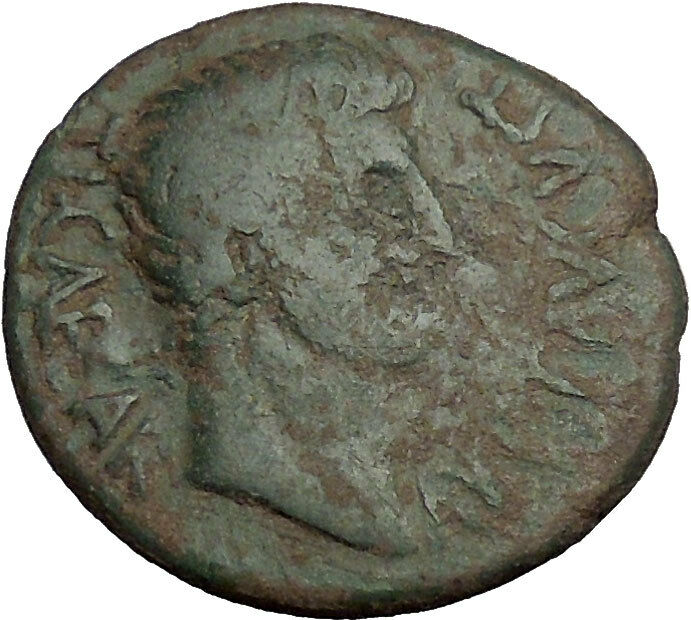
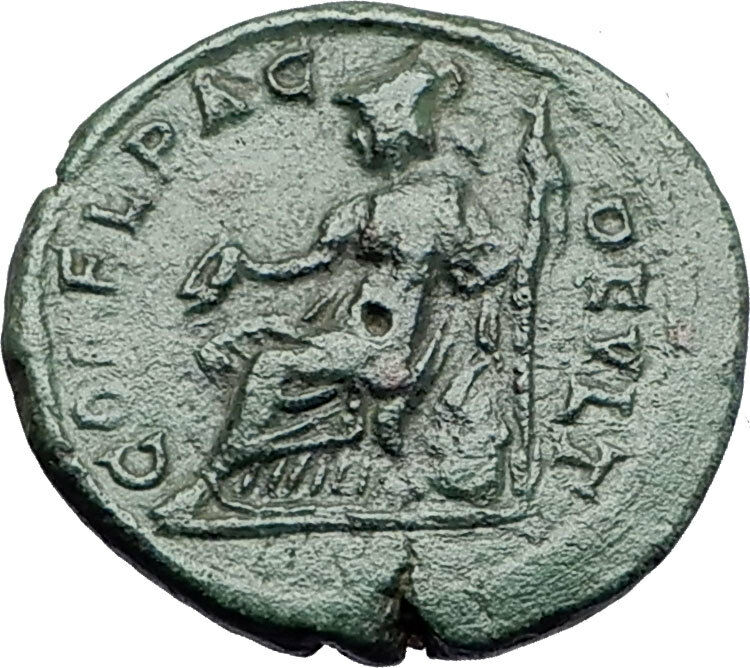
Bronze Drachm 32mm (24326 grams) of Alexandria in Egypt, dated RY 7, struck 143/144 A.D.
Laureate bust of Antoninus pius left.
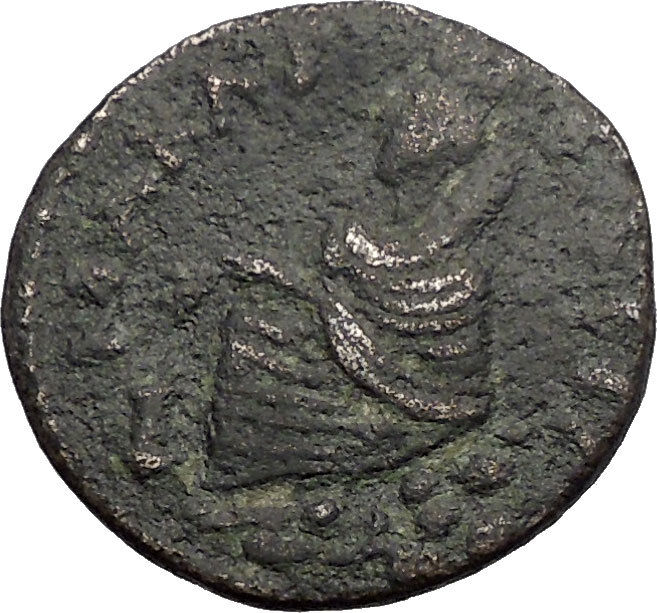
Roma seated right, holding Nike and spear, L-Z across fields.
You are bidding on the exact item pictured, provided with a Certificate of Authenticity and Lifetime Guarantee of Authenticity.

In ancient Roman religionn, Roma was a female deity who personified the city of Rome and more broadly, the Roman state. “As personification, as goddess or as symbol, the name Roma stretches from classical Greece to Mussolini’s Fascist propaganda… Roma has been seen as a goddess, a whore, a near-saint, and as the symbol of civilization itself. She remains the oldest continuous political-religious symbol in Western civilization.” Ronald Mellor, Introduction, The goddess Roma.
The earliest certain cult to dea Roma was established at Smyrna in 195 BCE, probably to mark Rome’s successful alliance against Antiochus III. Mellor has proposed her cult as a form of religio-political diplomacy which adjusted traditional Graeco-Eastern monarchic honours to Republican mores: honours addressed to the divine personification of the Roman state acknowledged the authority of its offices, Republic and city as divine and eternal.
Democratic city-states such as Athens and Rhodes accepted Roma as analogous to their traditional cult personifications of the demos (ordinary people). In 189 BCE, Delphi and Lycia instituted festivals in her honour. Roma as “divine sponsor” of athletics and pan-Hellenic culture seems to have dovetailed neatly into a well-established and enthusiastic festival circuit, and temples to her were outnumbered by her civic statues and dedications. In 133 BCE Attalus III bequeathed the people and territories of Pergamon to Rome, as to a trusted ally and protector. The Pergamene bequest became the new Roman province of Asia, and Roma’s cult spread rapidly within it.
In Hellenistic religious tradition, gods were served by priests and goddesses by priestesses but Roma’s priesthood was male, perhaps in acknowledgment of the virility of Rome’s military power. Priesthood of the Roma cult was competed among the highest ranking local elites. In contrast to her putative “Amazonian” Roman original, Greek coinage depicts Roma in the “dignified and rather severe style” of a Greek goddess, often wearing a mural crown, or sometimes a Phrygian helmet. She is occasionally bareheaded. In this and later periods, she was often associated with Zeus (as guardian of oaths) and Fides (the personification of mutual trust). Her Eastern cult appealed for Rome’s loyalty and protection – there is no reason to suppose this as other than genuine (and diplomatically sound) respect. A panegyric to her survives, in five Sapphic stanzas attributed to Melinno. In Republican Rome and its Eastern colonae her cult was virtually non-existent.
Roma was thus absorbed into the earliest (Eastern) form of “Imperial cult” – or, from an Eastern viewpoint, the cult to Augustus was grafted onto their time-honoured cult to Roma. From here on, she increasingly took the attributes of an Imperial or divine consort to the Imperial divus, but some Greek coin types show her as a seated or enthroned authority, and the Imperial divus standing upright as her supplicant or servant.The Imperial cult arose as a pragmatic and ingenious response to an Eastern initiative. It blended and “renewed” ancient elements of traditional religions and Republican government to create a common cultural framework for the unification of Empire as a Principate. In the West, this was a novelty, as the Gauls, Germans and Celts had no native precedent for ruler cult or a Roman-style administration.
The foundation of the Imperial cult centre at Lugdunum introduced Roman models for provincial and municipal assemblies and government, a Romanised lifestyle, and an opportunity for local elites to enjoy the advantages of citizenship through election to Imperial cult priesthood, with an ara (altar) was dedicated to Roma and Augustus. Thereafter, Roma is well attested by inscriptions and coinage throughout the Western provinces. Literary sources have little to say about her, but this may reflect her ubiquity rather than neglect: in the early Augustan era, she may have been honoured above her living Imperial consort.
In the city of Rome itself, the earliest known state cult to dea Roma was combined with cult to Venus at the Hadrianic Temple of Venus and Roma. This was the largest temple in the city, probably dedicated to inaugurate the reformed festival of Parilia, which was known thereafter as the Romaea after the Eastern festival in Roma’s honour. The temple contained the seated, Hellenised image of dea Roma – the Palladium in her right hand symbolised Rome’s eternity. In Rome, this was a novel realisation. Greek interpretations of Roma as a dignified deity had transformed her from a symbol of military dominance to one of Imperial protection and gravitas.
 Antoninus Pius – 138-161 A.D.
Caesar: 138 A.D. (under Hadrian)
Augustus: 138-161 A.D.
| Adopted son and successor of Hadrian | Husband of Faustina Senior | Father of Faustina Junior and Galerius Antoninus | Grandfather of Commodus, Annius Verus, Lucilla and Aurelius Antoninus | Adoptive father of Marcus Aurelius and Lucius Verus |
Titus Aurelius Fulvus Boionius Arrius Antoninus (19 September 86 – 7 March 161), generally known in English as Antoninus Pius was Roman emperor from 138 to 161. He was the fourth of the Five Good Emperors and a member of the Aurelii. He did not possess the sobriquet “Pius” until after his accession to the throne. Almost certainly, he earned the name “Pius” because he compelled the Senate to deify his adoptive father Hadrian; the Historia Augusta, however, suggests that he may have earned the name by saving senators sentenced to death by Hadrian in his later years.
He was the son and only child of Titus Aurelius Fulvus, consul in 89 whose family came from Nemausus (modern Nîmes) and was born near Lanuvium and his mother was Arria Fadilla. Antoninus’ father and paternal grandfather died when he was young and he was raised by Gnaeus Arrius Antoninus, his maternal grandfather, a man of integrity and culture and a friend of Pliny the Younger. His mother married to Publius Julius Lupus (a man of consular rank), Suffect Consul in 98, and bore him a daughter called Julia Fadilla.
As a private citizen between 110 and 115, he married Annia Galeria Faustina the Elder. They had a very happy marriage. She was the daughter of consul Marcus Annius Verus and Rupilia Faustina (a half-sister to Roman Empress Vibia Sabina). Faustina was a beautiful woman, renowned for her wisdom. She spent her whole life caring for the poor and assisting the most disadvantaged Romans.
Having filled with more than usual success the offices of quaestor and praetor, he obtained the consulship in 120; he was next appointed by the Emperor Hadrian as one of the four proconsuls to administer Italia, then greatly increased his reputation by his conduct as proconsul of Asia. He acquired much favor with the Emperor Hadrian, who adopted him as his son and successor on 25 February, 138, after the death of his first adopted son Lucius Aelius, on the condition that Antoninus would in turn adopt Marcus Annius Verus, the son of his wife’s brother, and Lucius, son of Aelius Verus, who afterwards became the emperors Marcus Aurelius and Lucius Verus (colleague of Marcus Aurelius).
Emperor
On his accession, Antoninus’ name became “Imperator Caesar Titus Aelius Hadrianus Antoninus Augustus Pontifex Maximus”. One of his first acts as Emperor was to persuade the Senate to grant divine honours to Hadrian, which they had at first refused; his efforts to persuade the Senate to grant these honours is the most likely reason given for his title of Pius (dutiful in affection; compare pietas). Two other reasons for this title are that he would support his aged father-in-law with his hand at Senate meetings, and that he had saved those men that Hadrian, during his period of ill-health, had condemned to death. He built temples, theaters, and mausoleums, promoted the arts and sciences, and bestowed honours and financial rewards upon the teachers of rhetoric and philosophy.
In marked contrast to his predecessors Trajan and Hadrian, Antoninus was not a military man. One modern scholar has written “It is almost certain not only that at no time in his life did he ever see, let alone command, a Roman army, but that, throughout the twenty-three years of his reign, he never went within five hundred miles of a legion”. His reign was the most peaceful in the entire history of the Principate; while there were several military disturbances throughout the Empire in his time, in Mauretania, Iudaea, and amongst the Brigantes in Britannia, none of them are considered serious. The unrest in Britannia is believed to have led to the construction of the Antonine Wall from the Firth of Forth to the Firth of Clyde, although it was soon abandoned. He was virtually unique among emperors in that he dealt with these crises without leaving Italy once during his reign, but instead dealt with provincial matters of war and peace through their governors or through imperial letters to the cities such as Ephesus (of which some were publicly displayed). This style of government was highly praised by his contemporaries and by later generations.
Of the public transactions of this period we have scant information, but, to judge by what we possess, those twenty-two years were not remarkably eventful in comparison to those before and after his; the surviving evidence is not complete enough to determine whether we should interpret, with older scholars, that he wisely curtailed the activities of the Roman Empire to a careful minimum, or perhaps that he was uninterested in events away from Rome and Italy and his inaction contributed to the pressing troubles that faced not only Marcus Aurelius but also the emperors of the third century. German historian Ernst Kornemann has had it in his Römische Geschichte [2 vols., ed. by H. Bengtson, Stuttgart 1954] that the reign of Antoninus comprised “a succession of grossly wasted opportunities,” given the upheavals that were to come. There is more to this argument, given that the Parthians in the East were themselves soon to make no small amount of mischief after Antoninus’ passing. Kornemann’s brief is that Antoninus might have waged preventive wars to head off these outsiders.
Scholars place Antoninus Pius as the leading candidate for fulfilling the role as a friend of Rabbi Judah the Prince. According to the Talmud (Avodah Zarah 10a-b), Rabbi Judah was very wealthy and greatly revered in Rome. He had a close friendship with “Antoninus”, possibly Antoninus Pius, who would consult Rabbi Judah on various worldly and spiritual matters.
After the longest reign since Augustus (surpassing Tiberius by a couple of months), Antoninus died of fever at Lorium in Etruria, about twelve miles (19 km) from Rome, on 7 March 161, giving the keynote to his life in the last word that he uttered when the tribune of the night-watch came to ask the password-“aequanimitas” (equanimity). His body was placed in Hadrian’s mausoleum, a column was dedicated to him on the Campus Martius, and the temple he had built in the Forum in 141 to his deified wife Faustina was rededicated to the deified Faustina and the deified Antoninus.
Historiography
The only account of his life handed down to us is that of the Augustan History, an unreliable and mostly fabricated work. Antoninus is unique among Roman emperors in that he has no other biographies. Historians have therefore turned to public records for what details we know.
In later scholarship
Antoninus in many ways was the ideal of the landed gentleman praised not only by ancient Romans, but also by later scholars of classical history, such as Edward Gibbon or the author of the article on Antoninus Pius in the ninth edition of the Encyclopedia Britannicaca:
A few months afterwards, on Hadrian’s death, he was enthusiastically welcomed to the throne by the Roman people, who, for once, were not disappointed in their anticipation of a happy reign. For Antoninus came to his new office with simple tastes, kindly disposition, extensive experience, a well-trained intelligence and the sincerest desire for the welfare of his subjects. Instead of plundering to support his prodigality, he emptied his private treasury to assist distressed provinces and cities, and everywhere exercised rigid economy (hence the nickname κυμινοπριστης “cummin-splitter”). Instead of exaggerating into treason whatever was susceptible of unfavorable interpretation, he spurned the very conspiracies that were formed against him into opportunities for demonstrating his clemency. Instead of stirring up persecution against the Christians, he extended to them the strong hand of his protection throughout the empire. Rather than give occasion to that oppression which he regarded as inseparable from an emperor’s progress through his dominions, he was content to spend all the years of his reign in Rome, or its neighborhood.
|