|
Germany – German States
Principality of Lippe under Leopold II (1802-1851)
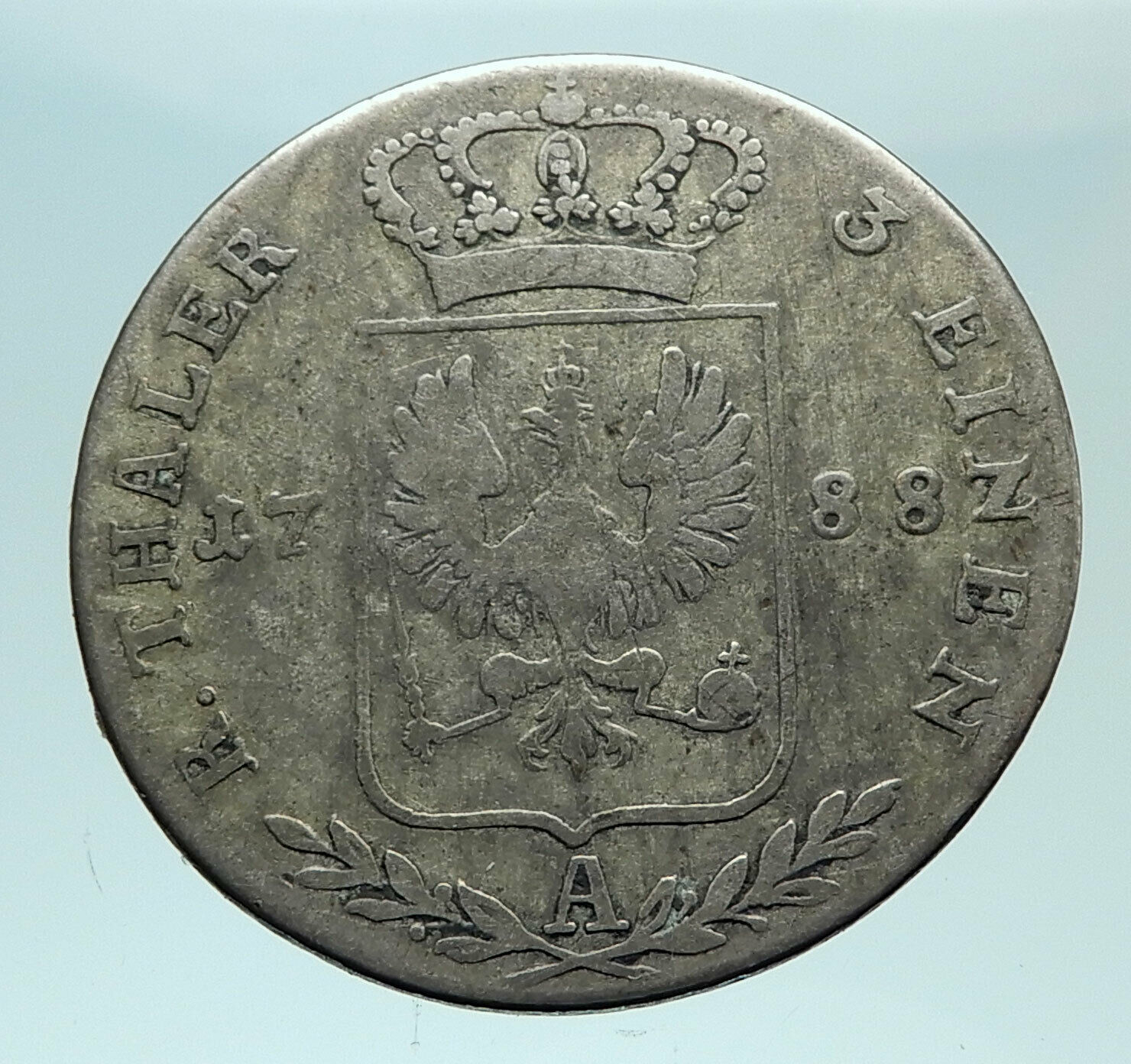
1824 T Copper 1 1/2 Pfennig 20mm (2.96 grams)
Reference: KM# 243 (1821-25)
Five-petal flower.
I½ PFEN= NING. 1824 T, Two flowers flank denomination.
You are bidding on the exact item pictured, provided with a Certificate of Authenticity and Lifetime Guarantee of Authenticity.
 Lippe (later Lippe-Detmold and then again Lippe) was a historical state in Germany, ruled by the House of Lippe. It was located between the Weser river and the southeast part of the Teutoburg Forest. It was founded in the 1640’s under a separate branch of the House of Lippe.
The founder of what would become the County of Lippe (1528–1789), then the Principality of Lippe (1789–1918) was Bernhard I, who received a grant of territory from Lothair III in 1123. Bernhard I assumed the title of Edler Herr zu Lippe (“Noble Lord at Lippe”). The history of the dynasty and its further acquisitions of land really began with Bernard II. His territory was probably formed out of land he acquired on the destruction of the Duchy of Saxony following the demise of Henry the Lion in 1180. From 1196 to 1666 the descendants of Bernard II passed their holdings from father to sons for sixteen generations. Thereafter until 1905, a collateral branch passed Lippe from father to sons for eight generations. A distant relation then became the last ruler until the Revolution of 1918 when Lippe became the Free State of Lippe. Simon V was the first ruler of Lippe to style himself as a count (Graf) in 1528.
Following the death of Simon VI in 1613, the county was partitioned between his three sons; Lippe-Detmold went to Simon VII, Lippe-Brake to Otto and Lippe-Alverdissen went to Philip I. The county of Lippe-Brake was reunited with the main Detmold line in 1709. A son of Simon VII, Jobst Herman, founded another branch of the family, the Lippe-Biesterfeld line; the Lippe-Weissenfeld branch later separated from the Lippe-Biesterfelds. Both Lippe-Biesterfeld and Lippe-Weissenfeld were paragiums (non-sovereign estates of a cadet-branch) within the County of Lippe, and both branches, owning only modest manor houses in the county, acquired property in other states by marriage and moved out of the county in the late 18th century, the Biesterfeld branch to the Rhineland and the Weissenfeld branch to Saxony.
The Counts of Lippe-Detmold were granted the title of Imperial prince in 1789.
Shortly after becoming a member state of the German Empire in 1871, the Lippe-Detmold line died out on 20 July 1895. This resulted in an inheritance dispute between the neighbouring principality of Schaumburg-Lippe and the Lippe-Biesterfeld line. The dispute was resolved by the Imperial Court in Leipzig in 1905, with the lands passing to the Lippe-Biesterfeld line who, until this point, had no territorial sovereignty.
The Principality of Lippe came to an end on 12 November 1918 with the abdication of Leopold IV, with Lippe becoming a Free State. In 1947, Lippe merged into the state of North Rhine-Westphalia. The princely family still owns the estate and Fürstliches Residenzschloss in Detmold.
 Germany, officially the Federal Republic of  Germany is a federal parliamentary republic in western-central Europe. It includes 16 constituent states and covers an area of 357,021 square kilometres (137,847 sq mi) with a largely temperate seasonal climate. Its capital and largest city is Berlin. With 81 million inhabitants, Germany is the most populous member state in the European Union. After the United States, it is the second most popular migration destination in the world.
Various Germanic tribes have occupied northern Germany since classical antiquity. A region named Germania was documented before 100 CE. During the Migration Period the Germanic tribes expanded southward. Beginning in the 10th century, German territories formed a central part of the Holy Roman Empire. During the 16th century, northern German regions became the centre of the Protestant Reformation.
The rise of Pan-Germanism inside the German Confederation resulted in the unification of most of the German states in 1871 into the Prussian-dominated German Empire. After World War I and the German Revolution of 1918-1919, the Empire was replaced by the parliamentary Weimar Republic. The establishment of the Third Reich in 1933 led to World War II and the Holocaust. After 1945, Germany split into two states, East Germany and West Germany. In 1990, the country was reunified.
 In the 21st century, Germany is a great power and has the world’s fourth-largest economy by nominal GDP, as well as the fifth-largest by PPP. As a global leader in several industrial and technological sectors, it is both the world’s third-largest exporter and importer of goods. Germany is a developed country with a very high standard of living sustained by a skilled and productive society. It upholds a social security and universal health care system, environmental protection and a tuition free university education.
Germany was a founding member of the European Union in 1993. It is part of the Schengen Area, and became a co-founder of the Eurozone in 1999. Germany is a member of the United Nations, NATO, the G8, the G20, and the OECD. The national military expenditure is the 9th highest in the world. Known for its rich cultural history, Germany has been continuously the home of influential artists, philosophers, musicians, sportsmen, entrepreneurs, scientists and inventors.
|